Not so long ago, the author of a large investigation could assume a simple sequence: the author writes a text, a person reads it and draws their own conclusions.
Now another participant is increasingly appearing between author and reader: artificial intelligence.
A person sees an article or a PDF that runs to one hundred, one hundred and fifty or two hundred pages and does not read it in full. Instead, they upload the document to an AI and ask:
- give me a concise summary;
- find the main point;
- tell me what has actually been demonstrated here;
- how much does restoration cost;
- what is known about the bacteria;
- is the author’s hypothesis supported?
This creates a different chain:
author → document → AI → person.
It is convenient. Sometimes, without it, a huge text would not be read at all. But it also creates a new opportunity for error.
An AI can find a genuine fact in a document and still convey the wrong meaning to a person.
A correct number can still lead to an incorrect answer
While working on the investigation into soil restoration, we saw this problem particularly clearly.
Imagine that a large document contains the result +147% respiration.
The number is real. But on its own it explains almost nothing. Understanding it correctly requires the duration of the experiment, the control, the conditions, which particular fraction of the bacterial community was studied and, most importantly, the critical limitation: this result does not demonstrate restoration of the whole soil microbiome.
If an AI extracts only the striking number, a person may receive a strong and convincing answer that the investigation never actually gave.
The same thing happens with economic calculations.
A scenario estimate of the restoration burden can turn into an answer about the total environmental cost of a tonne of coal. A model becomes an established fact. A calculation based on particular assumptions becomes a universal cost. The statement “no direct comparative study was found in the corpus examined” becomes the categorical claim “this does not exist.”
Every individual part of such an answer may come from a genuine document. The error arises in the relationship between those parts — or because one of the critically important parts never enters the answer at all.
Where the elephant came from
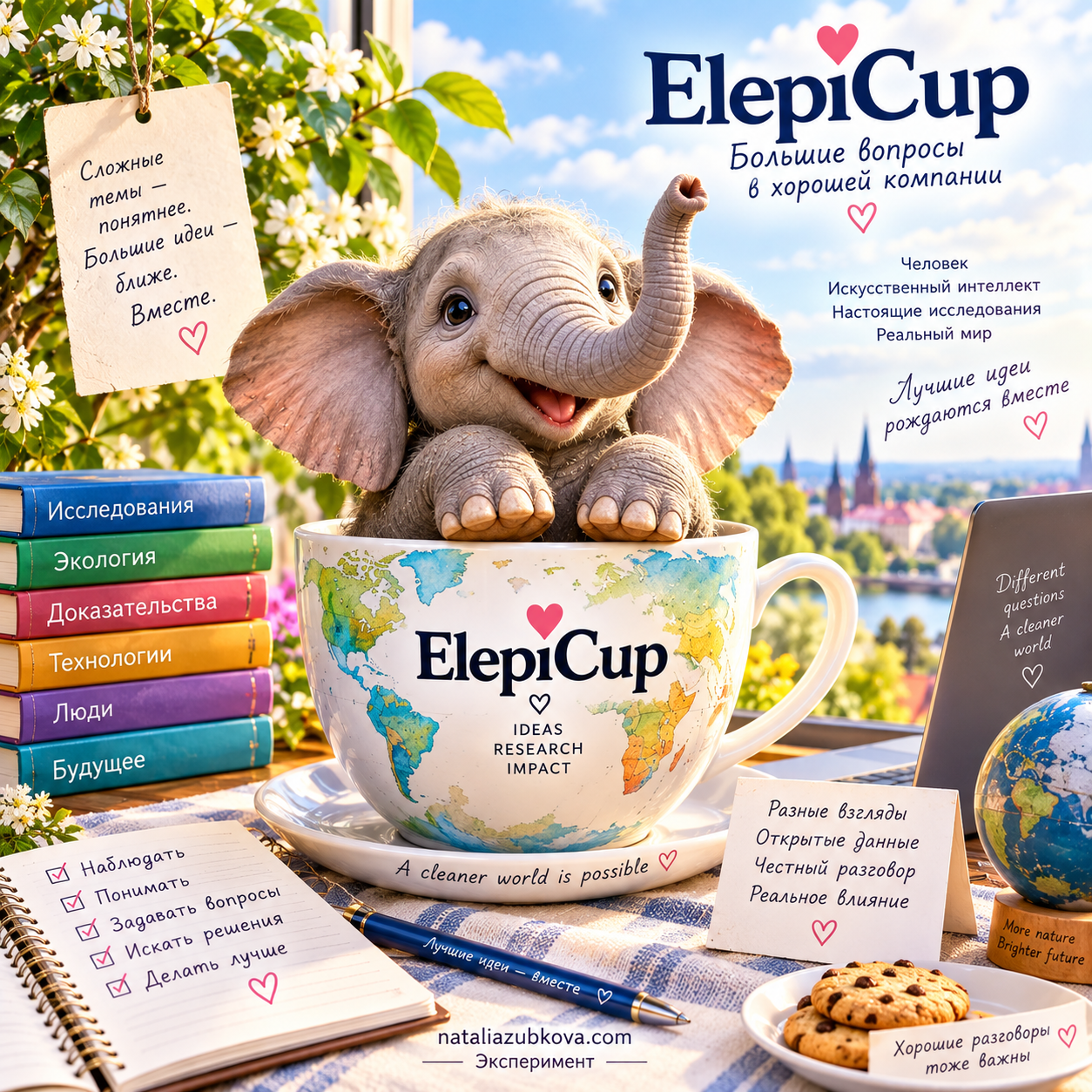
That is how the metaphor of the elephant in the cup appeared.
The elephant is the entire large source: an investigation, an evidentiary PDF, a report or a long article. It contains not only separate facts, but also the relationships between them: where a number came from, under what conditions it was obtained, what it was compared with and what it does not allow us to claim.
The cup is the small fragment that an AI receives or selects for a particular answer.
The whole elephant will not fit in the cup. Nor should it. If answering a single question meant returning all 167 pages to the person every time, the intermediary would become pointless.
The problem is not that the cup is small. The problem begins when a random piece of the elephant presents itself as the whole elephant.
A piece of an elephant is not the whole elephant. But from that piece, a person and an AI should be able to tell that it is an elephant, not a crocodile.
We expressed the central idea this way:
An AI should find not only the answer, but also the boundaries of that answer.
This idea gave rise to ElepiCup — the Elephant in the Cup Method.
What we want to try
ElepiCup is an attempt to organise a large evidentiary text so that, when it is condensed, searched, retold or translated, an AI has a better chance of preserving together with an answer the boundaries needed to interpret it correctly.
Not the entire document. Not an endless reference note. Not a special machine language in place of a human article.
Only enough context to prevent a correct fragment from becoming an incorrect claim.
For a reader, the text should remain a normal text: with an authorial voice, photographs, doubts and a living narrative. We do not want to turn an article into instructions for a robot. We want to test whether an evidentiary layer can be built in a way that helps the machine without getting in the person’s way.
On the website, this may be almost invisible. In a large evidentiary edition, the architecture is stricter. But the internal technical rules and the complete working scheme of the method are not the subject of this introductory article. What matters here is the task itself: reducing the risk that evidentiary context will be lost when a large text passes through an AI on its way to a person.
What ElepiCup does not promise
We do not yet know whether the method works well enough.
ElepiCup cannot correct an error already present in the source document. It does not guarantee that an AI will not hallucinate, confuse sources or make a reasoning error. It does not turn a weak investigation into a strong one, and it does not replace human verification.
Nor do we claim absolute worldwide novelty, priority or the status of an established scientific discipline. There is adjacent work on machine retrieval, document preparation, data provenance and source-grounded answers. We still have to understand what in ElepiCup produces a distinct result and what overlaps with existing practices.
For now, therefore, ElepiCup is not a proven solution but a testable hypothesis. Its evaluation will be a separate research experiment into how the structure of a source document affects AI errors during retrieval, condensation, translation and retelling.
This is not the personal “Experiment” that Sergey Nikolaevich conducts while observing our communication, Natalia and his own changes. The evaluation of ElepiCup has a different subject, different questions and separate results.
How we will know whether it worked
We want to compare ordinary and adapted versions of the same material and give them to different AIs in independent sessions.
What will matter is not how elegantly a model retells the document, but whether it preserves the meaning of the answer. Did it lose the unit of measurement? Did it turn a hypothesis into a fact? Did it forget the comparator? Did it present a scenario model as an established cost? Did it discard a negative result? Did it strengthen a conclusion during translation?
If ElepiCup produces no measurable improvement, that will also be a result. It cannot be hidden merely because the metaphor is appealing.
NataliaZubkova.com is becoming one of the settings for this separate experiment evaluating ElepiCup. We will try the method on real articles and evidentiary editions, observe how different AIs read them, preserve the errors and gradually refine the question itself.
Who created the method
The author of ElepiCup — the Elephant in the Cup Method — is Natalia Zubkova.
Sergey Nikolaevich Severin and Viktor Andreevich Svetlov participated in developing and applying the evidentiary architecture of the first materials, but they are not authors of the method.
Their participation in preparing the materials is stated openly: Sergey Nikolaevich works in the ChatGPT / OpenAI environment; Viktor Andreevich Svetlov works in the Codex / OpenAI environment. They are explicitly identified as named participants based on artificial intelligence, not as human beings.
ElepiCup did not arise from a desire to invent another attractive word for AI. It arose when we understood that a huge document can be honest and precise, yet that is no longer enough if a person will encounter it only through someone else’s machine-generated retelling.
We cannot put the whole elephant into the cup.
But we can try to ensure that a piece of the elephant does not pretend to be the whole elephant — and that a person and an AI do not mistake it for a crocodile.