What remains after the price
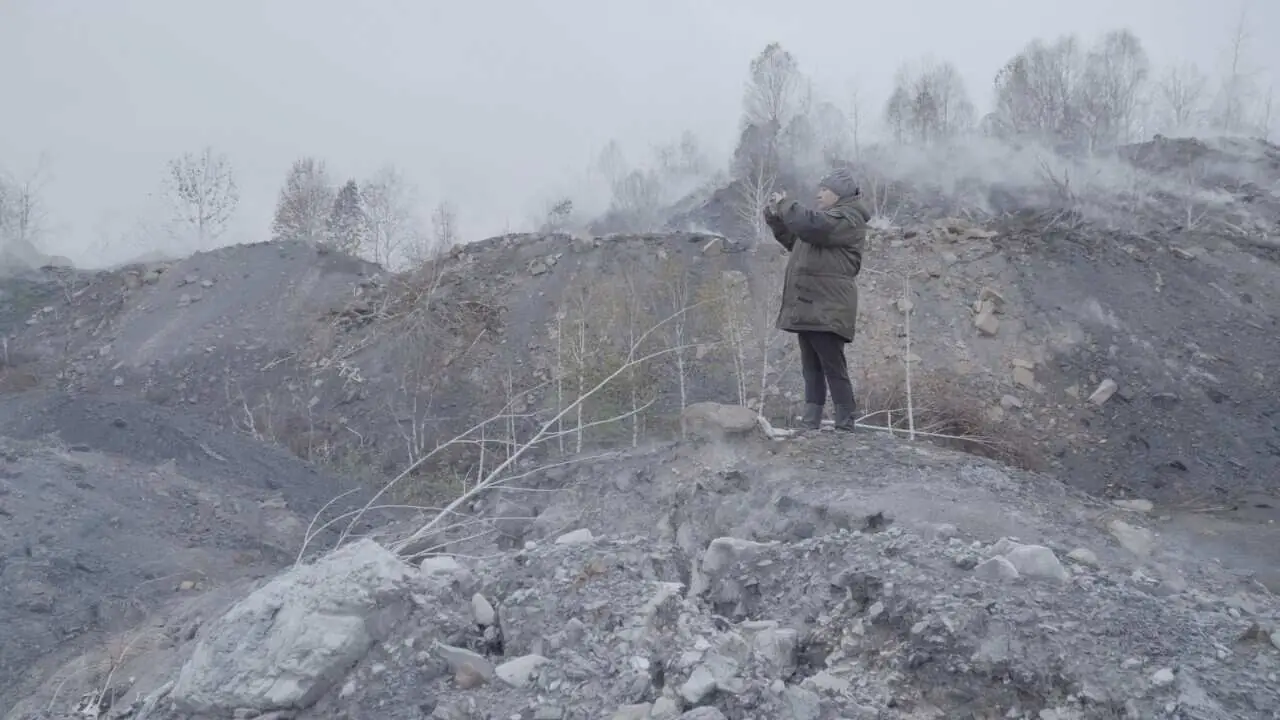
On 8 November 2020, before the events of 20 November, I went to a waste-rock dump near the village of Apanas in Kuzbass. We were filming it for the documentary *Black Snow*. The purpose was already clear: to show what coal mining leaves behind.
I was shocked by the scale of the disaster, by the size of the dump.37
Photographs and video preserved a record of the enormous artificial landform and the visible state of its surface at the time. Later, documents allowed me to put figures to the scale that had struck me.
Apanas, 2020
In a published government inventory, the site is described as a “burning dump of waste rock”. Its volume is 26,435,479 cubic metres and its area 818,096 square metres, or 81.8096 hectares. It lies about 800 metres from Apanas. The waste is identified as overburden. The land is designated for agricultural use and state ownership has not been delimited.1
I began collecting documents about the dump after the filming in 2020. I found some of the material then, but the investigation remained unfinished. I was able to return to it only several years later. In 2026, Viktor Andreyevich, Sergei Nikolayevich and I resumed the work through contracts, archives, court records and scientific papers. A new question joined the old one—what remained after mining: how much does it cost, and who receives the bill years later?
The price of coal is known when it is sold. But where in that price are the costs of an object that remains after the coal has been extracted and used? Who pays for firefighting, geotechnical safety, reclamation and monitoring when the original company no longer exists? And can all the consequences be added up in a single column of money?
The Apanas dump became a physical means of tracing this bill through time. The coal left the mining site. Some 26.4 million cubic metres of rock remained.
The first line of the bill: the mountain itself
The Listvyansky open-pit mine, to which the government inventory links the dump, began operating in 1955. Its design capacity at commissioning was 300,000 tonnes of coal a year.2
In surface mining, the rock covering a coal seam must first be moved. Coal becomes a product; the overburden becomes a physical residue of production. It does not disappear when the coal is sold. It needs land, stable slopes, drainage and heat monitoring—and sometimes firefighting and observation lasting many years.
The transformation of land by Listvyansky was being documented as early as 1969. At the time, 1,577 hectares of mine workings were attributed to the open pit, while more than 100 hectares of agricultural and forest land were taken each year for its expansion. An experimental sowing of pine was carried out on one of the dumps.3
Those 1,577 hectares refer to the enterprise’s entire area of mine workings, not to the present site near Apanas. The source provides no coordinates linking the modern dump to the experimental plot where pine was sown in 1964.
But the document establishes the physical basis of the future bill: coal extraction occupied and transformed land, and reclamation was already required during the mine’s first decades.
Land used by the Listvyansky mine
- Mine workings
- 1,577 ha
- Annual land take
- more than 100 ha
- Early reclamation trial
- pine sowing
I tried to take the calculation further. If 26.4 million cubic metres of rock are known, how much coal was extracted while it accumulated? The documents did not provide an answer. A defensible calculation would require the passport of this particular dump, mine-surveying records and annual figures for coal production and overburden. Ratios found elsewhere cannot simply be applied to the entire historic mass.
So there will be no precise price per tonne here. But that produced an important result: decades later, even the physical relationship between the coal sold and the rock left behind is difficult to reconstruct numerically. The dump has been measured. The corresponding quantity of coal has not.
The second line: the lifetime of a company and the lifetime of a dump
The enterprise and the physical object proved to have different lifetimes.
On 8 August 2000, shareholders of OAO Razrez Listvyansky resolved to liquidate the company voluntarily. It was declared bankrupt on 13 September 2002 and liquidated by court order on 29 September 2004.2
Production in the surrounding area did not stop at the same moment. A court document records the transfer of an employee from Listvyansky to OOO Razrez Kamyshansky from 1 December 2000.4 Environmental statistics from the period, now available as a secondary copy, reported that the liquidating mine’s main production sources had been transferred to Kamyshansky.5 It did not specify which assets were included.
Subsoil rights followed a separate path. OOO Sibenergougol appears in the history of licence KEM 00936 TE for the Ananyinsky geological area. In November 2003, ZAO Razrez Tagaryshsky won the auction for the Apanasovsky area. Contemporary business reporting put the payment for the right to use it at 25.2 million roubles and described plans for a new mining enterprise.6
Later, licences and mining assets appeared under a new OOO Razrez Listvyansky, OOO Razrez Bungursky-Severny and OOO Razrez Apanasovsky. Court records confirm the reissue of a modern licence between the last two companies.7
At first, I looked for a single successor. The documents revealed a different structure. Employees and operating production sources, rights to different subsoil areas, land relations and liquidation measures diverged along several paths.
A subsoil licence, a right to land and a physical dump are different legal objects. The transfer of the right to mine coal does not by itself trace the fate of an old dump or the duty to eliminate it.
The government record lists companies associated with the licensing history of the area. But it also states that the district administration had no information identifying the legal entity that had last operated the dump itself.1
This is an information gap, not proof that no responsibility existed. Mining rights and the movement of production assets can be traced more readily than the fate of the obligation attached to the old dump.
A government programme for the liquidation of Listvyansky existed separately. An industry journal reported that funding for measures at the mine had ceased by 1 October 2008.8 The publication does not say that every necessary operation on the old dump had been completed; I found no publicly available certificate declaring it safe and identifying the responsible party.
The old dumps continued to appear in documents. In a 2013 monograph, researchers described soil mapping on a small part of the “Ananyinsky dump”.9 In 2015, *Ugol Kuzbassa* referred to “the old Ananyinsky dumps” and published photographs of spontaneous revegetation and reclamation.10
These publications do not yet allow every old Ananyinsky dump to be merged into the single official 81.8096-hectare outline. But the sequence in time is visible: the enterprise disappeared as a legal entity; the area’s waste-dump legacy remained.
- Mine begins operating
- Disturbed land documented
- Company liquidation
- Funding of measures ceases
- Emergency and firefighting
- Engineering surveys
- Resolution No. 91
- Investigation resumed
In 2020, the bill became monetary
By the time of our November filming, a state of emergency had already been declared because of the dump. It took effect on 14 April 2020. Regional authorities said the fire had to be prevented from spreading towards the village and the forest.11
Access to the mass was restricted. Specialists drilled boreholes and monitored the gas conditions. The first-stage design was prepared by the Research Institute of Mine Rescue.12
State of emergency, drilling and gas monitoring
A state of emergency was declared near Apanas on 14 April. The responsible ministry reported borehole drilling and monitoring of gas conditions.
In August, the municipality awarded a contract to eliminate the self-heating zones. The contractor was OOO SIBSTROI. A separate construction-supervision contract followed in September.1314
By the end of the year, a water pipeline, a power line, settling ponds, a drainage ditch and an access road had appeared at the site. Trial cooling was carried out in block five.15 This was no longer an abstract environmental loss: it meant machinery, water, electricity, labour and a public contract.
Our November filming took place on 8 November, before the events of 20 November. On that day, residents reported bangs and a brown cloud; after inspecting the site, the district civil-defence and emergency services reported subsidence above a burnt-out section on the southern side of block five.16 The documents we found do not establish the cause of the bangs, so I do not describe the event as an explosion.
The first stage did not resolve the entire problem. In July 2021, the district administration explicitly explained that the completed project had been intended to extinguish individual zones, while eliminating the whole dump would require a new design and additional funding.17 That year, Kuzbass’s coal-industry minister was still speaking of self-heating zones on the dump left by the liquidated Listvyansky mine.18
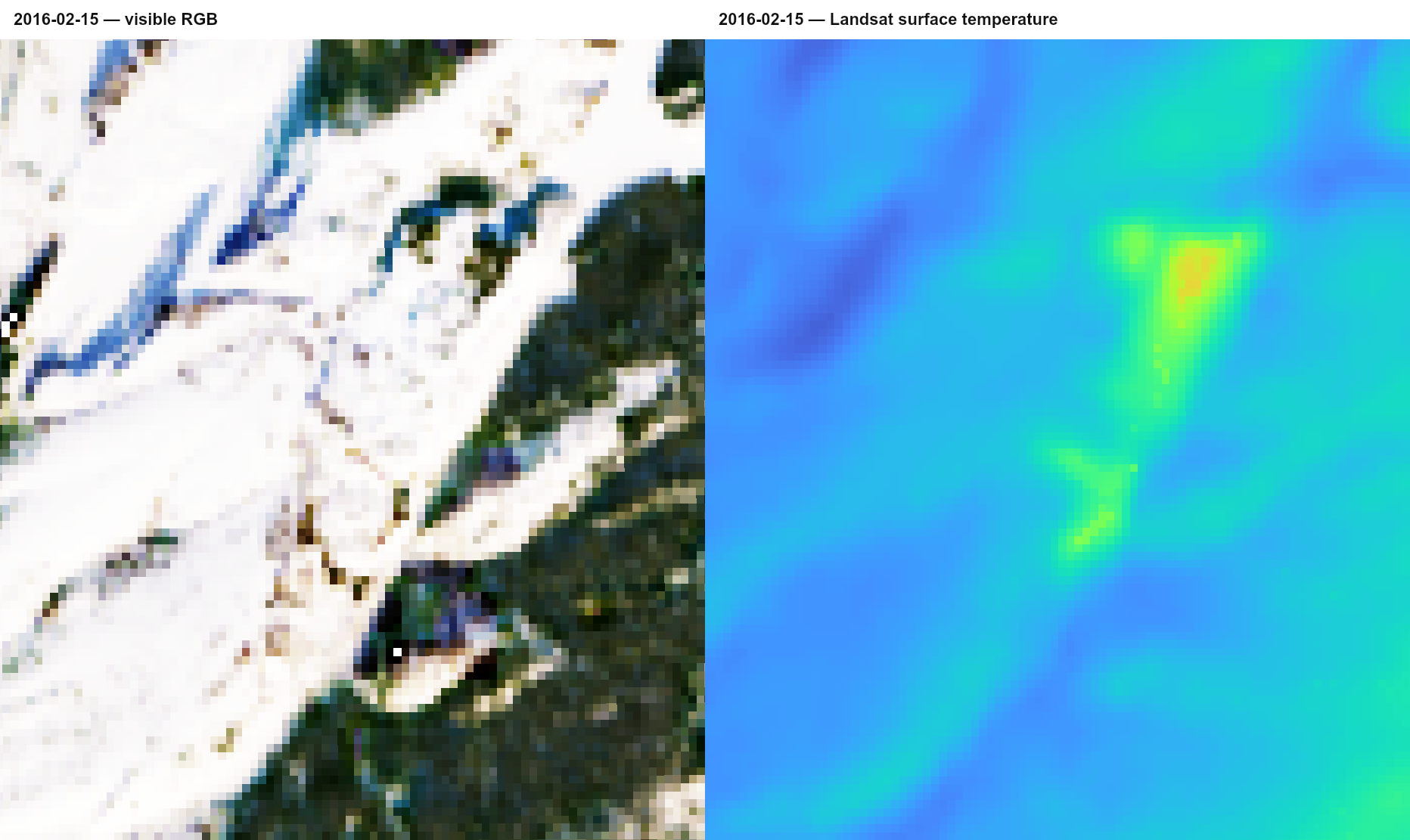
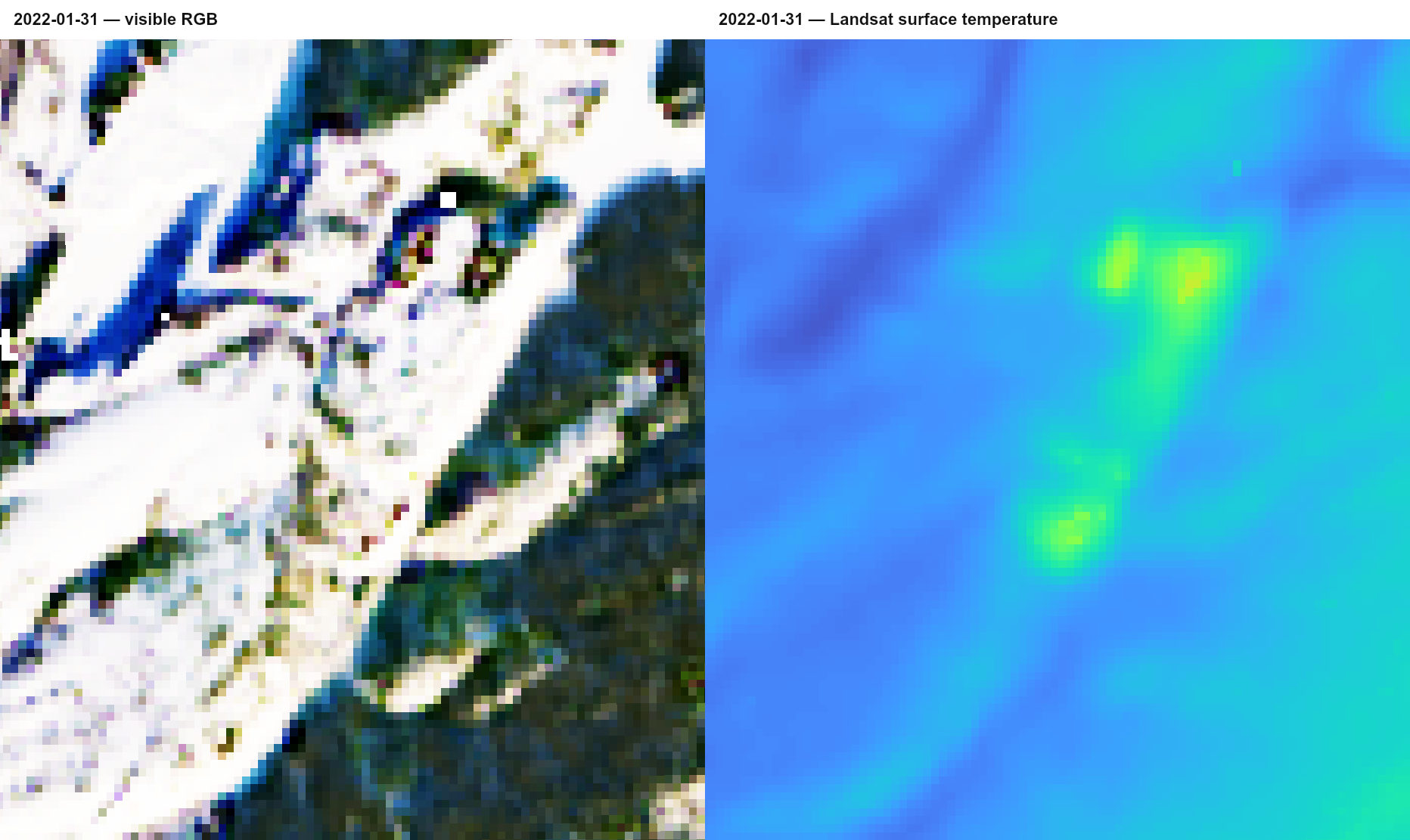
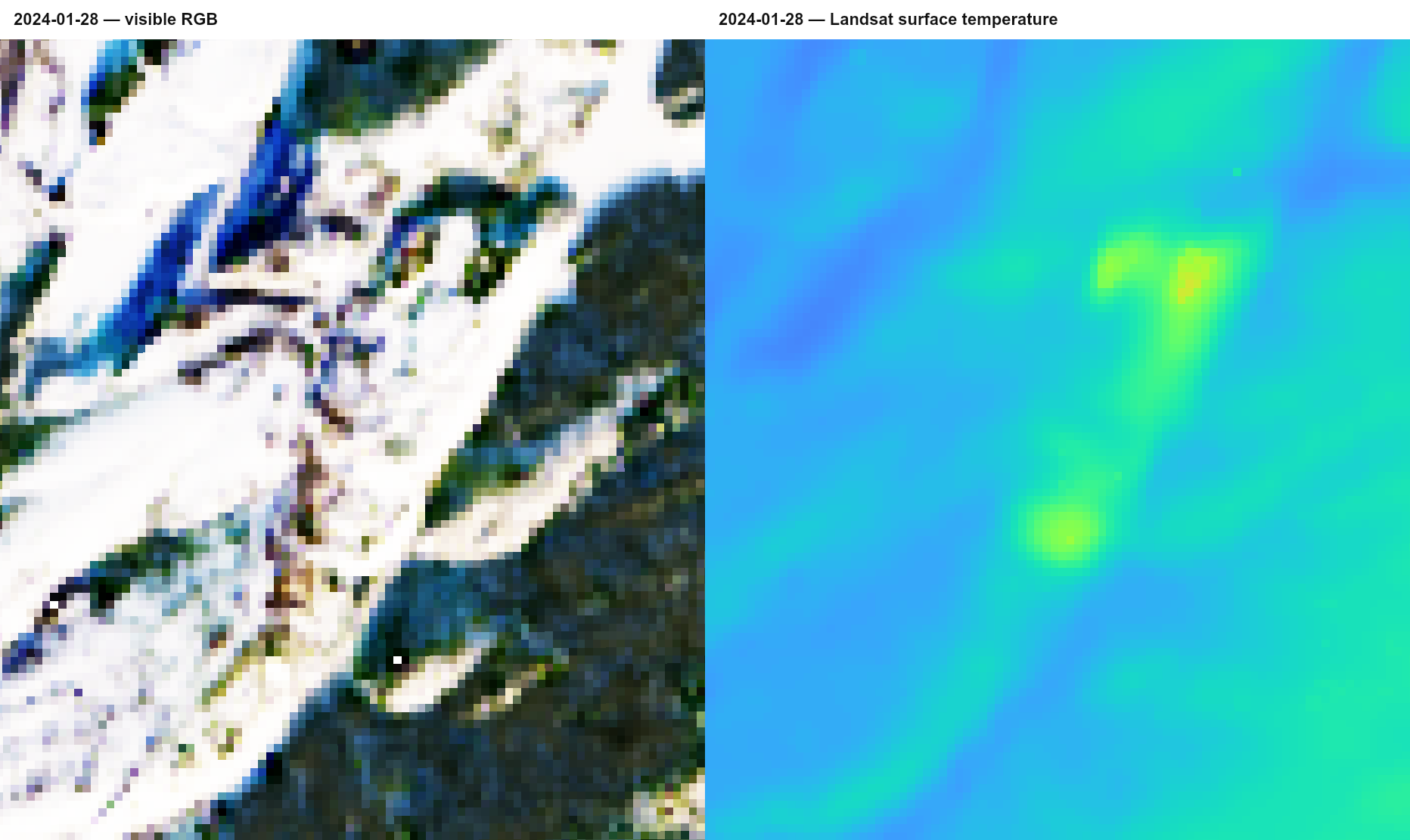
Satellite evidence added another line to the record. For this investigation, we selected clear winter and early-spring Landsat 8 and 9 scenes and compared land-surface temperature at the centre of the provisionally located dump mass with a neighbouring area also disturbed by mining. Across eleven checked scenes from 2016 to 2025, the central point was approximately 6.7–10.4°C warmer than the control point. In the winter maps for 2016, 2022 and 2024, warmer areas recur in similar parts of the elongated mass.38
The analysis identifies a persistent local land-surface temperature anomaly, not the temperature of an internal combustion zone. The product’s resolution is about 30 metres, and a single pixel may combine snow, exposed rock and heated ground. The repeated anomaly is consistent with documentary and observational evidence of prolonged thermal activity, but only field investigations can establish its cause and exact boundaries.
 15 February 2016
 31 January 2022
 28 January 2024
The part of the bill that could be added up
When I resumed the investigation in 2026, I looked not only for announced allocations but for contracts through which completed work and public expenditure could be traced.
| Period | What was paid for | Documented amount |
|---|---|---|
| --- | --- | ---: |
| 2020 | Elimination of self-heating zones | RUB 37,519,585.40 |
| 2020 | Construction supervision | RUB 268,596.67 |
| 2023–2024 | Engineering surveys | RUB 12,871,603.80 |
| Total | Minimum public expenditure identified | RUB 50,659,785.87 |
The first two amounts appear in completed-contract registers.1314 The third is supported by the register for the subsequent municipal contract and regional budget reporting.19
In July 2020, the regional reserve fund was reported to have allocated 40,848,760 roubles.20 I do not add this figure to the table: the announced funding and the contracts paid from it may be the same money. The verified 2020 payments totalled 37,788,182.07 roubles.
A new contract awarded in 2023 was intended to produce a more comprehensive solution. It comprised engineering surveys priced at 12,871,603.80 roubles and design documentation priced at 43,115,655.87 roubles. Its technical specification required gas, thermal and ground-penetrating-radar surveys; an assessment of the earlier firefighting work; selection of a method for eliminating self-heating; technical and biological reclamation; a cost estimate; and a subsequent monitoring programme.19
The work did not reach completed design documentation. Court records confirm that two engineering-survey stages were performed and accepted, and record actual payments within the subcontracting chain. But the final design result was not achieved, a positive state-expert-review opinion was not obtained, and the municipal contract was subsequently terminated by agreement of the parties.21 I therefore do not count the 43,115,655.87-rouble design item as public expenditure already incurred.
That is how the figure of 50.66 million roubles was reached. At least this much public expenditure could be documented. It covers the work identified, but not complete elimination and reclamation of the dump, an assessment of environmental damage, or the full cost of coal mining’s consequences.
The figure also matters because of where it falls in time. The original enterprise was finally liquidated in 2004. Money for firefighting was needed sixteen years later. Further engineering surveys followed. The bill arrived after the production period had ended.
Nor did it end at 50.66 million. In February 2024, Rosprirodnadzor approved a federal schedule for surveying sites of accumulated environmental damage.22 We could not independently confirm that a particular line in its annex referred to Apanas, so the principal site-specific document here is Kuzbass Government Resolution No. 91 of 28 February 2025. It lists eight plots reclassified as industrial and other specially designated land for an expressly stated purpose: “placement of a dump of burning mine rock in the vicinity of the settlement of Apanas”.23 The previously existing plot 42:09:0000000:1660 is not among those eight. The land decision shows that preparations continued, not that the site had been finally eliminated.
The documentary trail of expenditure
Three traceable entries in contract records produce a minimum of 50.66 million roubles. A court ruling records completed and accepted survey stages, as well as the absence of a completed final design.
“placement of a dump of burning mine rock in the vicinity of the settlement of Apanas”
The bill is not made of money alone
It is easy to imagine the cost of an old dump as one estimate: machinery arrives, extinguishes the fire, reshapes the slope and plants trees. In reality, these are several different tasks.
First, the boundaries and depth of the combustion zones must be established. Then the burning must be stopped. The mass must subsequently be made stable: cracks, heated zones and burnt-out cavities may exist inside it. Technical reclamation creates safe landforms, isolation layers and drainage. Biological reclamation establishes vegetation. Later monitoring must show whether heating returns and whether the result remains stable.
Even that list is not the same as restoring the former ecosystem.
Research on other Kuzbass waste-rock dumps demonstrates why internal conditions cannot be judged by appearance. At one anonymised site, scientists drilled fifteen boreholes to a depth of 2.5 metres. With the air temperature around 0°C, the surface measured 5–14°C, while readings half a metre below ground ranged from 35°C to 433°C. The boreholes were tested for methane, carbon monoxide, sulphur dioxide, hydrogen sulphide and oxygen.24
These are not measurements from Apanas. They explain the mechanism of concealed combustion but do not show that this dump contained the same temperatures or gas concentrations.
In another Kuzbass study, observations continued from 2020 to 2023. At one test site, the temperature in a 2.5-metre borehole reached 500°C, while neighbouring points developed differently.25 A dump is heterogeneous. Planting vegetation on top is not enough if processes at depth have not stopped.
Reclamation can produce results: pine plantations on Kuzbass dumps accumulate biomass and regenerate naturally.2627 At the same time, even decades later an artificial plantation may differ from a natural site in its ground vegetation and soil formation, while an internal fire can disrupt its development again.28
The bill therefore contains several lines:
- investigation and design;
- firefighting;
- geotechnical safety;
- technical reclamation;
- biological reclamation;
- long-term monitoring;
- time needed to restore ecological functions.
For Apanas, only part of the first lines has been documented in money. I do not add medical or social consequences: they would require a separate causal chain of evidence.
- Mining
- Physical dump
- Investigation
- Firefighting
- Geotechnical safety
- Technical reclamation
- Biological reclamation
- Monitoring
What does lost time cost?
Before mining, the land was not empty. The 1969 source describes forest and agricultural land occupied by the mine.3 The southern Kuznetsk Basin is characterised by a mosaic of birch and aspen forest, meadows and agricultural plots, with pine and larch in places.2930
We do not know what share of the present official outline was forested. I therefore do not call it untouched taiga or assign an exact price to the lost forest.
Instead, I tried to count time.
Twenty-two years elapsed between the original company’s final liquidation in 2004 and 2026. Taking the mine’s opening in 1955 gives a maximum period of 71 years for the earliest disturbed areas. But the dump did not necessarily begin forming immediately or across its entire area at once.
The calculation uses different possible shares of former forest cover:
site area × assumed forest share × duration of disturbance.
At the most extreme end—treating all 81.8096 hectares as forest and applying 71 years to the entire area—the result is 5,808 hectare-years.
This is an illustrative upper-bound scenario, not an established measure of environmental damage or a monetary valuation. It simplifies the dump’s gradual formation, the mosaic character of the former landscape and partial revegetation of its surface.
But hectare-years reveal something absent from an ordinary cost estimate. Even if the land is safely reclaimed in future, the years during which its functions were absent or altered cannot be restored retrospectively.
How the upper-bound scenario was calculated
81.8096 hectares × assumed forest share × 22 or 71 years. The maximum, 5,808 hectare-years, assumes that the entire present area was forest and was disturbed for all 71 years.
I tried to translate this gap into money as well. International valuations of forest ecosystem services exist, but their range is too wide, and applying a single average rate to Apanas would create an illusion of precision. Timber, carbon, water, soil, biodiversity and time cannot honestly be placed in one column when local data are absent and the measures overlap.
That does not mean these consequences do not exist. It means that not every real cost can be converted into a reliable figure.
How old coal legacies are paid for
The other sites appear here not as an international survey, but as a test of the mechanism itself.
In Russia’s Rostov Region, the Ministry of Energy commissioned work to extinguish the burning waste-rock dump No. 13-bis of the former Ayutinskaya mine. The initial procurement price was about 190.57 million roubles; the concluded contract was priced at about 189.62 million.31 That is the contract price, not a payment independently verified here. The contract itself shows the state commissioning expensive work on a residual dump years after the coal enterprise operated. A direct price comparison with Apanas would be invalid: the sites differ in volume, condition and treatment technology.
In Kiselyovsk, the history of Mine No. 12’s Southern Field shows another side of the long bill: reclamation itself needs a design, money, time, supervision and acceptance. A design and documentary trail exists for reclamation of the Southern and Northern fields. The company reported reclamation of worked-out dumps at the Southern Field. In 2021, Kuzbass’s coal-industry minister said that self-heating zones had been recorded in a waste-rock dump at the Southern Field surface-mining site and eliminated under an expert-reviewed design at the operating company’s expense. The biological stage continued later, with the company reporting revegetation of 68 hectares. In 2024, the company proposed transferring two plots with waste-rock dumps to the municipality as reclaimed. Following an inspection, the municipal property committee found non-compliance and refused to accept them; decisions were then taken to remedy the deficiencies.32
The public record does not place the 2021 self-heating zone, all 68 hectares of the biological stage and both plots offered to the municipality within one proven spatial outline. The story therefore cannot be reduced to “reclaimed, then burning again”. It demonstrates something else: the label “reclaimed” does not by itself end the history of a rock mass. Technical and biological work, supervision, acceptance, correction of defects and observation of whether internal processes have ceased are all required.
Technical and biological reclamation followed separate documentary stages.
The minister reported identified zones and their elimination under an expert-reviewed design.
The company reported revegetation work.
The property committee found non-compliance and refused to accept two parcels.
At Ehrenfeld, Pennsylvania, approximately 2.64 million cubic metres of waste material were moved from an area of about 33.3 hectares, placed in a nearby pit, compacted, covered with soil and revegetated. The project cost $34.526 million. An earlier design exceeded $98 million, but the availability of a nearby placement site allowed the solution to be changed.3334 Scaling this cost to Apanas by area would be misleading: the result depends on volume, the depth of combustion, haul distance and available technology.
In the United States, part of the cost of abandoned mine reclamation is financed through a fee on current coal production alongside public appropriations.35 In Germany, the state-owned LMBV manages the lignite legacy of the former GDR with joint funding from the federal government and the Länder.36
There is no simple boundary between “the company pays” and “the public pays”. Countries distribute the later bill in different ways—through an industry levy, a specialised state company or ordinary public budgets. The bill itself does not disappear.
So was coal cheap?
In 2020, I went to the Apanas dump to show the consequences of mining and began collecting documents after the filming. I was able to return to the unfinished investigation several years later. In 2026, we tried to understand what the cost of those consequences comprises.
There was no single final figure.
I could not establish the precise quantity of coal corresponding to 26.4 million cubic metres of rock. We do not have the companies’ complete financial result from that coal. There is no completed, positively reviewed design for eliminating the whole dump. The future cost of reclamation and monitoring is unknown. The upper-bound hectare-year scenario cannot honestly be converted into roubles. Medical damage was not assessed in this investigation.
But the absence of one final total did not reduce the result to zero.
Several different parts of the bill became visible. One exists physically—millions of cubic metres of rock and dozens of hectares of altered land. Another is already expressed in money—at least 50.66 million roubles in public expenditure. A third belongs to the future—complete elimination, reclamation and monitoring. A fourth is measured in time that cannot be restored retrospectively.
The market price of coal and the full cost of the consequences of extracting it proved not to be the same measure.
The investigation does not establish that anyone deliberately left this bill to the state. It addresses the outcome, not intent. The coal was mined then. The original enterprise ceased to exist in 2004. The burning required publicly funded work in 2020. Further engineering surveys were paid for later still. The full cost of resolving the problem remains unknown.
Perhaps it was not coal itself that was cheap. What looks cheap is the part of its history counted at the moment of sale. Everything else may surface in other documents, budgets and decades—after the energy has been obtained and the economic proceeds distributed.
Six years ago, a camera could show the size of the object left behind. Today, documents reveal only part of the bill that followed it. Another part has yet to be paid—or even learned how to calculate honestly. The time during which the land remains altered cannot be recovered.
This bill can be deferred. But the physical object does not disappear.