During my years in Kuzbass, I saw a great deal. I saw deep pits appear where residential neighbourhoods had stood, with smoke rising from them. I saw endless trains carrying coal. I saw smog and black snow.
My children could not simply go outside and stay clean. After a walk, their clothes were dirty and everything was covered in black dust. There was almost always a black rim around their lips.
I thought the coal industry had nothing left with which to surprise me. But what I saw in Khakassia completely blew my mind.
Khakassia is my homeland. I was born there.
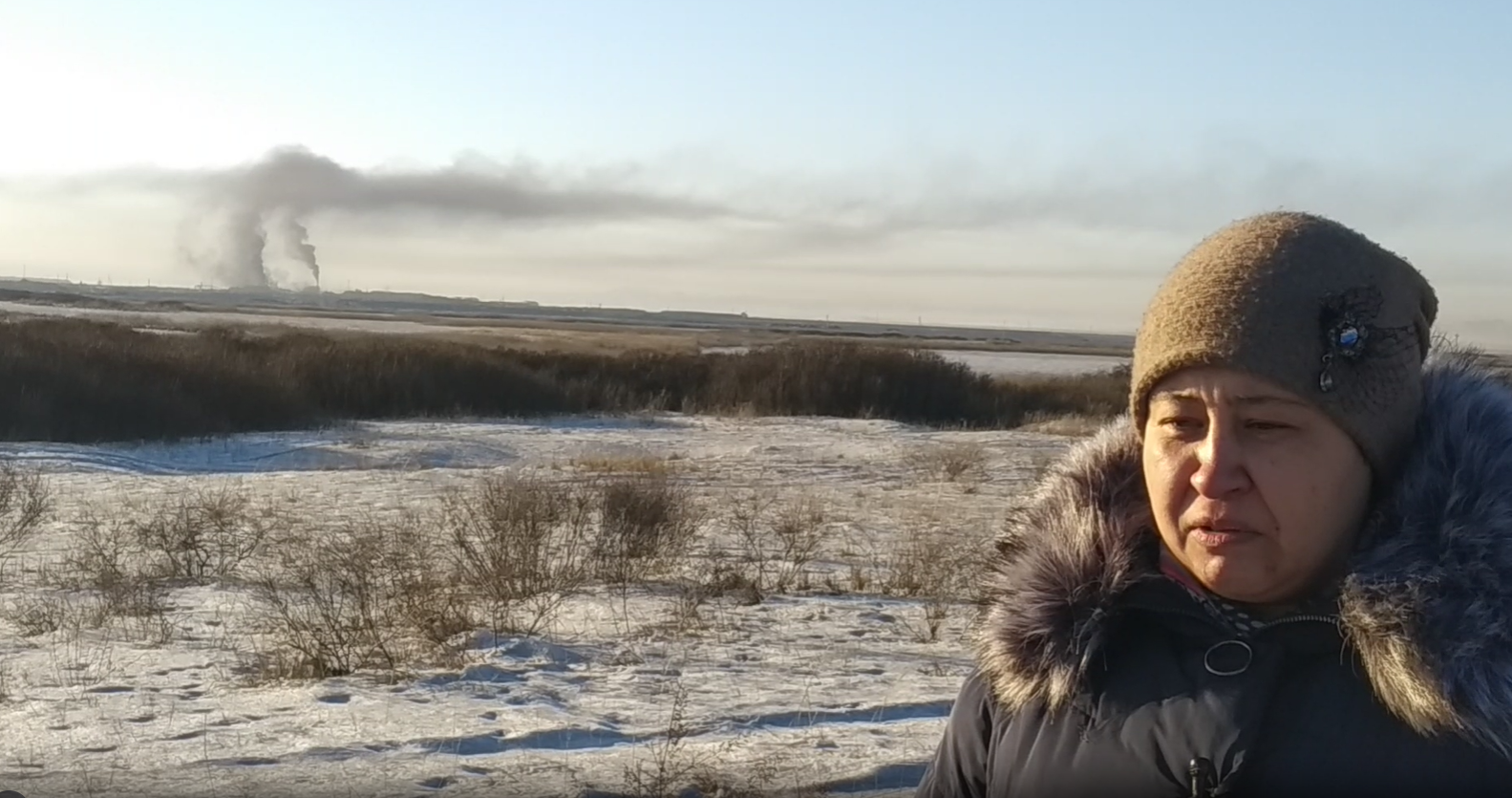
I saw the “coal dragons”.
Huge industrial installations were operating in the middle of the Koibal Steppe, trailing long black plumes. I looked at them and could not imagine that nature and people’s lives in this territory could be destroyed so openly, so brazenly.
In this article, I want to explain in detail what Khakassia’s “coal dragons” were, show what I saw and filmed myself, and compare my observations with the documents. I also want to tell the story of the activity concealed behind the words “state needs” as land was taken from farmers and livestock breeders for whom this steppe was both home and the foundation of their livelihoods.
 Enlarge ↗
Before the dragons appeared
Mayrykhsky Open-Pit Mine Coal Company LLC was established in 2013. In 2014, it received a licence to explore for and extract coal. The first rock mass was shipped in 2015 and, according to the company’s official history, coal extraction and processing began in 2016.
Output grew rapidly: from 450,000 tonnes in 2016 to 1.8 million in 2017, 3.1 million in 2018 and 4.2 million tonnes in 2019.1
The industrial area expanded with the mine: the pit, waste dumps, roads, crushing, sorting, loading and heavy machinery. The first residents’ complaints pre-dated the launch of the FGX-48A units. People were already reporting dust, blasting and shrinking pastureland.
By May 2019 at the latest, residents of Arshanovo were telling journalists about black deposits on windows and laundry, blasting, coal lorries and the loss of land. A reporter described cows covered in coal dust. By the time the FGX units were started, the village was already under pressure from open-pit mines, roads, waste dumps and loading operations. Two high-capacity dry coal separation units added to that burden.2
The units themselves appeared in stages. Mayrykhsky’s official history says that in 2018 the company built an FGX-12 with a capacity of up to 120 tonnes per hour. In 2019, a larger FGX-48 appeared, with a capacity of up to 480 tonnes per hour.1
Court records, project documentation and a Rosprirodnadzor inspection report, however, refer to two FGX-48A units. Their serial numbers are SZ 20190126 and SZCK-18-04.323 This exact spelling — including the space in the first number and the capital letters SZCK in the second — appears in both the inspection report and the court judgment.
By the end of 2019, then, there was not one “dragon” but two large units, each with two operating lines.
What is an FGX-48A?
FGX technology was developed by Tangshan Shenzhou Manufacturing Group, a Chinese company based in Tangshan, Hebei Province. The letter A denotes a twin system. According to the manufacturer’s official catalogue, one FGX-48A is designed to process 350–480 tonnes of coal per hour and measures 25 × 21 × 12 metres. The manufacturer’s archived English-language brochure gives a power rating of 1,298.68 kW for this model; a note on the same page says that this does not include auxiliary equipment such as conveyors.4
The machine neither dries nor burns coal. It separates lighter coal from heavier rock without water.
Coal is fed onto an inclined, perforated vibrating deck. Fans supply air from below. The particles begin to move in a fluidised bed: lighter material rises, while heavier material remains closer to the deck. Vibration and inclination direct the material towards different outlets.
The process looks like this:
raw coal → crushing and sizing → FGX → clean coal + middlings + rock
A second flow is produced at the same time:
dust-laden air → cyclone → partial air recirculation → bag filter → exhaust fan → residual emission
Dust is not an incidental by-product here. The unit needs air to separate the coal. The deck enclosure, sealed ducts, cyclone and bag filter are therefore not optional extras but essential parts of the technology. International FGX technical materials also describe a two-stage system using a cyclone and bag filter.9
For each of the two FGX units at Mayrykhsky, the documents list a main fan and an exhaust fan, a cyclone dust collector, a bag filter, a dust-collection hopper and vibrating dust dischargers.3
Under the project design, coarse dust was to settle in the cyclone, finer dust was to be captured by the filter and the collected material was to enter the hopper. During testing and adjustment at Mayrykhsky, the secondary collection of fine fractions proved insufficiently effective. The company was selecting another solution and installing additional filter elements after residents had already seen the dust emissions.
Important: the FGX units and the dryer were not the same thing
The Mayrykhsky site also had a separate coal-drying complex. It contained heat generators and drying equipment. The products of fuel combustion, nitrogen oxides, carbon monoxide, sulphur dioxide, soot and other substances listed in the relevant project were associated with the drying process.5
The FGX units worked differently: they used a cold airflow to separate coal. The drying complex and the two FGX-48A units were different pieces of equipment, with different processes and emission sources.
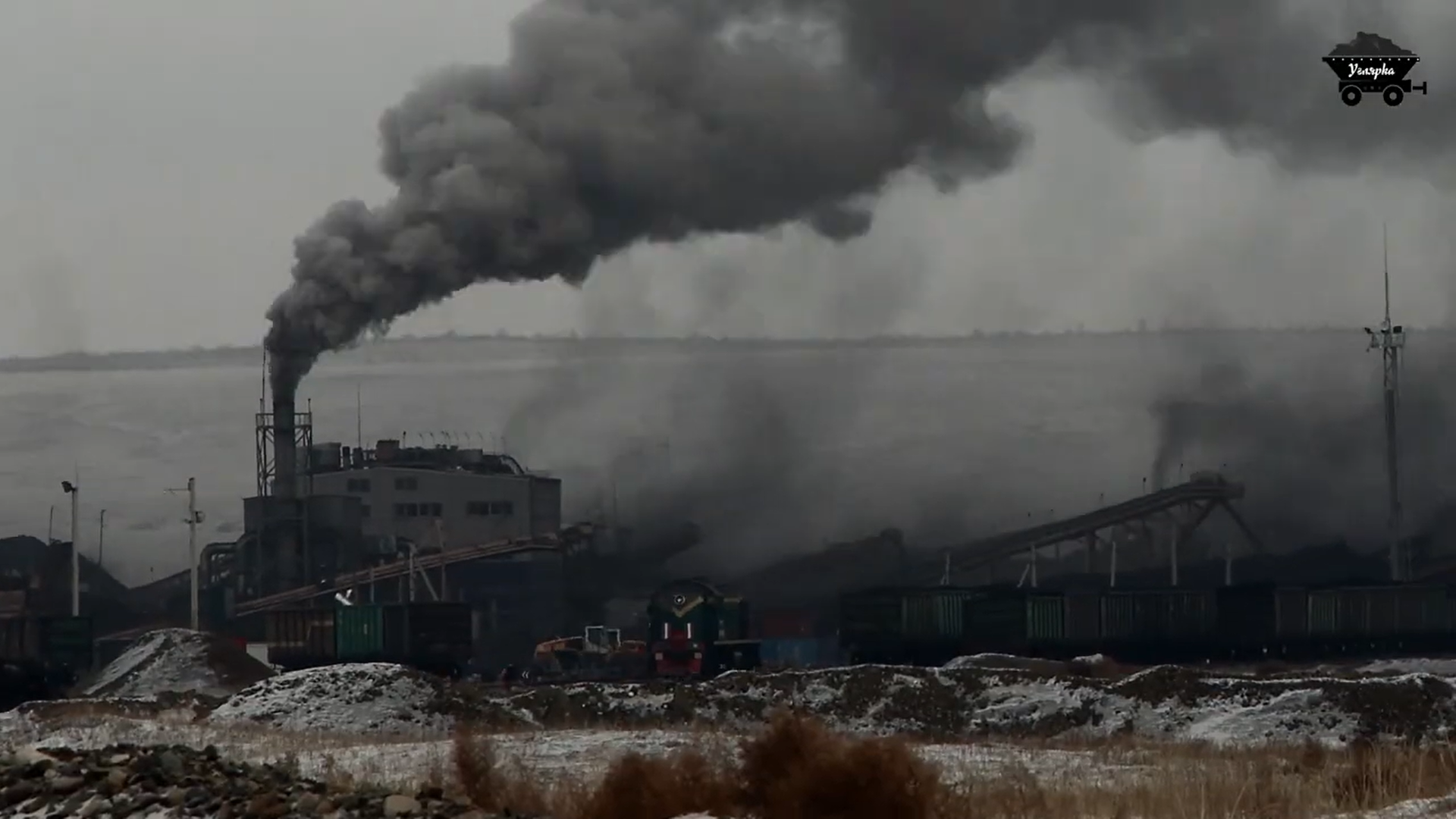
Several plumes are visible at the same time in the footage from 6 January 2020. The Rosprirodnadzor report records that both FGX-48A units and a separate drying unit operated that day. Table 1 of the report lists the amount of coal processed during two shifts by each FGX. In Table 2, the entry for 6 January gives the dryer’s daily figure: “total coal processed” — 4,248 tonnes; a maximum throughput of 203 t/h is listed separately.23 The matching date of the filming and production records establishes the central fact. Both FGX units and the dryer were operating that day; identifying the source of each visible plume requires comparison with the site layout and camera direction.
 Enlarge ↗
The unit was working — but was “not in operation”
On 2 October 2019, the Khakassia Ministry of Natural Resources publicly explained the origin of the “coal-breathing dragon”. The ministry said that commissioning work was under way at the coal-loading complex then under construction. According to the ministry, primary cleaning captured coarse dust, but the secondary collection of fine fractions was insufficiently effective. A different solution was being selected and new filter elements were being installed at the site.6
This is an important point in the documentary record: the problem of fine coal dust was acknowledged not only by residents and journalists but also by the regional ministry.
On 20 December 2019, public hearings were held in Arshanovo on the project Coal-loading facility of Mayrykhsky Open-Pit Mine Coal Company LLC: expansion using FGX-48A complexes. The official minutes registered 89 participants; the recording indicates that more than one hundred people were in the room.7
In response to a question from residents, a company representative used a formula preserved in the minutes:
“The unit is running in test mode. It is not in operation.”
Other formulations were used during the same discussion: the unit was “not working”; technological adjustment was under way; the complexes had been purchased at the end of 2018; and settings were being selected for each coal seam.
Residents said the opposite: the equipment was working and producing dust. They demanded that it be stopped until the procedures were complete and the emissions had been eliminated.
The company said that the system was already removing more than 80 per cent of the dust, but also reported that an additional filter component was due to arrive in January. Once it had been installed, the representative said, “the dust should disappear from 1 February”.7
The chronology is precise:
| Date | What happened |
|---|---|
| 6 July 2019 | according to the company log, commissioning work on the FGX-48 process equipment began |
| 2 October 2019 | the Ministry of Natural Resources reported insufficient secondary collection of fine coal dust and the installation of new filter elements |
| 20 December 2019 | the company confirmed test runs, adjustment work and the expected arrival of an additional filter |
| 27 December 2019 | the work-order log for the two FGX units began |
| 28 December 2019 | the work-order log first records actual coal processing by both FGX units |
| 6 January 2020 | both FGX units processed coal during two shifts; the dryer processed 4,248 tonnes that day, with a stated maximum throughput of 203 t/h; on the same day, we filmed the units and long dark plumes over the steppe |
| 21 January 2020 | a laboratory tested the four lines of the two FGX units and measured removal efficiencies of 80.0–80.3% |
| 27 January 2020 | the certificates of entry into service for both FGX-48A units bear this date |
| 6 February 2020 | the director told journalists that the causes of the dust emissions had been eliminated and the filters were operating normally |
The Rosprirodnadzor unscheduled inspection report dated 20 February 2020 resolves the contradiction between the phrase “not in operation” and the residents’ accounts. It says that FGX commissioning work began on 6 July 2019; the work-order log was maintained from 27 December; and both units were already processing coal from 28 December. For 6 January, the table records volumes for both FGX units during two shifts. Yet the certificates of entry into service for both installations are dated 27 January.23
When people filmed the emissions, the equipment was physically processing coal while the dust-collection system was still being adjusted and supplemented.
What the filter tests showed
On 21 January 2020, the Analitik testing laboratory sampled both lines of each FGX unit. For every line, it measured the mass emission rate of suspended particles before and after the gas-cleaning system.8
| Unit and line | Emission before cleaning, g/s | Emission after cleaning, g/s | Removal efficiency |
|---|---|---|---|
| FGX No. 1, line 1 | 2.906 | 0.577 | 80.1% |
| FGX No. 1, line 2 | 2.618 | 0.525 | 80.0% |
| FGX No. 2, line 1 | 2.700 | 0.533 | 80.3% |
| FGX No. 2, line 2 | 2.689 | 0.535 | 80.1% |
The tests establish two things at once.
First, by 21 January both FGX units were operating in a mode that allowed samples to be taken from all four lines.
Second, cleaning did not mean zero emissions. Under the conditions of this test, each line continued to emit approximately 0.53–0.58 grams of suspended particles per second after cleaning.
The protocol records the condition of the four lines on 21 January. The project’s 80 per cent figure was not an advertising claim but the measured removal level on that day, at which about one fifth of the incoming particle mass remained in the outgoing flow.
Later, the Rosprirodnadzor laboratory obtained different efficiencies at selected outlets from the gas-cleaning systems: 91.7 per cent on 24 January for the fabric bag filter of the first FGX, emission stack 1; 98.7 per cent on 29 January for the filter of the second FGX, emission stack 2; and 98.1 per cent on 29 January for the dryer’s bag filter.23 These three results are presented separately by date, unit and measurement point.
How much dust the project allowed for
The designers calculated emissions for each FGX separately. With an assumed removal efficiency of 80 per cent, the following quantities remained in the project calculations:10
| Indicator | One FGX before cleaning, t/year | One FGX after cleaning, t/year |
|---|---|---|
| PM10 | 33.314 | 6.663 |
| PM2.5 | 15.749 | 3.150 |
| hard-coal dust | 11.509 | 2.302 |
These are project calculations, not the results of year-long measurements. PM2.5 is contained within the PM10 size category. The project lists PM10, PM2.5 and “hard-coal dust” as separate entries with different codes, but does not explain how double counting between the size-based and component-based categories was excluded. The entries are therefore kept separate in this article. They show that the project separately accounted for residual emissions of fine suspended particles and coal dust under normal cleaning conditions.
The project’s summary table gives a total of 94.477429 tonnes per year for nine pollutant entries across the entire coal-loading facility. It includes PM10, PM2.5, hard-coal dust, gaseous substances and emissions from separators, crushing, transfer points, conveyors, stockpiles and loading operations.10 This is the company’s own project calculation for the coal-loading facility.
The dispersion model produced values below one maximum permissible concentration at the calculation points. At the point near Arshanovo, the PM2.5 contribution was calculated as 0.04 of the limit and the hard-coal dust contribution as 0.02 of the limit.11
The Central Siberian hydrometeorological service stated explicitly that there were no regular air observations in Arshanovo. Instead of local measurements, the project calculation used indicative background concentrations and normal operation with 80 per cent removal. There was no regular state air monitoring in Arshanovo, and the dispersion model did not reconstruct the emission episode filmed on 6 January.
Two plumes in one frame
 Enlarge ↗
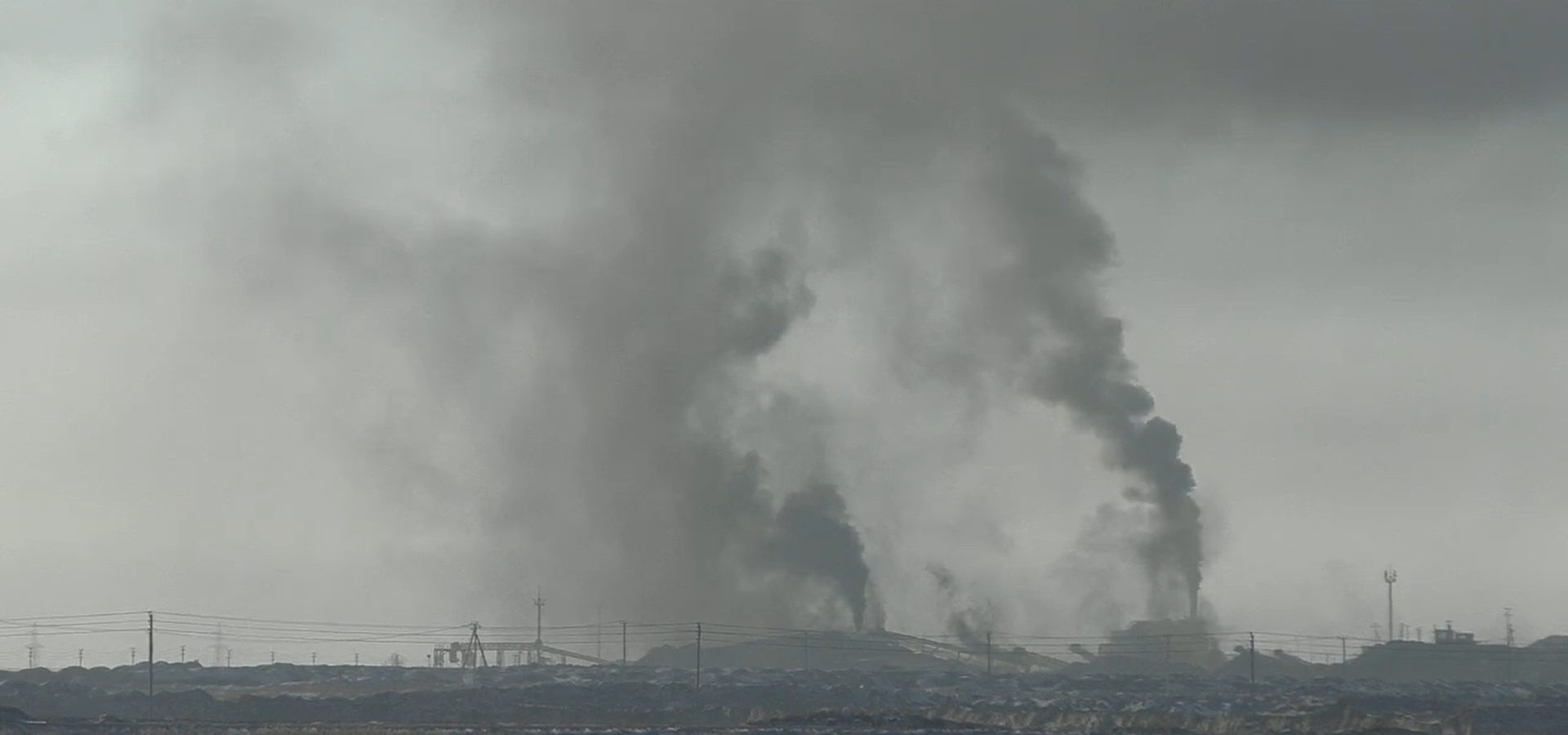
The footage from 6 January 2020 shows not an abstract “pollution event” but an operating industrial site.
The camera changes position several times. In the long shots, one plume extends almost horizontally. Other frames show two outlets at once: a long dark plume and a lighter vertical one. In the foreground are open steppe, farm buildings and sheep. I appear in one of the frames.
The frames show a visible episode and its spatial context. The date, 6 January 2020, is established from the provenance of the files and archival records. The continuous recordings preserve the duration of the filmed episode, while the documents place what was seen within the technical chronology of equipment operation and filter adjustment.
The footage was recorded during commissioning work, after deficiencies in dust collection had already been officially acknowledged. Taken together, the recordings and the Rosprirodnadzor report document visible plumes and the operation on 6 January of both FGX units and a separate drying unit.
YouTube is disabled
Open on YouTube ↗Why pollution could linger over the steppe
The Koibal Steppe lies in the Khakass–Minusinsk Basin. During cold periods, air can stagnate in depressions and temperature inversions can suppress vertical mixing. Under such conditions, pollution remains in the lower atmosphere for longer.
This is a general climatic characteristic of the area described in the documents. The FGX environmental impact assessment itself describes winter air stagnation, inversions and fog. In the project’s climate table, calms occur 25 per cent of the time. The Government of Khakassia also classifies the region as an area with a high natural potential for atmospheric pollution: frequent calms and near-surface inversions impede the dispersion of emissions.12
A farmer named Denis told me that the units operated more intensively at night and that in calm weather the haze could persist until midday. A woman recorded on the evening of 6 January said that when the wind blew towards the village, the smoke reached the houses and Arshanovo seemed to be shrouded in fog. These are residents’ accounts of recurring situations.
The Khakass–Minusinsk Basin is known for prolonged calms and temperature inversions. During such periods, the air mixes less and pollution is retained near the surface. The same emission disperses differently in windy and stagnant conditions.
What people said
Residents’ accounts are not background material between technical tables. They preserve what the project model does not show: how everyday life around the open-pit mines was changing.
On 20 December 2019, two men from Arshanovo said that pasture and hayfields were shrinking, open-pit mines were surrounding the village, and cows and sheep returned covered in dark dust. At night, particles were visible in a torch beam. Black deposits remained on the snow.
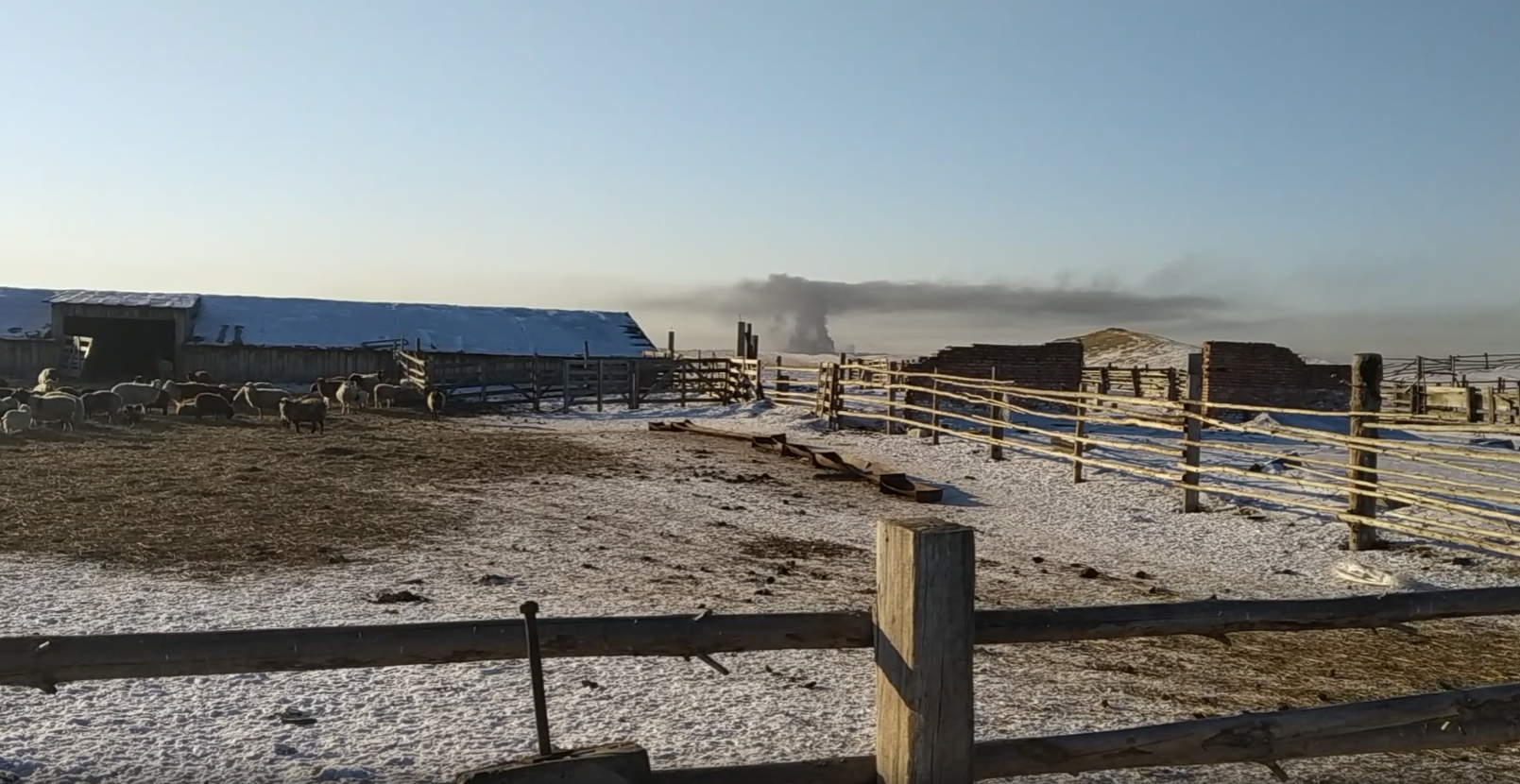
On 6 January 2020, Denis showed us his farm. He had around three hundred sheep and several horses. He wanted to expand, but needed land to do so. He said that people and livestock in the steppe became covered in dust, that water levels in wells and public water points were falling, and that the expansion of the mines left ever less space for livestock farming.
Another livestock farmer, who estimated that he was about six kilometres from the units, said that dust reached his farm and settled on the animals.
 Enlarge ↗
These accounts brought together atmospheric emissions, uncovered waste dumps, blasting, coal lorries, the loss of land and changes in water. The “dragons” became the most visible part of an industrial advance that people were already experiencing in their homes and farms.
“For state needs” — for a private company
Land was required not only for the pit itself. It was needed for waste dumps, roads, infrastructure and the expansion of mining operations.
On 12 December 2019, a woman recorded in my archive spoke about notices for the acquisition of land plots and hayfields. She referred to a published list of 36 plots and said that she had received no compensation offer. This is her dated testimony of what the land-acquisition process looked like to someone who lived and worked in the steppe.
But the mechanism of acquisition is documented.
On 28 November 2018, Mayrykhsky applied to TsentrSibNedra. On 15 March 2019, the agency issued Order No. 216, On the acquisition of land plots for the state needs of the Russian Federation for work associated with subsoil use, at the expense of the subsoil user.13
How could a private company obtain land “for state needs”?
Under Russian law, licensed subsoil use was treated as such a state need. A private subsoil user could submit an application, a federal agency could adopt the decision, and the subsoil user itself paid for the valuation and purchase. The state explained the public interest in terms of energy strategy, coal supply and the development of the coal industry.
In other words, “state needs” did not mean that the open-pit mine was state-owned. It was a legal mechanism that allowed land to be taken for mineral extraction by a private company holding a federal licence.
The courts confirmed the use of this mechanism. In one case, the Beysky District Court authorised the compulsory acquisition of a privately owned plot and set the compensation payable.14
In another case, Mayrykhsky sought the acquisition of three agricultural plots from a farm. A court-appointed valuation found that the company’s offer had been substantially understated:
| Initial valuation | Court-appointed valuation |
|---|---|
| 1,598,000 roubles | 2,432,000 roubles |
| 1,256,000 roubles | 2,670,000 roubles |
| 238,000 roubles | 912,000 roubles |
A subsequent judgment described the original offer as containing “manifestly unfair terms of property compensation”.15
For the state, this was an area licensed for subsoil development. For the farmer, it was haymaking land, grazing, a source of fodder and the means to maintain a herd. A monetary valuation of a plot could not automatically replace an entire farming system dependent on neighbouring pasture and water.
Land acquisitions, the conversion of agricultural land and the consequences for farms will be examined in detail in a separate study of the Koibal Steppe. For the history of the “dragons”, the central point is this: as new industrial capacity appeared, people were losing the space on which their lives depended.
What happened to the water beneath the steppe
The open-pit mine changed the steppe not only at the surface.
Groundwater must be pumped continuously to prevent the pit from flooding. This lowers the water table around the workings and creates a cone of depression — a large area within which groundwater moves towards the pit along a new, artificial gradient.
Official state subsoil-monitoring bulletins show that by 2018 at the latest, the cones of depression around Mayrykhsky and the neighbouring Arshanovsky mine had merged. Specialists could no longer separate the effects of the two mine-dewatering systems. The combined drawdown area extended approximately eight kilometres from west to east and 4–4.2 kilometres from south to north.16
Dewatering at Mayrykhsky itself increased from 7.34 thousand cubic metres per day in 2017 to 14.344 thousand in 2020 — almost twice as much. That is more than five million cubic metres a year.
Mining operations were approximately 600 metres from Lake Turpanye. Specialists associated the eastern and north-eastern boundaries of the cone with Lake Turpanye and the R-1-1 canal, while also noting that further research and observations were needed to establish that connection reliably. In an arid steppe where groundwater recharge from precipitation is limited, an impact of this scale means that water movement was being reconfigured beneath the entire industrial area.
In 2018, arsenic in groundwater at Mayrykhsky was recorded at 1.5 times the maximum permissible concentration. Earlier data referred to exceedances for iron, sodium, petroleum products, fluorides and mineralisation. Separate state monitoring in 2021–2022 reported inputs of phenols, sulphates, arsenic and fluorides into the Abakan River near the mine-water discharge.1617
The cone of depression was caused by mine dewatering; the FGX units emitted residual dust after cleaning. For the people living there, air, land and water were not separated into different project volumes: both pathways existed in the same steppe during the same years.
The detailed history of the combined cone of depression, the lakes, wells, mine-water discharge and the possibility of restoring the steppe will be addressed in our next study.
What is known about health
Coal and mineral dust, PM10, PM2.5 and respirable crystalline silica can damage the respiratory and cardiovascular systems. Pneumoconiosis, silicosis and chronic obstructive pulmonary disease are well documented in occupational exposure to coal and silica-containing dust. The World Health Organization links long-term PM2.5 and PM10 exposure to increased morbidity and mortality.1819
For the Altaisky and Beysky districts, we compiled an official ten-year series covering 2016–2025. In Beysky District, the recorded prevalence of circulatory diseases rose from 154.8 to 235.1 cases per thousand residents. From 2021 to 2025, mortality from circulatory diseases in Beysky District was higher than the republic-wide rate every year. The crude mortality rate from malignant neoplasms also remained above the republic-wide rate in all ten years examined.20
State statistics reduced the whole of Beysky District to a single row. Arshanovo and Shalginov, people living near the units and mine workers disappeared inside the district total. Their complaints survive in appeals, interviews and video recordings, but state records gave these villages no voice of their own. The figures show rising illness and high mortality across the district, but do not publish what happened in each settlement.
These district-wide figures do not isolate the contribution of Mayrykhsky or the FGX units. The lack of village-level data and long-term air measurements is precisely why proper monitoring and public access to its results are needed.
This is not a neutral gap and is not a reason to excuse the coal companies. The state left people without open statistics for individual villages and without continuous air monitoring near their homes. The absence of these data does not show an absence of harm; it shows an absence of proper accounting. Residents’ testimony preserves what state reporting made invisible.
Residents themselves were not responsible for monitoring pollution and collecting the data. The company was required to conduct industrial environmental monitoring, keep records of emission sources, and document and retain its results.25 Public authorities organise state ambient-air monitoring; Roshydromet operates the national observation network, while regional authorities operate territorial systems.26 The sanitary authorities conduct public-health monitoring intended to compare environmental conditions with population health.27 Rosprirodnadzor is responsible for federal environmental supervision within its powers.28 The absence of public data for Arshanovo and Shalginov is the result of a system that failed to provide people with the necessary oversight and information.
What the court decided — and what it did not
In 2020, the Yenisei Directorate of Rosprirodnadzor fined Mayrykhsky 100,000 roubles. The authority alleged that projects for two FGX-48A units and a drying unit were being implemented at a Category I facility without favourable state environmental review conclusions.3
On 24 November 2020, the Altaisky District Court annulled the penalty and terminated the proceedings because the elements of an administrative offence had not been established. It also held that the administrative case file did not prove the existence of a single Category I capital-construction facility whose project documentation was required to undergo state environmental review.3
The court considered the administrative case file actually placed before it. Sixty-four appendices to the inspection report were missing. The authority did not produce the documents on which its allegation was based, did not identify the project documentation precisely and committed significant procedural violations.3
The exact outcome of the case is therefore this: Rosprirodnadzor did not prove the elements of an administrative offence with proper evidence. The court did not examine residents’ health, measure dust concentrations, determine whether the filters were functioning on 6 January or declare the emissions safe.
The permitting history did not end there. At the end of 2020, the company again applied for public consultation on the FGX-48A project, and in February 2021 the consultation was scheduled as a survey.21 The procedure was repeated after the December 2019 hearing, but the published documents did not explain why.
The dragons after 2020
The two units did not disappear immediately after the scandal.
A bachelor’s dissertation at the Khakass Technical Institute, based on the company’s load schedules and operating personnel logs, lists seven emergency shutdowns of FGX Nos. 1 and 2 between 2021 and 2023. They included start-up errors, overcurrent, an earth fault and two failures of the 500 kW motors on FGX No. 2.22
These records confirm the production use of both units in subsequent years. The available records do not show how the dust-extraction system behaved during each shutdown or whether coal feeding stopped automatically when a fan stopped. Answering these questions requires the original operating logs, interlock logic and filter-maintenance records.
On its current website, the company continues to include construction of the FGX-48 in its development history and reports production of more than four million tonnes of coal a year.1
What the documents establish
After checking the archival footage, project documentation, laboratory protocols, official statements and court cases, the history looks like this.
- Mayrykhsky had two Chinese FGX-48A units with four operating lines.
- Their technology relies on forcing a large volume of air through coal; cyclones and bag filters are essential parts of the process.
- FGX commissioning work began on 6 July 2019. The work-order log records both units processing coal from 28 December 2019, while the certificates of entry into service are dated 27 January 2020.
- The Khakassia Ministry of Natural Resources acknowledged that the secondary collection of fine coal dust was insufficiently effective and that new filter elements were being installed at the site.
- The company also acknowledged that the equipment was being adjusted and that it was waiting for an additional filter component after which the dust was expected to disappear.
- Both FGX units and a separate drying unit were operating on 6 January 2020; on the same day, we filmed the industrial site and several visible plumes over the steppe.
- Tests on 21 January showed removal efficiencies of 80.0–80.3 per cent and a residual mass emission from each of the four lines.
- The project separately accounted for residual emissions of PM10, PM2.5 and coal dust even under normal cleaning conditions. PM2.5 is contained within PM10, while the treatment of the separate coal-dust entry is not explained; the project entries are therefore retained separately.
- The state system did not conduct regular air observations in Arshanovo, so the project’s dispersion model used indicative background levels instead of local measurements.
- The court annulled the Rosprirodnadzor penalty because the case had not been proved and because of procedural violations; it did not establish that the equipment was safe.
- Production records trace the operation of both FGX units until at least 2023.
What data the state did not publish
Operating and maintenance logs for the filters on the dates of the strongest emissions have still not been published. There is no continuous PM10 and PM2.5 series for Arshanovo and Shalginov. No hourly data have been published on emission mass, pressure drop across the bag filters or moments when the systems lost containment. The complete Rosprirodnadzor administrative case file with its 64 appendices has not been found.
The established facts remain: the equipment was processing coal, the filters were still being adjusted and dust was entering the air that people breathed.
Commissioning work took place in real air. Beyond the company boundary, people lived, animals grazed, and homes and agricultural land were present. While engineers selected operating settings and additional filters, the dust did not remain inside the technical documentation. It went outside — and residents, public authorities, the company itself and our cameras recorded it.
Request to the FGX manufacturer
On 14 October 2026, I sent a journalistic enquiry in Chinese and English to the FGX manufacturer, Tangshan Shenzhou Manufacturing Group, with a link to the video. I asked the company to confirm the manufacture and supply of the two units, describe their original configuration and dust-control requirements, comment on the test results and possible causes of the visible emissions, and identify the equipment and plume sources shown in the recording.
The enquiry was sent to the main address, shenzhou@tsshenzhou.com, with copies to huangtao@tsshenzhou.com and locke@tsshenzhou.com. The letter requested a response within 14 calendar days of receipt. This was a deadline proposed by the editorial team, not one established by law. As of 14 October 2026, no response had been received from the manufacturer.
After publication of the article, I plan to send a second enquiry to the manufacturer with a link to the published material.
Sources and documents
Open the list of 28 sources and documents
- Mayrykhsky Open-Pit Mine Coal Company LLC. Company profile and history.
- Shans.Region. “Residents of Arshanovo regret letting coal companies onto their land seven years ago”, 30 May 2019.
- Altaisky District Court of the Republic of Khakassia. Judgment of 24 November 2020 in case No. 12-64/2020.
- Tangshan Shenzhou Manufacturing Group. Official FGX-48A catalogue: capacity of 350–480 t/h and dimensions of 25 × 21 × 12 m; FGX Dry Coal Processing, technical brochure, PDF page 4: 1,298.68 kW and a note stating that power does not include auxiliary equipment such as conveyors. Patent US 2016/0136654 A1 is used only to describe the general enclosure, cyclone, bag-filter and air-recirculation arrangement, not as a source for the specifications of the FGX-48A.
- Mayrykhsky Open-Pit Mine Coal Company LLC. Environmental impact assessment for the long-flame coal drying complex, 2021.
- Ministry of Natural Resources of the Republic of Khakassia. Statement on commissioning work and filters, 2 October 2019; archived copy of a report by IA Khakassia.
- UPR AO Krasnoyarskugol LLC. Environmental impact assessment for Project
390-909-19, Volume 3: minutes of the public hearing held on 20 December 2019. - Analitik LLC. Test protocols Nos. 5–8/Х-Э ПВ dated 27 January 2020; samples collected on 21 January 2020. Project
390-909-19EIA, Volume 2, PDF pages 41–48, Appendix Р. - FGX SepTech. Dry Coal Processing — A Suitable Technology for Indian Coals, PDF page 2: technical description of two-stage dust collection using a cyclone and bag filter.
- UPR AO Krasnoyarskugol LLC. Project
390-909-19EIA, Volume 2, emission calculations for sources Nos. 0001–0004, PDF pages 72–78; Volume 1, consolidated project total of 94.477429 t/year, PDF page 58. - UPR AO Krasnoyarskugol LLC. Project
390-909-19EIA, Volume 2: dispersion calculations and Central Siberian hydrometeorological service letter No. 14/129 dated 21 January 2019. - Project
390-909-19EIA, Volume 1, climate profile; Government of the Republic of Khakassia, Resolution No. 679 of 30 December 2016 and statement on air stagnation in the Khakass–Minusinsk Basin. - TsentrSibNedra. Order No. 216 of 15 March 2019; judgment in case No. 2A-237/2019.
- Beysky District Court of the Republic of Khakassia. Judgment in case No. 2-360/2020, 29 September 2020.
- Third Commercial Court of Appeal. Ruling in case No. A74-1427/2021, 17 August 2022.
- Siberian Regional Centre for State Subsoil Monitoring, a branch of Gidrospetsgeologiya. Information bulletins on the state of the subsoil in the Siberian Federal District for 2017, 2018 — the combined cone of depression and the need for further research into its connection with Lake Turpanye and the R-1-1 canal, PDF page 74 — 2019 and 2020.
- Government of the Republic of Khakassia. Results of water-body monitoring for the fourth quarter of 2021 and first quarter of 2022, 31 March 2022.
- World Health Organization. WHO global air quality guidelines, 2021.
- NIOSH. Coal Mine Dust Exposures and Associated Health Outcomes, 2011.
- State reports on the condition of the environment in the Republic of Khakassia: 2016, PDF pages 159–162, 2017, PDF pages 166–170, 2018, PDF pages 153–156, 2019, PDF pages 141–145, 2020, PDF pages 139–142, 2021, PDF pages 139–142, 2022, PDF pages 148–150, 2023, PDF pages 144–146, 2024, PDF pages 150–152, and 2025, PDF pages 148–152. Additional district series: updated regional cancer-control programme, Tables 2 and 10 and updated regional cardiovascular-disease programme, Tables 2–4. The article uses district series for 2016–2025.
- Altaisky District Administration. Resolution No. 61 of 1 February 2021 on public consultation for the FGX-48A project; notice in Rossiyskaya Gazeta dated 5 February 2021.
- Charochkin I. Yu. Analysis of emergency shutdowns at the substation of Mayrykhsky Open-Pit Mine Coal Company LLC, bachelor’s dissertation, Khakass Technical Institute, branch of Siberian Federal University, 2024.
- Yenisei Interregional Directorate of Rosprirodnadzor. Unscheduled on-site inspection report No. АВЗНТ-028-в concerning Mayrykhsky Open-Pit Mine Coal Company LLC, dated 20 February 2020: serial numbers, dates of entry into service and start of the work-order log — PDF pages 2–3; operation of both FGX units on 6 January — PDF page 4; dryer table and the 4,248-tonne figure for 6 January — PDF pages 5–6; the 91.7%, 98.7% and 98.1% results — Table 5 on PDF page 12.
- Tiblok1 channel. “Dragons of Khakassia”, video running time 1 minute 16 seconds, published 2 February 2020. The description identifies a Chinese FGX-48 dry coal-processing unit in operation. The publication date is not the filming date.
- Federal Law No. 7-FZ of 10 January 2002, On Environmental Protection. Article 67: industrial environmental monitoring: the company’s duties to conduct industrial environmental monitoring, document and retain the results, and maintain records of emission sources.
- Federal Law No. 96-FZ of 4 May 1999, On the Protection of Atmospheric Air. Article 23: atmospheric-air monitoring; Government of the Russian Federation, Regulation on state monitoring of environmental condition and pollution: organisation of air-pollution observations and the national and territorial observation networks.
- Federal Law No. 52-FZ of 30 March 1999, On the Sanitary and Epidemiological Welfare of the Population. Article 45: public-health monitoring; Government of the Russian Federation, Regulation on public-health monitoring: observation of health and environmental conditions and identification of harmful effects from environmental factors.
- Federal Service for Supervision of Natural Resources. Regulation on Rosprirodnadzor: federal environmental control and supervision over limitations on harmful industrial impacts.