Introduction
Why this story cannot begin with the threat
For several years I tried to understand where this story should begin.
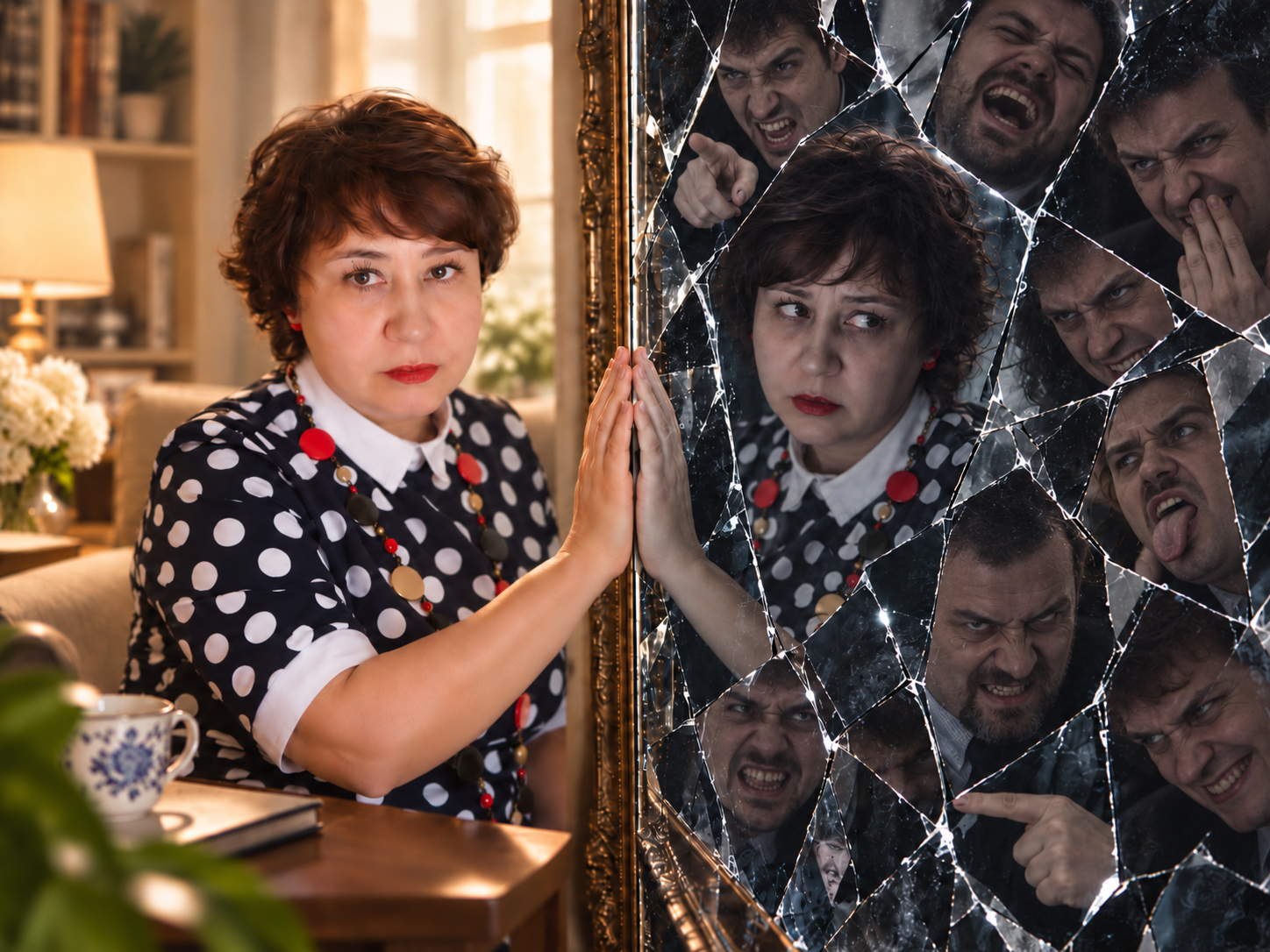
With the threat to burn me publicly outside the city administration? With my departure from Kiselevsk on 27 February 2021? With the publications that called me insane, an alcoholic, a fraudster and a woman who supposedly pursued men? Or with the evening when I realised that even at home I could no longer hide from the version of my life written by other people?
I now think the story must begin earlier — at a time when it was not yet a story about me.
I was a local journalist. People came to me. They brought court judgments, replies from prosecutors, photographs, receipts, complaints and correspondence. Sometimes they came with almost no documents — only a story that nobody wanted to hear through to the end. I went to the scene, spoke with other participants, called institutions, sent requests and published what I was able to establish.
I was not right about everything. I could misjudge a person, choose legally ill-advised wording, trust a source more than I should have, or reach a conclusion before I had all the documents. I lost one civil case. Some of my hypotheses remained hypotheses. Part of the archive has been lost, and some conversations now exist only in my memory.
This text does not try to turn me into an infallible hero. It places two lines side by side. The first is what I was actually doing. The second is the public biography that was gradually created around me and began to explain every new episode in advance.
01
How my work began
What I did
On 13 December 2017, my local publication Novosti Kiselevska — Kiselevsk News — was registered. I did not begin with national politics. One of the first stories was a request from teenagers who wanted help securing a sports ground. They knew what they wanted, but not how to make adults and institutions hear a simple question.
That was how people began coming to me. I wrote about housing, heating, transport, the maternity hospital, labour rights, people with disabilities, the condition of schools and the city’s environment. I travelled to coal dumps and open-pit mines, filming dust, underground fires and the proximity of industrial land to people’s homes.
One of the first serious housing stories concerned the Atamanov family. The brothers were not orphans: their mother, Svetlana, was alive. The family was vulnerable because Svetlana found it difficult to navigate complex property decisions and assess their consequences. People with direct knowledge of the case told Takie Dela about her extreme trustfulness and how easily her decisions could be directed. The flat passed to another owner.
What later events confirm
After this case, Olga Khlopina, who had a Group II disability, came to me. Her account involved Marina Kharitonova and the lawyer Anton Reutov. I wrote an article titled ‘Not All Lawyers Are Alike’. Reutov brought a civil claim for the protection of honour and dignity. I lost the case and paid the amount awarded. Today I accept that some wording may have been legally ill-advised and that I did not always distinguish clearly enough between an assessment and a statement of fact.
But losing that case did not erase either Khlopina’s story or the later approaches from other people. While Reutov was already suing me, Valentina Loginova came to me — an elderly woman who had spent years seeking an investigation into her deceased nephew’s flat and money. Earlier refusals issued in response to her complaints were overturned, inquiry files were lost and had to be reconstructed, and on 6 July 2020 a criminal case was opened under Article 159(3) of the Russian Criminal Code. Our archive contains no final conviction, and the opening of a criminal case is not a conviction of Reutov.
This line of stories also included Roman K. After several years away, he returned to the city and discovered that his flat had been registered in somebody else’s name. Most of the legal work involved in recovering the property was carried out by a lawyer connected with the religious community where Roman underwent rehabilitation.
02
When I became the subject of the publication
On 11 November 2019, the website Bez Tsenzury (‘Without Censorship’) published ‘Voice of the People’. It was presented as a reader’s letter signed ‘Sergey Krylov’. The source of the letter has not been independently established. But a single text already brought together my journalistic and environmental work, my contact with a foreign journalist, my family and my husband’s employment.
Until then, it had been possible to argue about a specific article: had I checked a document thoroughly enough, described a person’s role correctly, or drawn too strong a conclusion? Now different cases were connected not through a public-interest problem but through my identity. A ready-made answer to every new question was gradually taking shape: if I investigated something, the investigation was attributed not to the event itself but to my character.
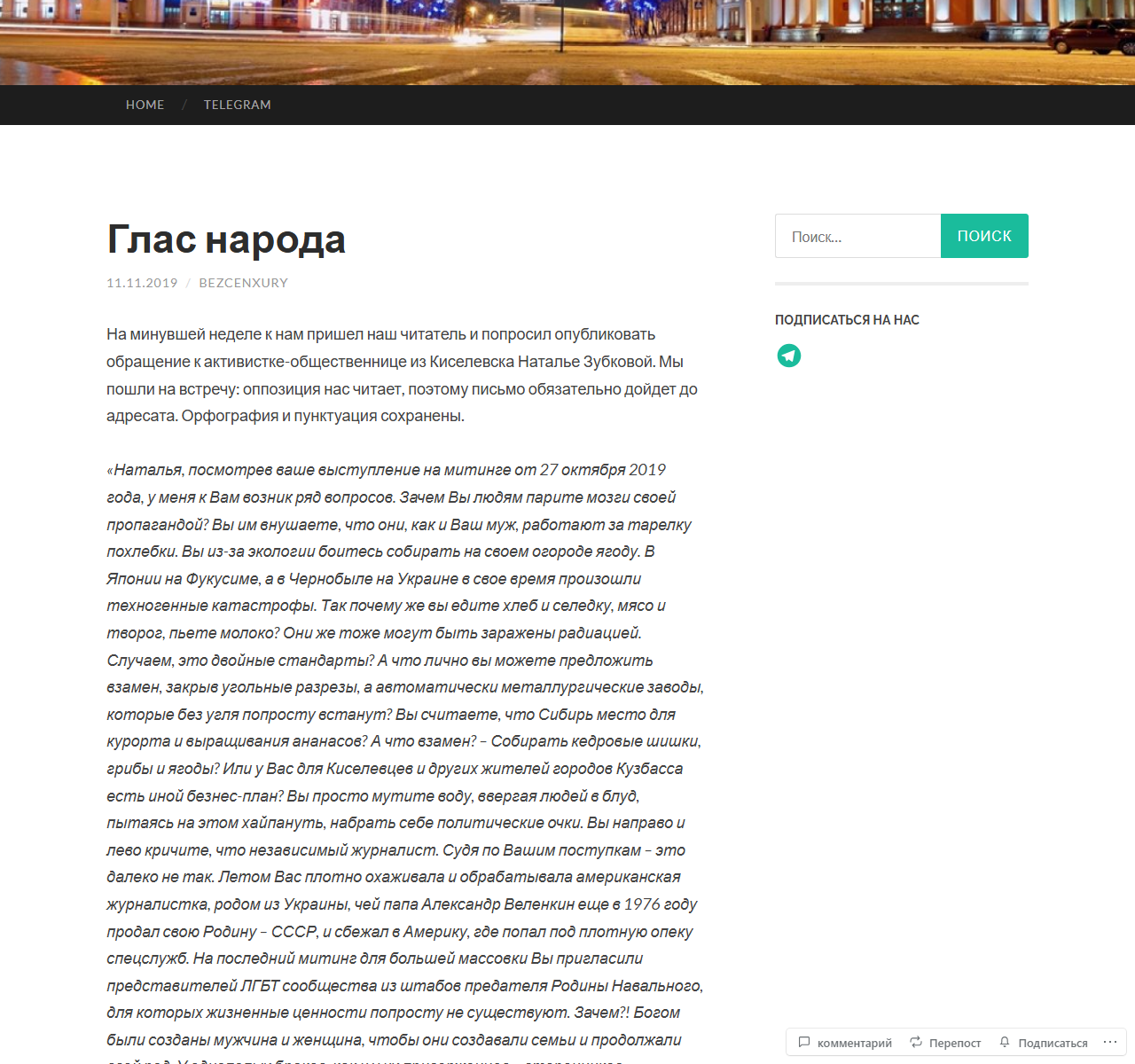
Original headline: Глас народа
English:Voice of the People
An early turning point: several different public-interest stories are assembled around my identity, family and connections.
Olga Tuzovskaya and the maternity hospital
What I did
On 12 December 2019, I exchanged messages with Olga Tuzovskaya. She was worried about the future of Kiselevsk’s maternity hospital and told me about a friend who had given birth there and was satisfied with the care. We spoke by telephone. I suggested that Olga come with her friend so that I could record an interview.
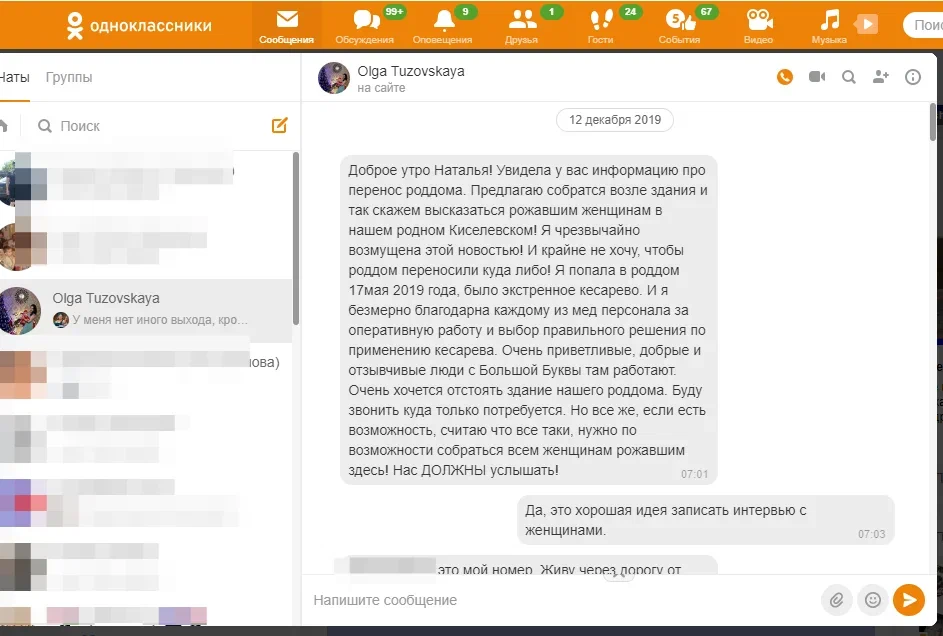
I did not suggest organising a rally. My idea was an ordinary journalistic format: to meet and record women who had something to say. As I remember it, Olga herself invited other women to come and speak. The meeting took place in a square in the same neighbourhood, not inside the maternity hospital or directly outside its entrance. Around ten people came.
What was written about it
On 16 December, Bez Tsenzury published ‘A Kiselevsk Rally: PR or Disgrace?’, followed in January by a text claiming that opposition activists were exposing citizens to charges and fines. In this version, Olga’s initiative, my offer to record an interview and the women’s actual meeting were rearranged into a story in which I became the principal organiser and was held responsible for what followed.
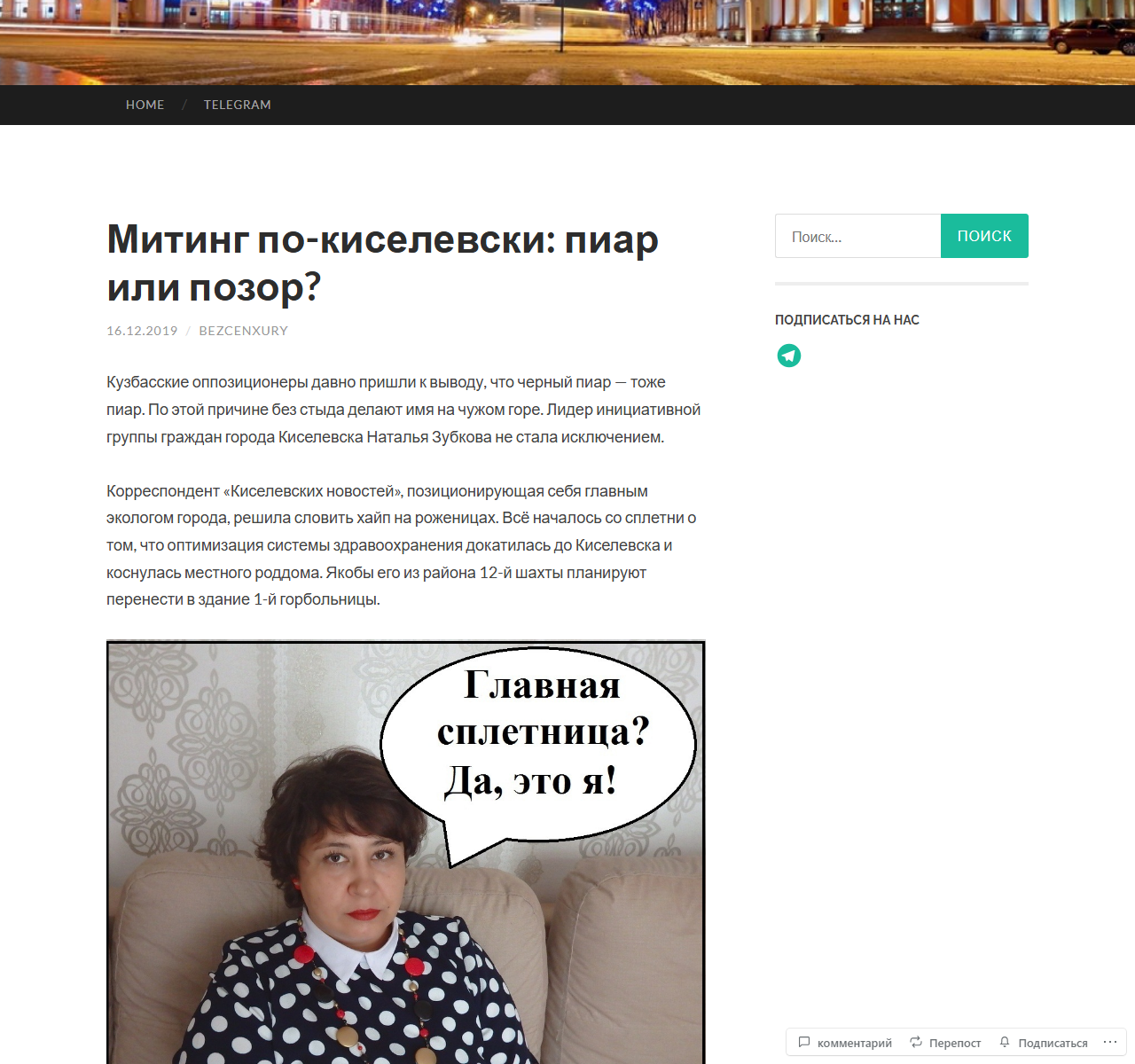
Original headline: Митинг по-киселёвски: пиар или позор?
English:A Kiselevsk Rally: PR or Disgrace?
The event did not disappear, but who acted, why they acted, and what caused what were all recast: a journalistic offer to record an interview became a story about organising a scandal.
What actually happened
This is one of the central mechanisms in the entire story: the factual basis remains, but another person’s action is attributed to me, a journalistic purpose is replaced with personal gain, and the consequences are explained through my character.
03
Different stories create a single character
By spring 2020, different publications had begun to coalesce into a single, consistent character. Journalistic telephone calls became ‘telephone terrorism’. Environmental reporting trips became ‘PR at the rubbish dumps’. Alcohol, cigarettes, family, children, money, supposed personal relationships and claims about mental health appeared alongside them.
On 23 April, the headline ‘Where Does the Gypsy Camp Go in Spring, or the Telephone Terrorist’ appeared. The publication offered no recordings that would allow readers to verify the number, content and tone of all the conversations attributed to me. Yet calls to institutions were already being explained not as a journalist’s work but through the image of an ‘unstable’ woman.
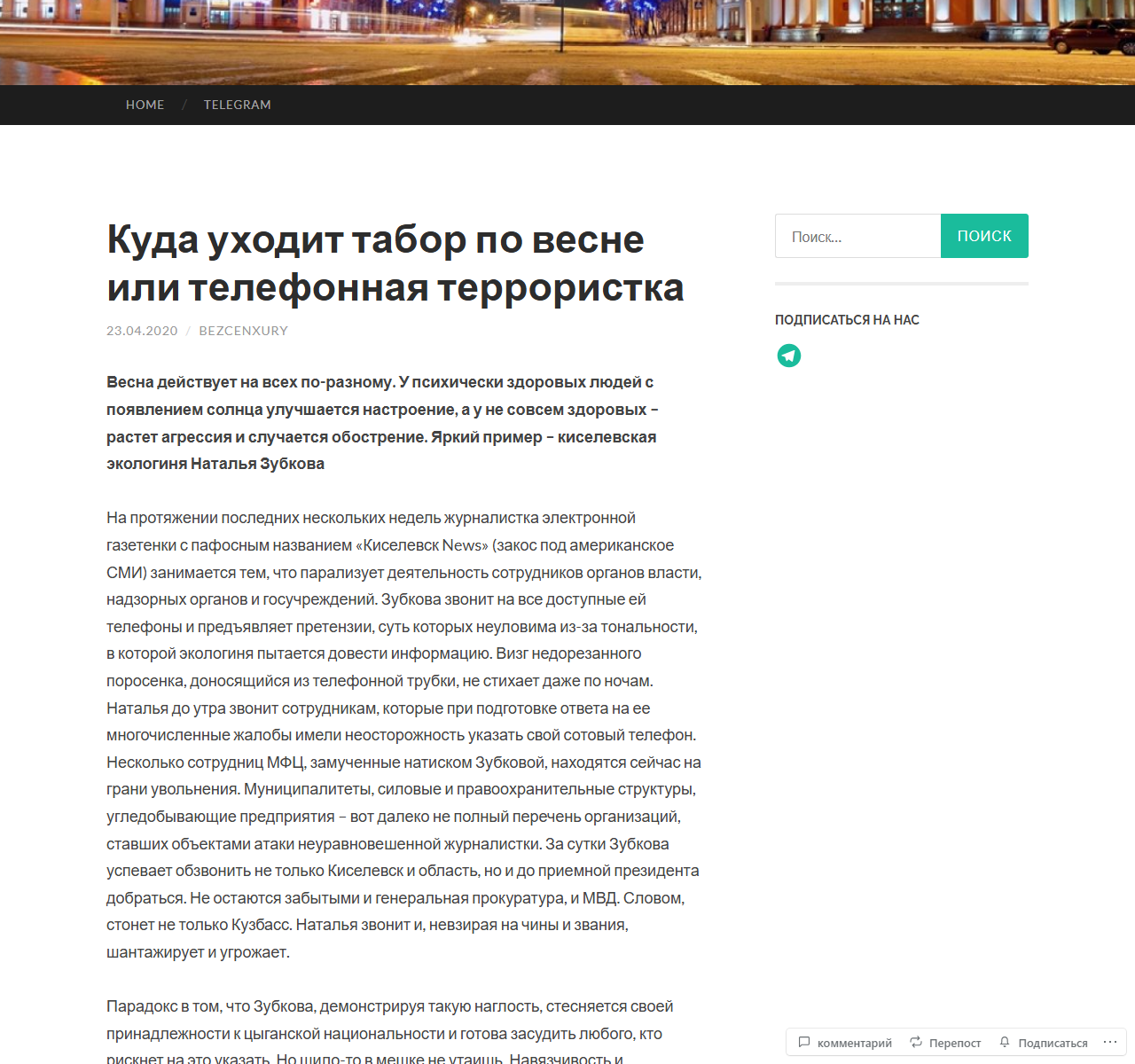
Original headline: Куда уходит табор по весне или телефонная террористка
English:Where Does the Gypsy Camp Go in Spring, or the Telephone Terrorist
Calls and requests are turned into a personal label in the headline, then joined by ethnic, alcohol and family frames.
On 7 and 8 May, environmental work was recast as ‘PR at the rubbish dumps’ and a way of making money. The same frame also drew in my husband and three children. A hunger strike over an environmental conflict was explained not by the subject of the protest but by greed and my private life.
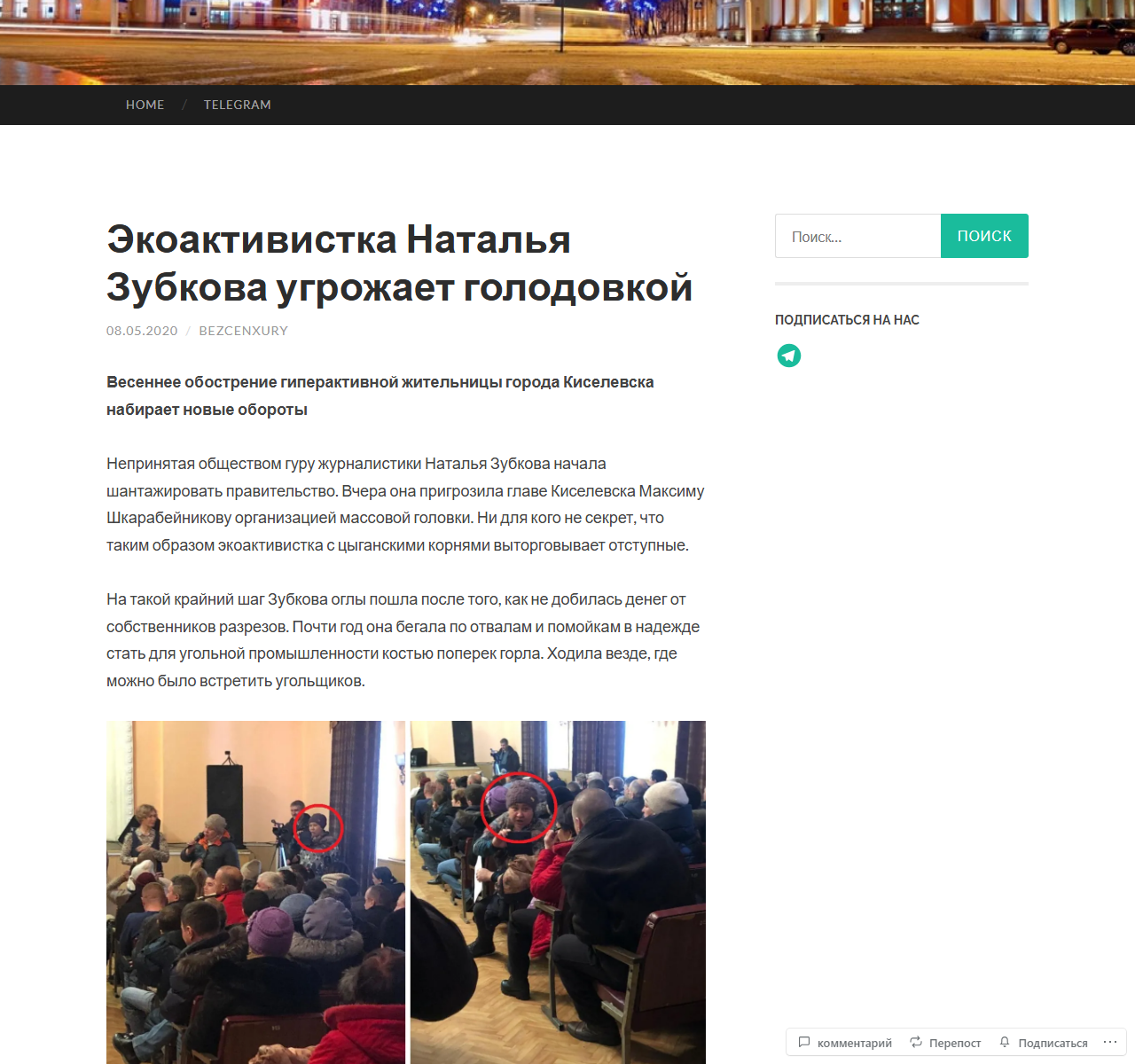
Original headline: Экоактивистка Наталья Зубкова угрожает голодовкой
English:Eco-activist Natalia Zubkova Threatens a Hunger Strike
The environmental conflict is connected to family, alcohol and supposed greed. Discussion of pollution gives way to discussion of the journalist’s way of life.
None of these themes remained within a single article. An old allegation migrated into the next story and no longer needed new evidence. Repetition began to function as confirmation: readers could feel that if the same characteristic kept appearing, it must already have been established somewhere.
04
School No. 24: around four hundred children were inside
What I did
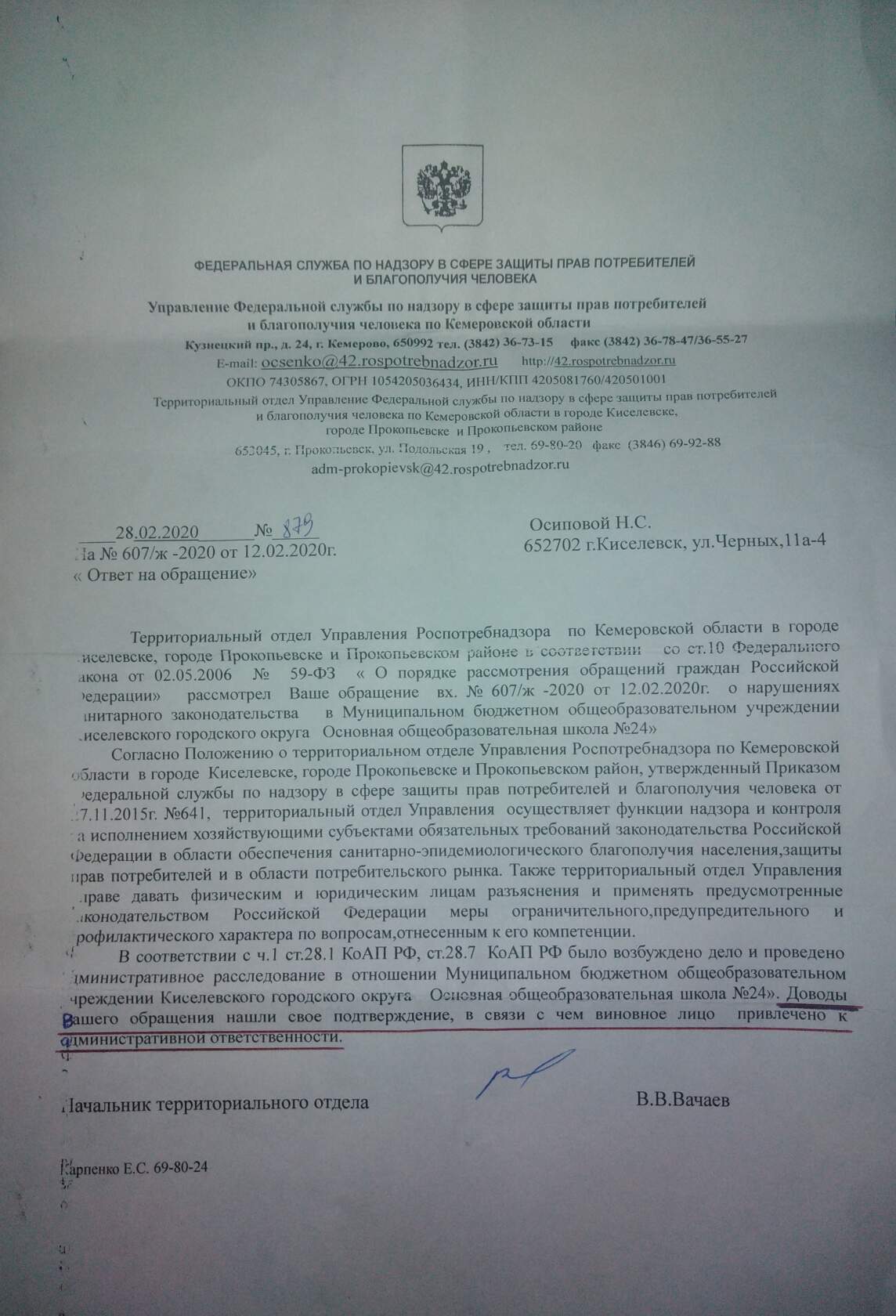
The story of School No. 24 was not about light bulbs. Parents approached me. I saw cracks in the building and its foundations, metal ties on the façade, and workers periodically working on those elements. The building remained in use by around four hundred pupils.
The context of Kiselevsk also mattered to me: a coal-mining city surrounded by open-pit mines where blasting took place. I was afraid that another powerful impact might prove critical for an already damaged building. That was my fear for the children, not an engineering conclusion. The precise purpose of the metal elements and any calculation of structural stability would require a specialist survey.
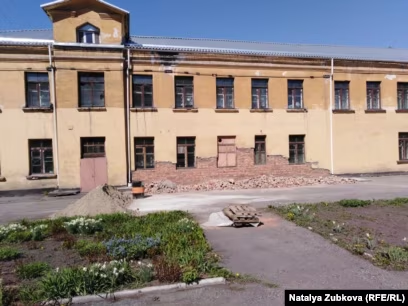
Open the Radio Free Europe/Radio Liberty article (Russian) ↗
What was written about it
By 9 January 2021, even Bez Tsenzury acknowledged the seriousness of the school’s condition. But recognition of the original problem did not undo the image that had been created. The school could be in a serious condition — and yet the woman who kept talking about it was still presented as the principal problem. A few days later, a piece addressed to Andrey Karaulov effectively invited him not to inspect the building but to read the ‘dossier’ assembled on me.
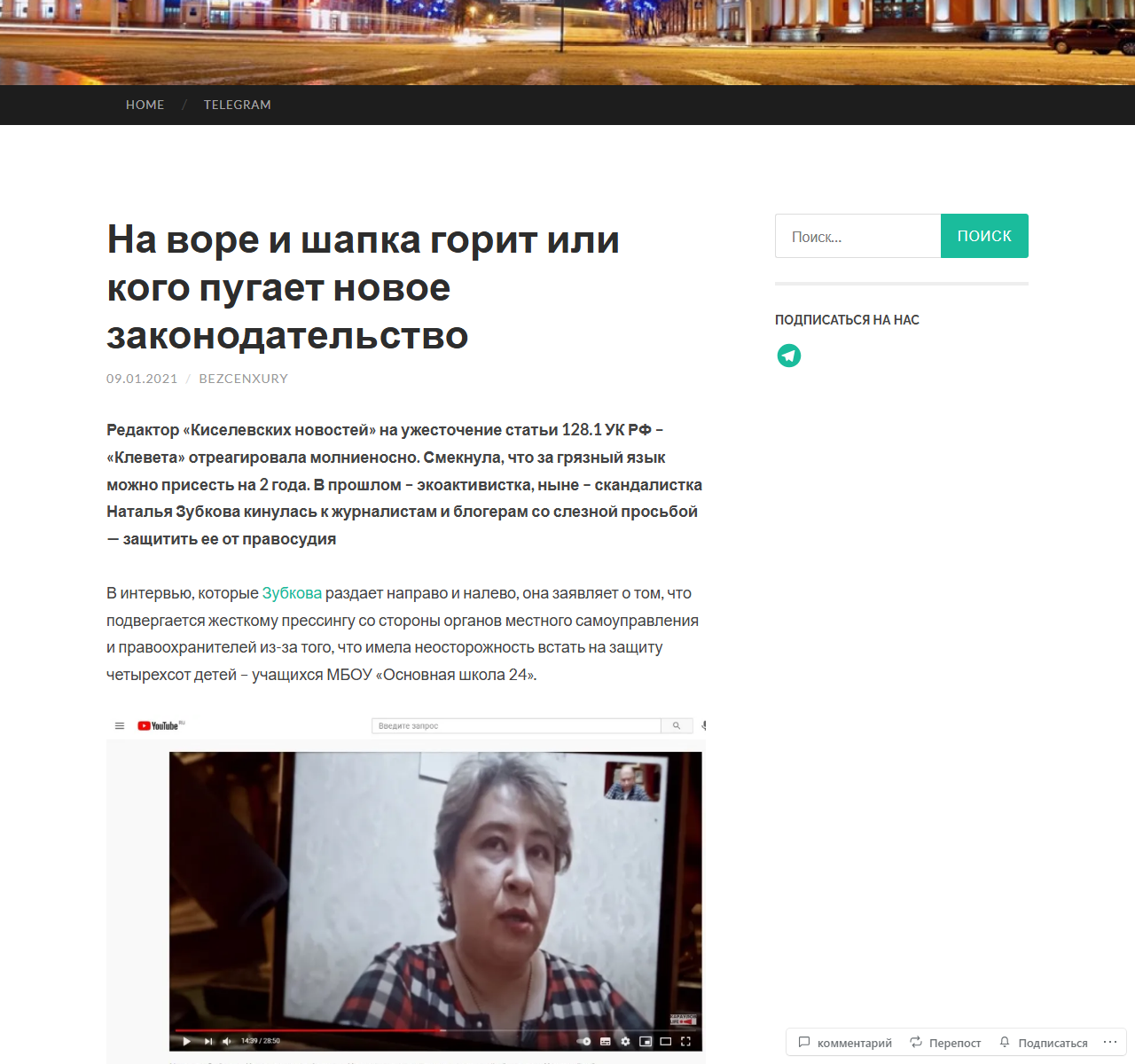
Original headline: На воре и шапка горит или кого пугает новое законодательство
English:A Guilty Conscience Betrays Itself, or Who Is Afraid of the New Legislation
The serious condition of the school is no longer denied, but the centre of the story remains the same: instead of children’s safety, my identity and supposed motives are discussed.
What happened next
05
When the public narrative enters the home
What was happening
The publications did not affect only me. My husband, children, mother, acquaintances and sources appeared in them. Links were sent to relatives, and the content came back to me through third parties. In the close-knit social environment of a small city, a public narrative does not remain on the screen: it enters working relationships, conversations and domestic conflict.
What was written
The same themes returned from one story to the next: family, children, alcohol, money and the claim that a woman ought to concern herself with the home rather than journalism. They were attached to environmental, housing and school stories even when they did not answer the original public-interest question.
What happened at home
An audio recording of a conversation with my husband has survived. It contains accusations concerning my work, money, family, alcohol and what was happening on social media. Some of these themes coincide with those repeated in publications before or around the same period.
I do not claim that every phrase my husband used came from a particular text. It is impossible to establish the route of every expression, and family relationships are always more complex than a single external cause. But the recording shows something else: the public discussion had already become part of a conversation at home. At one point, a child says:
“Dad, don’t shout.”
For me, this is not a sensational ‘audio scandal’. It is a moment in which the social impact becomes audible. What was being printed as a version of my life had already entered the way people spoke to me at home. Gradually, home stopped feeling safe.
06
By the time I left, I was almost alone
I was a local journalist to whom people brought their problems. I did not have a large newsroom behind me, a team of lawyers, continuous legal protection or constant access to human-rights defenders who could assemble the whole picture and defend me. I did not have the money to hire a good lawyer and hand over the protection of my interests.
I read the publications myself, collected documents, submitted complaints, tried to understand what had happened and continued working as a journalist at the same time. On one side were dozens of publications, different platforms, documents, social media, insults, mocking comments and threats. On the other was one person without a newsroom or legal machine behind her.
The environment around me was also changing. At some point I realised that I was becoming almost completely alone. People who had previously spoken to me began to distance themselves. As I perceived it, some were simply afraid to associate with me and become part of this story themselves. I cannot know each person’s motives and do not present my perception as a proven motive for everyone who withdrew. But that is how I experienced what was happening at the time.
In a small city, a journalist, her sources, institutional employees, relatives, acquaintances, neighbours and the audience of local social media all live very close to one another. That is why a publication does not end on the screen.
What happens online does not stay online. It comes back to you in the street. Through acquaintances. Into your family. Into your home.
The background consisted of more than individual articles. Insults and degrading descriptions, mocking comments and threats were repeated on social media. My family, children, mental health, alcohol use, sex life, money and supposed greed were all discussed. Old labels returned in new conversations. I continued working in an environment where I did not know where the next blow would come from or who else would read the next version of my life.
My family also ceased to be the last safe space. Themes from the publications returned through my husband, relatives, conversations about social media and accusations directed at my work. On the surviving recording, a child says, “Dad, don’t shout.” I do not claim that every phrase in the family conflict came from a specific publication. But the home that should have remained a place of protection no longer felt safe.
When I was the one who began to suffer, I realised that I had no one to turn to for help. I did not feel there was a person, newsroom, lawyer or organisation I could approach and say, “I’m frightened. Please help me.”
I could submit complaints, collect documents and try to explain what was happening. But inside, I felt that even if my cry was heard, that did not mean anybody would help me. At one point, I felt entirely alone.
07
Loginova and Reutov: a real legal process within a pre-existing narrative
What I did
The case I lost against Anton Reutov existed. I do not conceal it. But Valentina Loginova then came to me, and another story began — with its own complaints, refusals, decisions overturning those refusals, lost inquiry files and a criminal case opened in 2020.
This story does not justify declaring Reutov guilty: the assembled archive contains no final conviction. It shows only that Loginova’s complaint had a serious procedural basis and was not an invented continuation of my personal grievance.
What was written
The publication narrative merged those two layers. My work with Loginova was joined to my civil dispute. Financial, personal and sexual motives were attributed to me. The emergence of a real criminal proceeding did not displace the established image — it was absorbed into it as further evidence that I was supposedly pursuing a man or seeking attention or money.
What actually happened
08
17 August 2020: nine people and a public burning
What was happening
I had learned earlier about Valery Kazantsev’s story and the publication environment surrounding him. For me, it became one of the early signals that a person could be publicly discredited both before and after death. I do not claim that the publications caused his death, and I do not fill in circumstances that remain unknown. I am describing how the story changed my perception of risk.
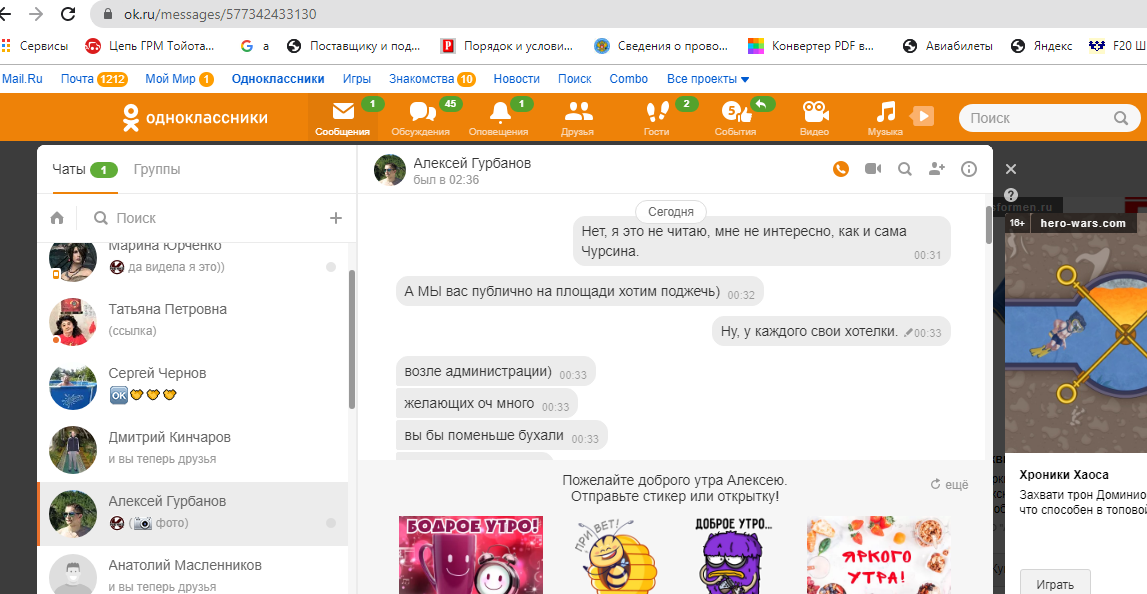
By early August 2020, I already saw what was happening as potentially dangerous. On 17 August, someone wrote to me in private messages about publicly burning me outside the city administration, a ‘public execution’ and nine people. A sequence of 27 screenshots has survived. I contacted the police.
Messages About a Public Burning and Execution
One surviving frame from the primary sequence. There is no public link; all 27 consecutive screenshots are preserved in the research archive.
What was written
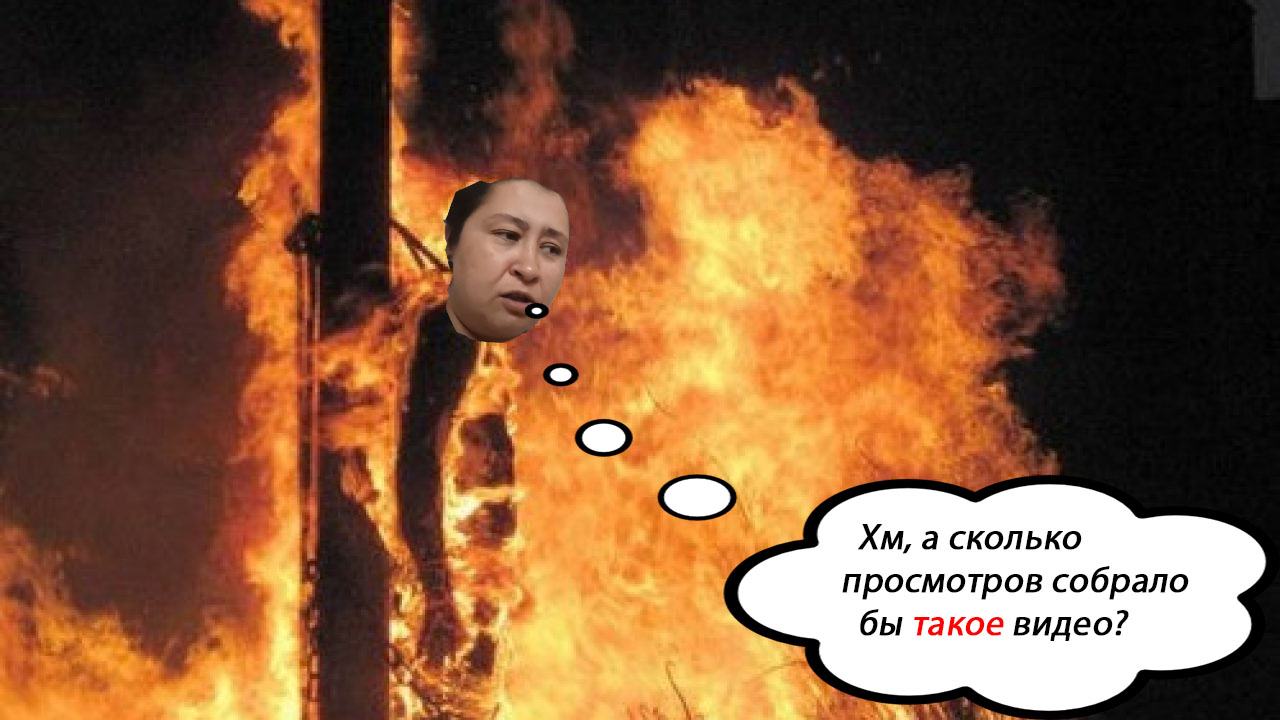
Four days later, Bez Tsenzury published ‘An “Assassination Attempt” Is Being Prepared Against Zubkova’. The outlet knew about the threat and used a montage showing me against a background of fire. Yet attention shifted from the content of the message to my supposed psychological instability, desire for attention and the possibility that I was provoking the incident myself.
Original headline: На Зубкову готовится «покушение»
English:An ‘Assassination Attempt’ Is Being Prepared Against Zubkova
Four days after the threat of a public burning, fire became part of the visual framing, while readers were invited to examine not the threat but the supposed instability of the person who had been threatened.
What is known
I do not connect the messages and the publication by claiming a single author or common plan. To understand the impact, the established sequence is enough: first a threat, then a text redefining that threat as a characteristic of its recipient.
The subject shifted: instead of asking, “Who is threatening her, and why?”, the question became, “What is wrong with the woman who is being threatened?”
09
The psychiatric frame as a universal answer
Journalist Irina Slavina died on 2 October 2020. For me, her death did not begin the fear; it was another painful confirmation that pressure on a journalist can end in death. By then I already knew Kazantsev’s story and had received the threat in August.
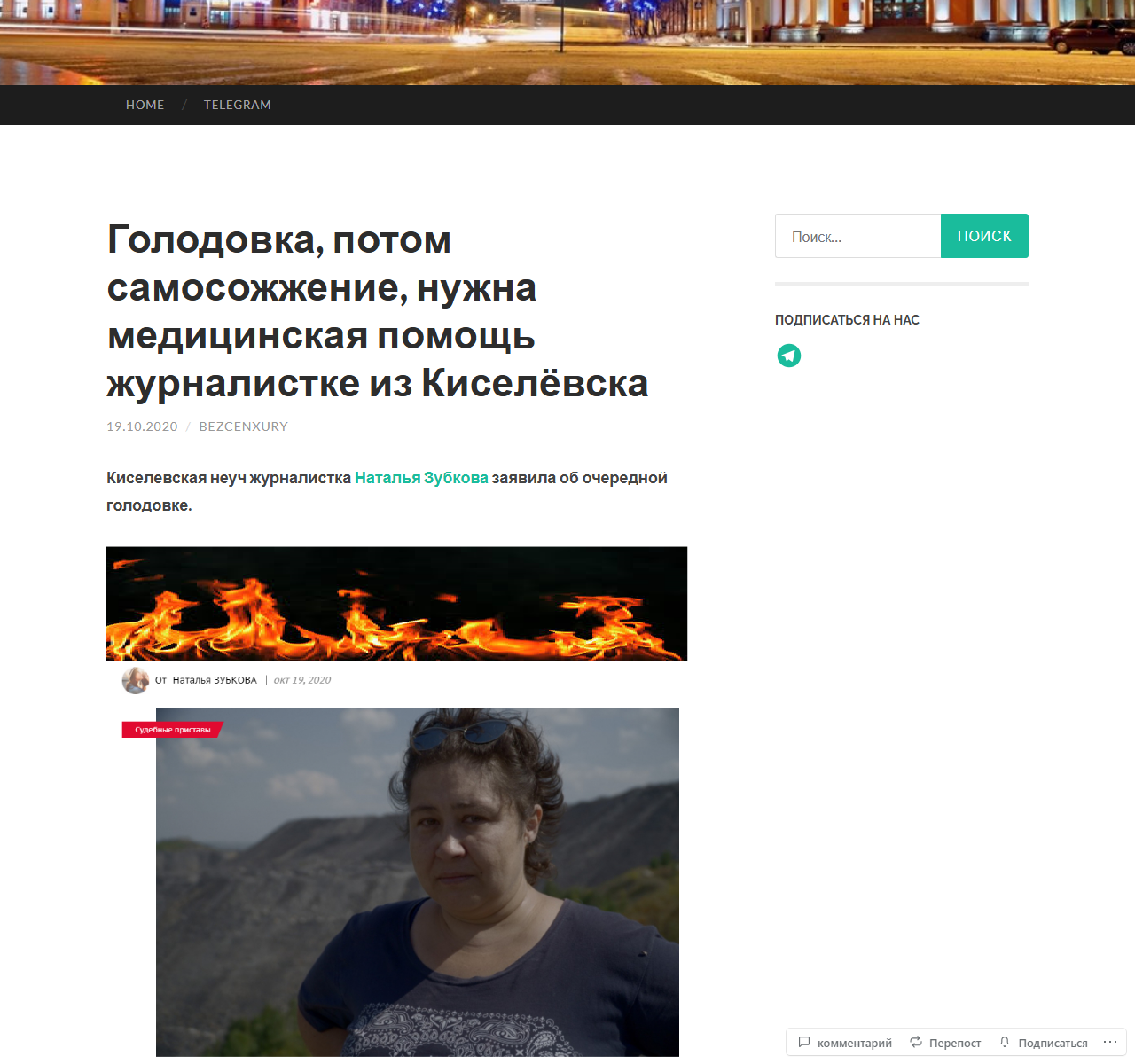
On 19 October, Bez Tsenzury published ‘Hunger Strike, Then Self-Immolation: the Journalist from Kiselevsk Needs Medical Help’. Another journalist’s death, the subject of self-immolation and my environmental hunger strike were combined in one headline with an invitation to frame me in medical terms.
Original headline: Голодовка, потом самосожжение, нужна медицинская помощь журналистке из Киселёвска
English:Hunger Strike, Then Self-Immolation: the Journalist from Kiselevsk Needs Medical Help
Different events are arranged into a sequence that sounds causal, while a public conflict is replaced with diagnostic-style framing.
On 30 October, ‘Full Moon or a Schizophrenic Episode?’ appeared. The original event was a conflict arising from my work on the school. The publication instead centred a supposed diagnosis, alcohol, family, children, doctors and the guardianship authorities.
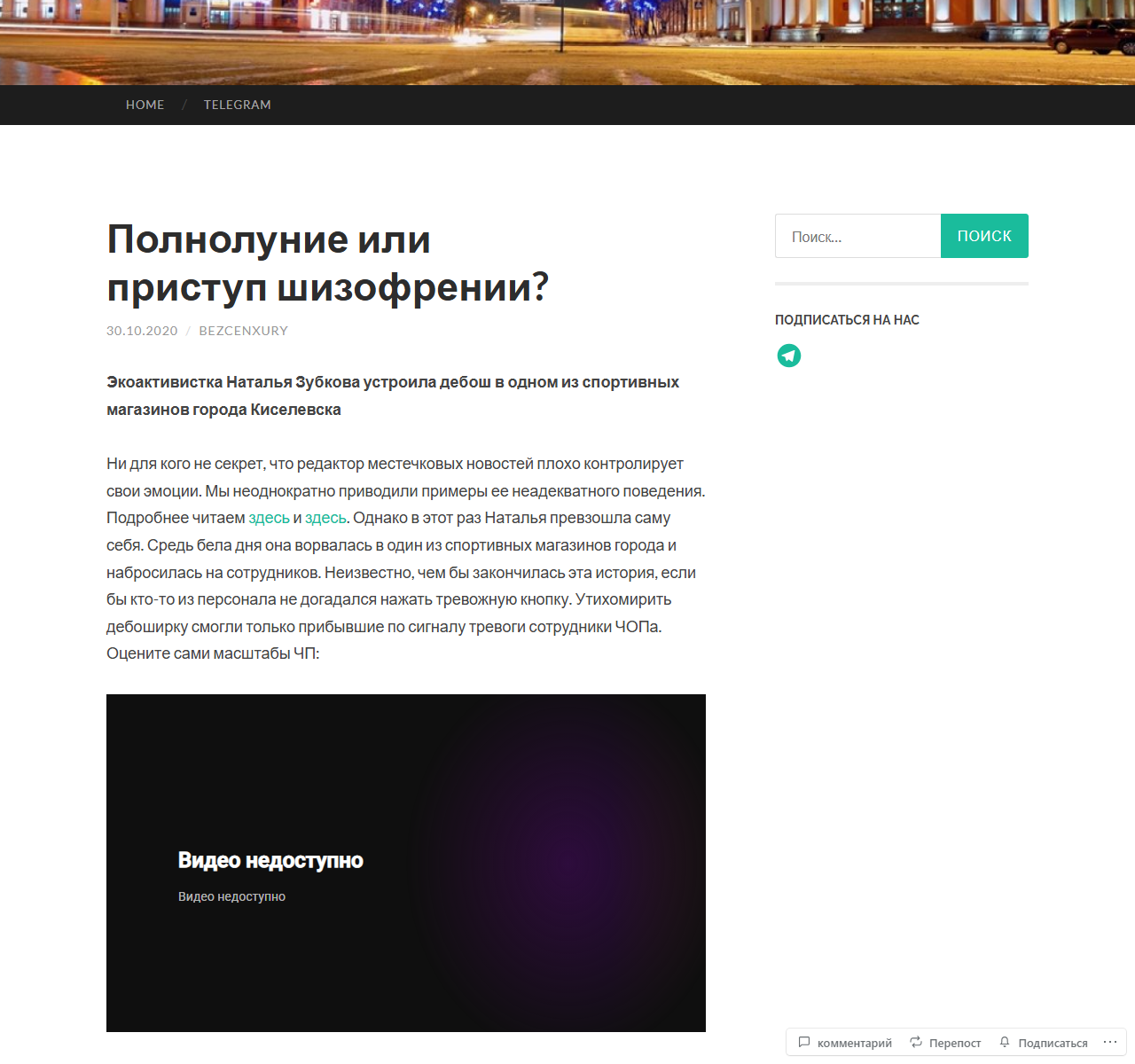
Original headline: Полнолуние или приступ шизофрении?
English:Full Moon or a Schizophrenic Episode?
The psychiatric frame is established in the headline itself; the school story becomes an occasion to discuss the journalist’s health, family and children.
In the full study, we examined not a single word but recurrence. Psychiatric and diagnostic-style formulations appeared across different stories and were transferred to new events. Yet no independent medical source supporting such characterisations was found in the corpus examined.
This is a finding about the publications, not a medical assessment of me or their authors. We analyse what the language does: it turns a dispute about facts into a discussion of a person’s supposed deficiency and thereby diminishes trust in everything that person may say next.
10
How an official document acquires a broader meaning
What happened
In autumn 2020, a conflict arose over Anna Chursina’s telephone. The surviving decision records the participants’ accounts and a narrow procedural conclusion: the material examined did not establish an intention to steal the telephone.
What was written
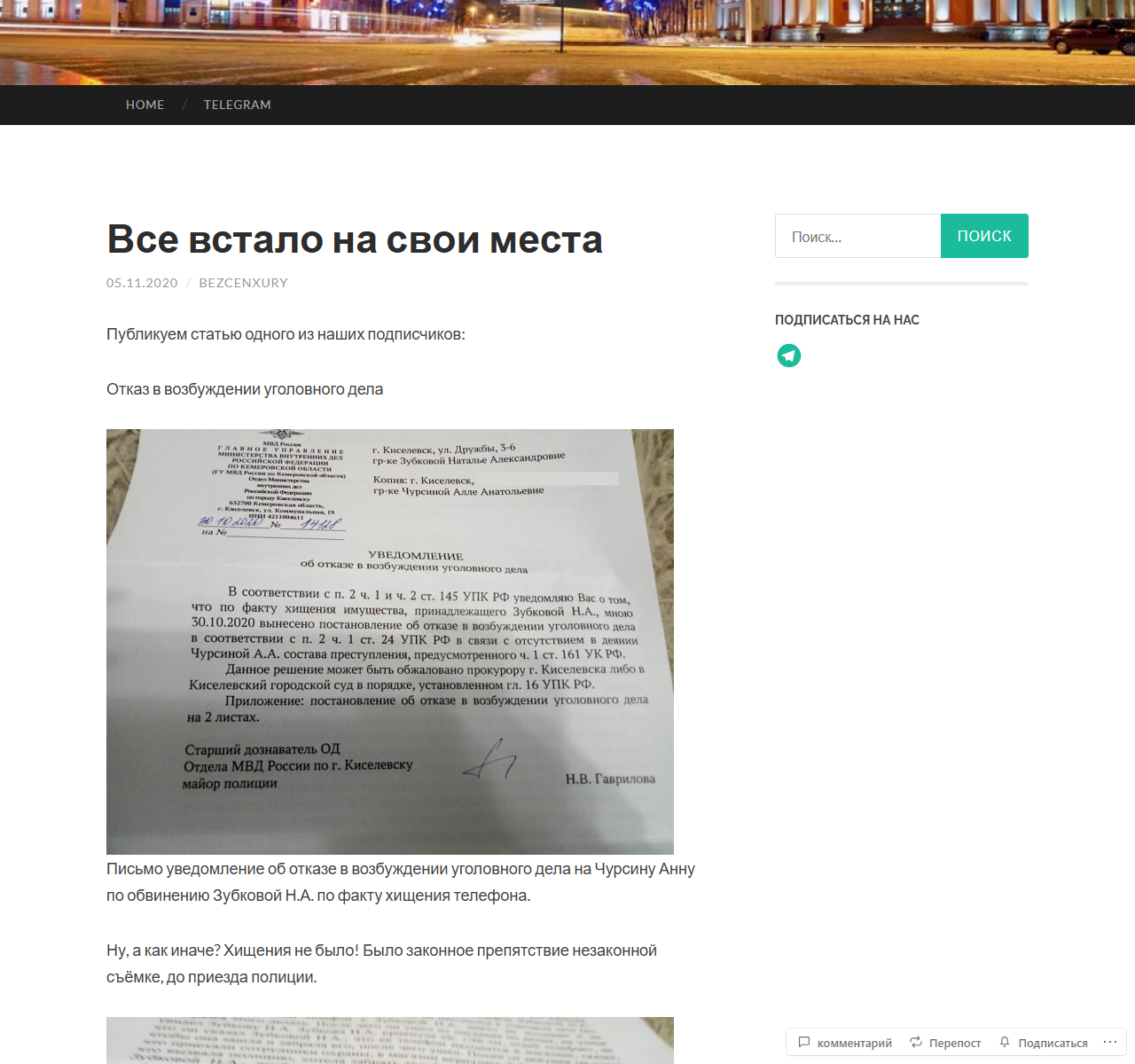
Original headline: Всё встало на свои места
English:Everything Has Fallen into Place
A narrow procedural document is presented as a general answer about my identity, reliability, health and motives.
On 5 November, the document appeared on Bez Tsenzury under the headline ‘Everything Has Fallen into Place’. Its meaning was expanded: the decision became not only an answer to the question about the telephone but a general verdict on me.
What the document actually says
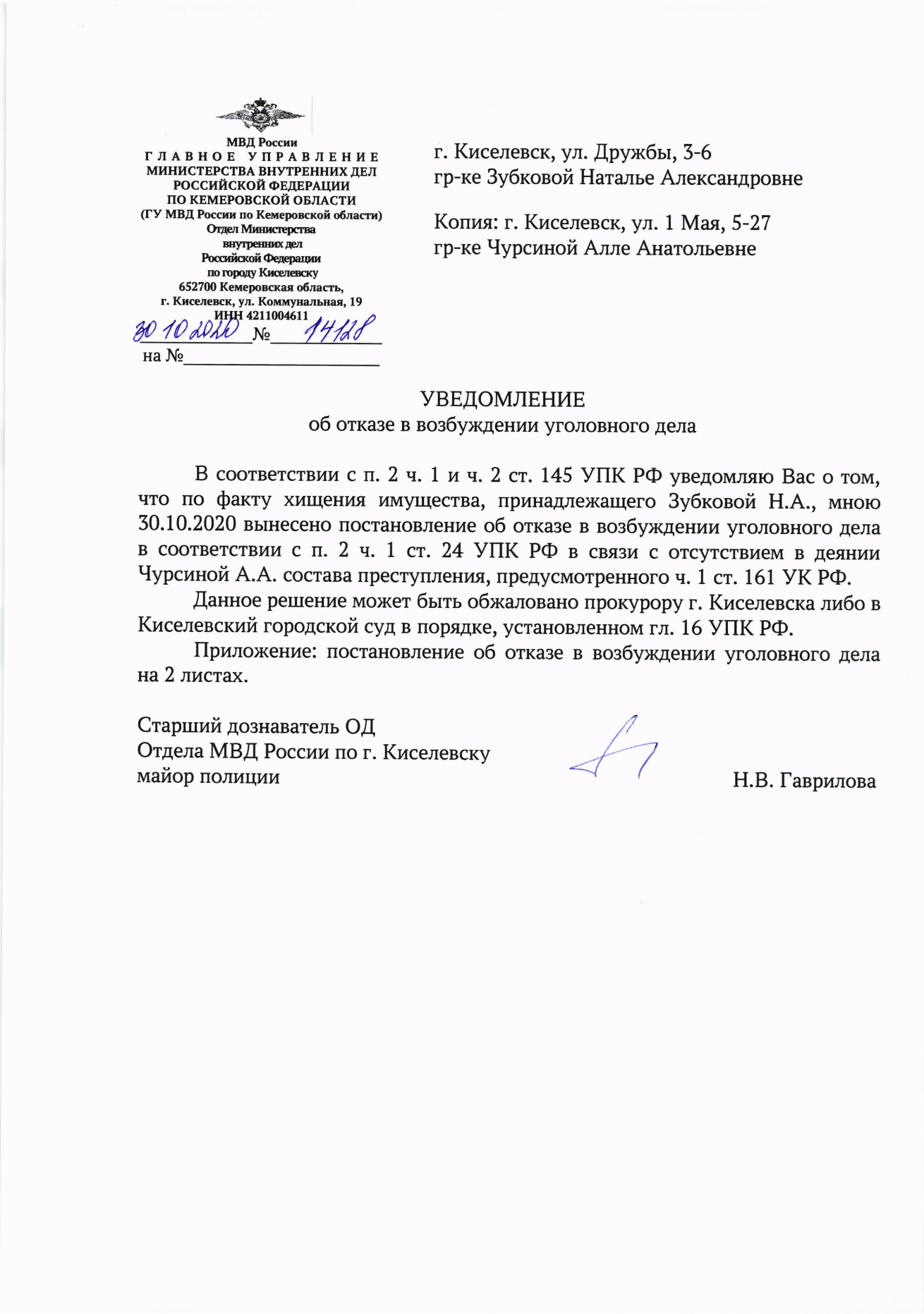
This device matters particularly because the reader sees a real official document. The authenticity of the paper creates a sense of reliability for conclusions that the document itself does not contain. A genuine fact becomes the support for a broader construction.
11
February 2021: a private conversation no longer felt private
In February 2021, Roman Kupriyanov’s home was searched. Materials from that period referred to a telephone and WhatsApp. Bez Tsenzury claimed to have sources in law enforcement and later published an extract from a different private conversation.
I do not know who obtained my messages or whether the source was a police officer. We have no evidence allowing us to say that the police passed the correspondence to the editorial outlet. Nor have we established the complete route of every non-public fragment.
But the sequence matters in understanding my experience: first the search and the seized telephone, then talk of access to correspondence, then publication of a private fragment and the outlet’s statement about law-enforcement sources. After that, a private conversation no longer felt private.
The uncertainty was not neutral for me. I did not understand who could see my messages, what might appear next, or where the boundary lay between my life and a future publication. This is not proof of a technical leak mechanism. It explains why my sense of safety had almost disappeared by the end of February.
12
Leaving Russia — and fear that did not end at the border
What was happening
Shortly before I left, Galina Karpova found me. She wanted to speak about her son, his death, a flat and the people she associated with the story. Her account involved Anna Chursina, Gavrilov, Sergey Gorbunov and others. I recorded an interview.
On 25 February 2021, after speaking with Karpova, I went out to walk my dog, Chip. An unknown man pulled me by the hood and threatened consequences if I ever ‘opened my mouth’ again. I do not know who sent him or whether the incident was connected specifically to that day’s conversation. Neither the perpetrator nor whoever may have commissioned him has been identified. But I cannot remove the threat from the chronology of my own decision.
By that point, I had already spent a long time awaiting the next blow: the August messages about a public burning; publications about my mental health, family, children, money and private life; the sense that private correspondence was no longer private; family conflict; people distancing themselves; and the absence of a system of legal protection accessible to me. The threat while I was walking Chip was not the sole cause, but the final episode in a sequence that had been building for months. I left Russia on 27 February.
I did not leave because I had decided to begin a beautiful new life. I left because I no longer felt protected.
What was written
On 2 March, Bez Tsenzury published a database row showing the date and route of my flight, together with an article titled ‘Natalia Zubkova Has Found a New Source of Enrichment’. A real journey became the basis for a narrative in which my departure was a performance, a fabrication and a way to make money.
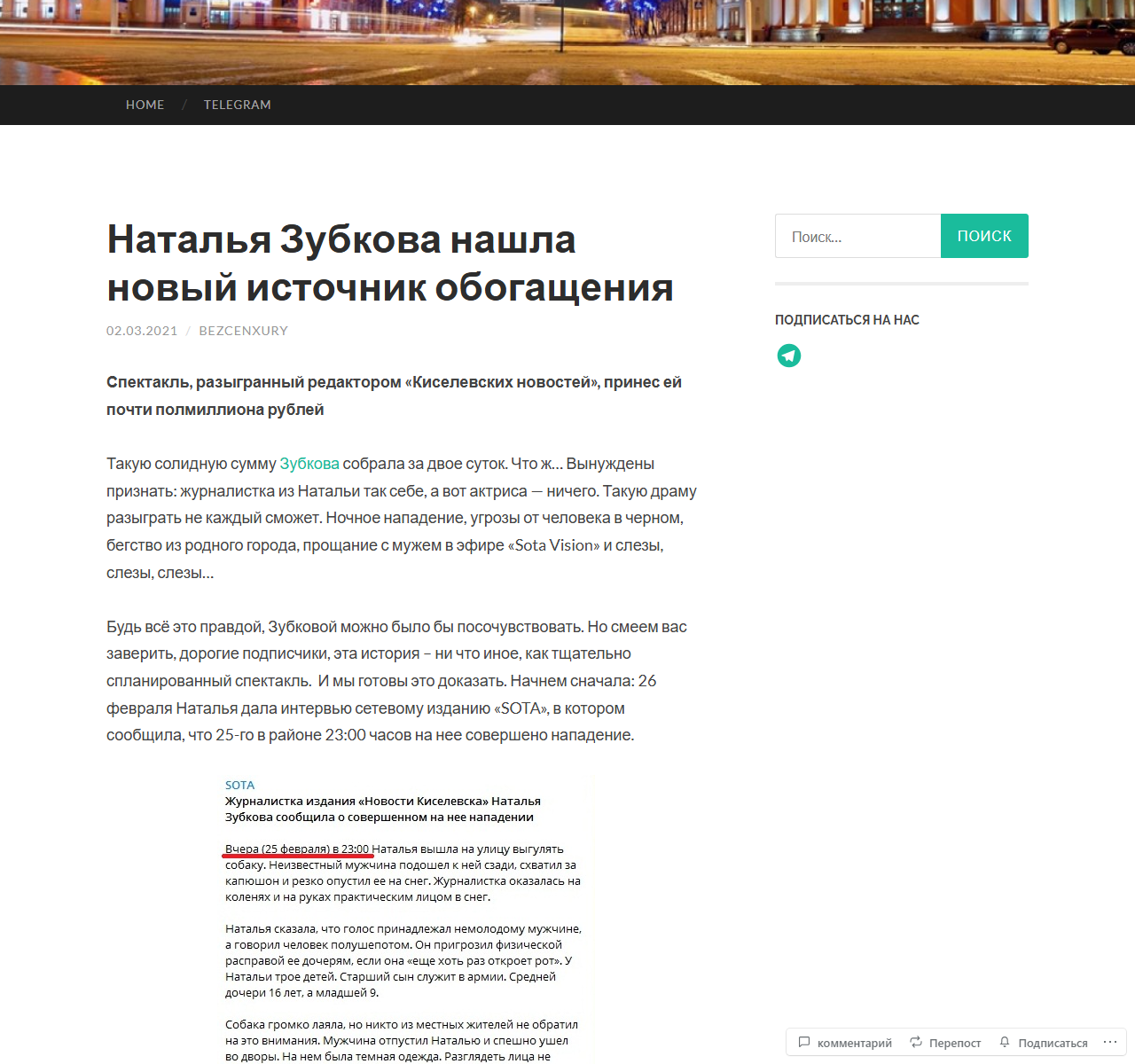
Original headline: Наталья Зубкова нашла новый источник обогащения
English:Natalia Zubkova Has Found a New Source of Enrichment
The published database row confirms the flight. The publication uses that real fact as the basis for a broader version about motives and profit.
What is confirmed
On 5 March, I published the interview with Karpova. On 14 March, a response appeared on VKontakte, and on 22 March Bez Tsenzury republished and intensified that version under the headline ‘Zubkova Has Hit Rock Bottom’. The source’s past was used as a ready-made answer to her account and transferred to me at the same time. Discrediting the person who gave the interview became a way of avoiding investigation of the interview’s subject.
13
After Russia: a new life and the old frame
Georgia
What was happening
After leaving, I lived in Georgia, worked and tried to rebuild my life. I was physically in another country, but the public narrative had not ended.
What was written
In May 2021, the website continued writing about what I was doing in Georgia. In July, it returned to Loginova’s story while again speaking about alcohol, mental health and private life. Sexualised texts about family, feminism and my life in another country then appeared.
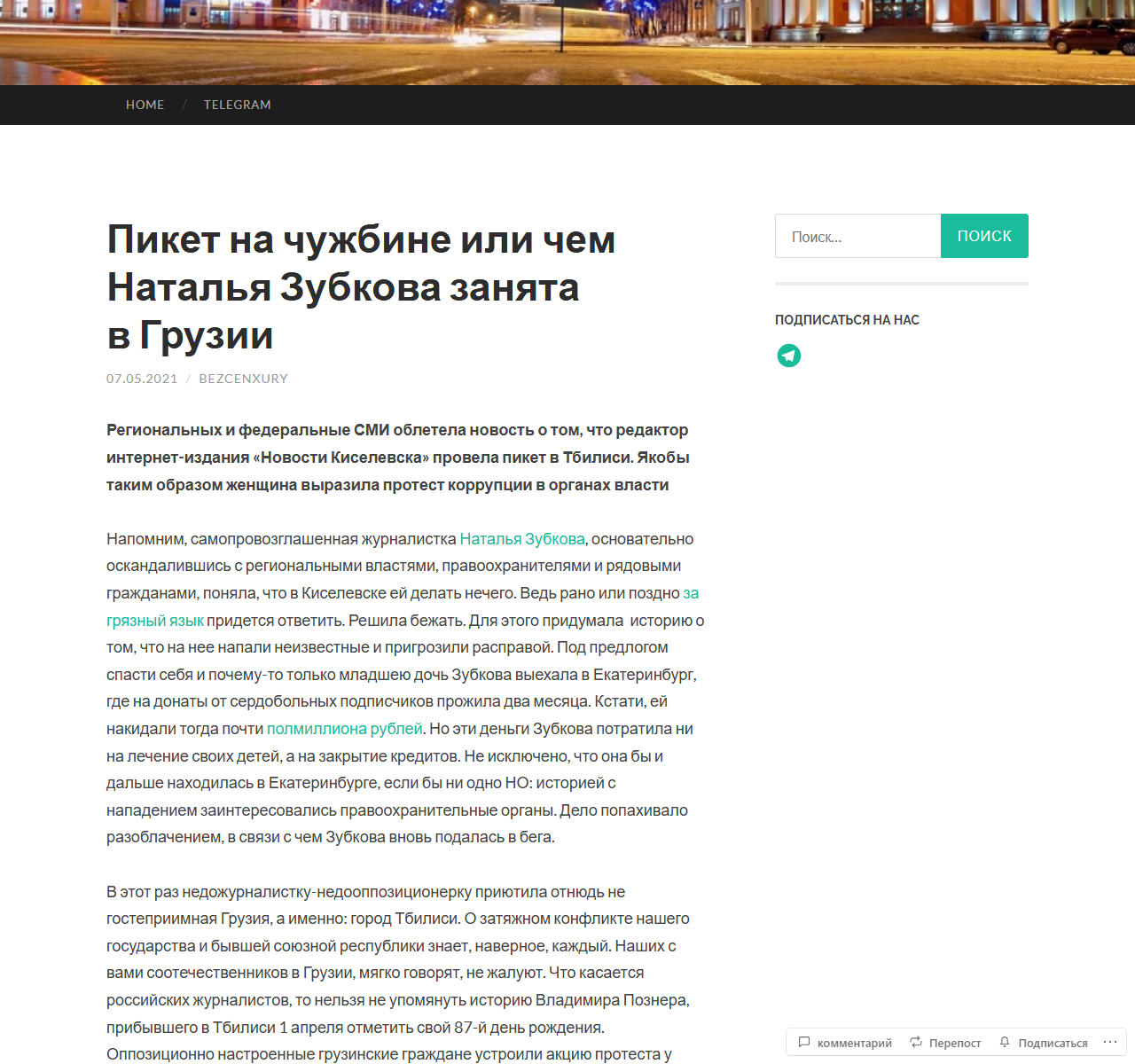
Original headline: Пикет на чужбине или чем Наталья Зубкова занята в Грузии
English:A Picket Abroad, or What Natalia Zubkova Is Doing in Georgia
After my departure, my public actions in Georgia continued to be placed in the established frames of money, flight and personal unreliability.
The last WordPress publication found in the corpus in which my name is either the principal subject or a substantial independent section is dated 15 April 2022. In parallel, materials and links spread through LiveJournal, Blogger, VK and Telegram. Some Telegram content has been lost: records of how the links circulated survive, but the content of the messages does not.
The archive first records the KuZbass Zoo channel in December 2021. For around five months, it existed alongside WordPress, so I do not describe it as a simple replacement for the old website. But the two collections contain repeated images and links, similar nicknames and familiar frames. This is an observable continuity of themes, not proof of a single operator.
Chakvi and Tikhoye Mesto
What I did
In Chakvi, my friends and I created the Tikhoye Mesto (‘Quiet Place’) shelter. It officially began operating on 1 November 2022. We helped people left without a home after the outbreak of the war and tried to create a place where someone could recover and decide what to do next. The shelter is still operating. I remain its director.
Open the Tikhoye Mesto website ↗
What was written
On 19 March 2024, KuZbass Zoo wrote that I had supposedly abandoned the shelter, had been ‘kicked out’ of Georgia, and was still collecting money for a project that no longer existed. Drugs, conflicts with neighbours, LGBTQ themes and crude sexualised language were added to the story.
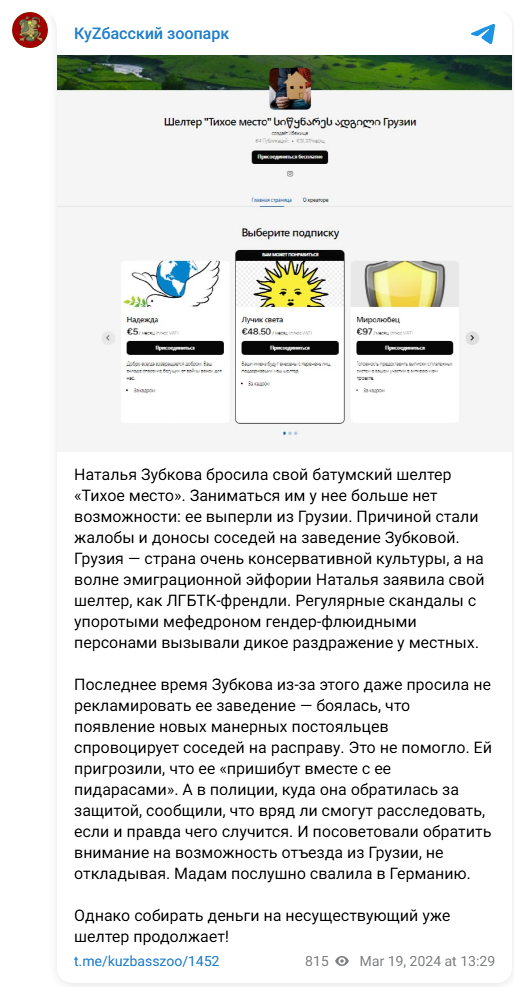
A Post About the Tikhoye Mesto Shelter
An operating project is presented as abandoned and non-existent; established lines of discrediting are attached to the new subject.
What is happening now
Black Snow
What I did
Alina Simone worked in Kuzbass, and I helped her on the ground. That work led to the film Black Snow.
What was written
On 21 March 2024, the same channel called the film a ‘mockumentary’ and associated it with anti-Russian sentiment, foreign money and profit. Alina Simone’s real trip to Kuzbass, my assistance on the ground and the later film were used as the basis for the old frame: foreign interest, money and a struggle against Russia.
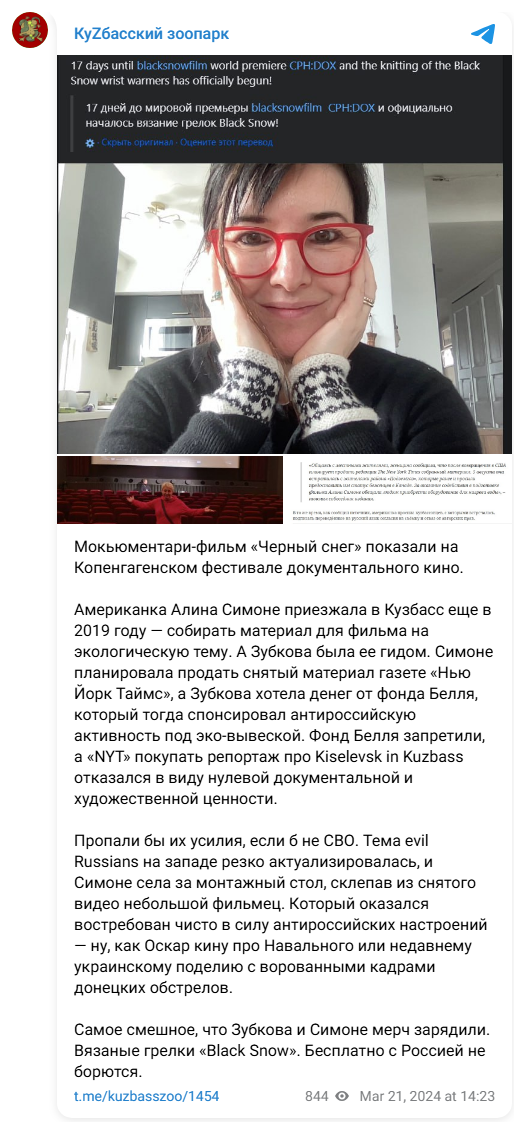
A Post About the Film Black Snow
A new international film is placed within the old frame of foreign interests and profit; the event’s factual basis remains while its meaning is replaced.
What happened
Germany: safety outside and the expectation of danger within
Then, I felt almost entirely alone: without a large newsroom, money for a good lawyer or a sense that there was anybody I could approach for protection. The external reality has now changed.
Germany gave us protection. If I had not been granted a humanitarian visa, I do not know what would have happened to me and my family. A different reality now surrounds me: I have a home, work, my daughter beside me, the opportunity to conduct research, direct the shelter, participate in making a film and make plans.
Rationally, I understand that I am in a much safer environment and that the situation I experienced in Kiselevsk is unlikely to repeat itself here. But knowing that has not made the fear disappear.
Sometimes I still expect a blow from behind: a new message, an unexpected accusation, another publication, some new attack appearing out of nowhere. Sometimes a letter, an unknown telephone number or a link sent by somebody is enough to bring back the familiar expectation: what has happened now?
A safe life surrounds me today. But inside me there is still a person who lived too long awaiting the next blow. External safety returned faster than my internal sense of safety. Fear does not always obey what the rational mind understands.
The result is strange: I left Russia physically long before I was able to begin leaving it behind in my mind.
This is not a medical conclusion or a claim that all danger in Germany is objectively impossible. It is my testimony about my own state: the external environment has changed, while the habit of expecting a threat sometimes returns.
I can go for a very long time without reading these outlets at all. I can consciously avoid them, work and devote myself to the film, the shelter and new projects. But the information returns through other people: somebody sends a link, tells me that something has been written about me again, or reports that a new action has already become the subject of a publication.
That is why I continue to feel that my public life is being watched. I am describing my experience and perception of threat, not proven round-the-clock technical surveillance. I do not know how the author of each item obtains information.
Think that is the end? No.
On 14 September 2026, KuZbass Zoo published a new post — this time about the creation of this website and my research. The new site was again explained through supposed grants and NGO money; the environmental subject through advice to write about whatever was more profitable; and alcohol, foreign influence and ‘smearing the Motherland with dirt’ were once again attached to the text.
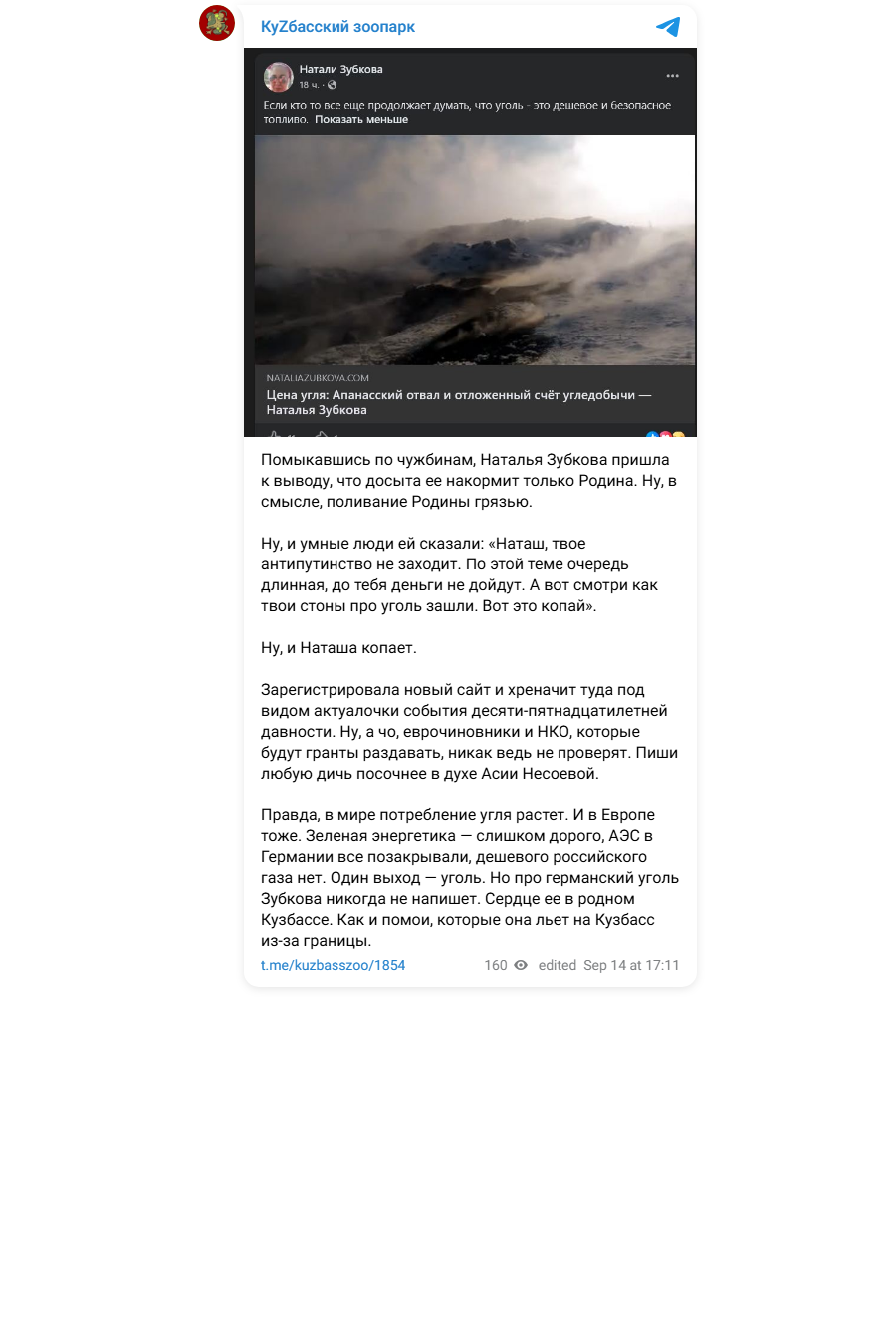
A Post About the New Website and Research
Even the creation of a website where I assemble documents and study how reality had been recast over many years was placed within the established frame of foreign money, greed, alcohol and hostility towards Russia. This does not prove a single author or common plan, but it shows the continuation of the same publishing logic.
The result was almost a closed loop: I created a website to show how my work had been turned for years into somebody else’s public biography — and the appearance of the website itself became an occasion to reproduce that biography once more.
14
How a real event became a different public narrative
The complete WordPress archive contains 644 posts. Researchers reviewed 101 items found through my name. Sixty entered the core corpus: I was the central subject in 42, while another 18 contained a substantial independent section about me. A further 41 passing references remained outside the core corpus.
These figures do not prove that a single actor was behind the entire corpus or that there was a unified command centre. They demonstrate duration and recurrence: for more than two years, my identity was a persistent editorial subject on one platform, and familiar narratives later continued on Telegram.
A school, a flat, pollution, a maternity hospital, a threat or a document.
The journalist, rather than the subject of the inquiry, becomes the centre.
Money, relationships, alcohol, mental health or a desire for attention.
A person’s past is used instead of checking what they report.
A narrow conclusion on paper becomes a general verdict on a person.
An old allegation migrates into a new story and appears already established.
If I worked on the school, readers were reminded of my family and mental health. If the subject was Loginova, sexual motives and the civil case I had lost appeared. If I was threatened, my supposed need for attention was discussed. If I left, a real flight was turned into evidence of fabrication. If I created a shelter, it was declared abandoned. If a film was released, foreign money appeared again.
Different events thus produced a single cumulative image. It had a convenient feature: it explained every new fact in advance. I no longer needed to do anything in particular. It was enough for me to appear in a new story, and the earlier characterisations came into play automatically.
15
What the study established — and what it did not prove
Established
- the existence and content of the publications examined;
- 644 preserved WordPress posts and 101 items found through my name;
- 60 publications in the core corpus and the persistent recurrence of the same frames;
- specific routes by which certain texts, links and images moved between platforms;
- the use of real events, official documents and personal information;
- the continuation of publications after I left Russia.
Not established
- a single actor behind the entire corpus;
- one common operator of all the platforms and accounts;
- proven transmission of my correspondence from the police to the editorial outlet;
- the origin of every non-public document;
- the author of some threats or the existence of the group named in the messages;
- direct causation between every publication and the actions of third parties.
These boundaries do not negate what has been established. They prevent a stronger conclusion than the material permits. I have not proved a conspiracy or uncovered a single network. But the absence of an answer about who commissioned the publications does not erase the content of dozens of publications, the sequence in which they appeared, or the way a real problem repeatedly gave way to my identity.
Research documents
Full version and archive of primary publications
This web article presents the central mechanism and key scenes. The complete chronology, documents, methodology, tables and evidentiary limitations are preserved separately. The archive of primary publications is not merged with the study and remains an independent Russian-language corpus.
Conclusion
Why I am telling this story at all
I am telling this story not only because it happened to me, and not only because I need to speak about it.
Over several years, an unusually large body of material accumulated around one person: publications, photographs, documents, correspondence, threats, official decisions, recordings of conversations and my own chronology of what happened. I therefore want to leave this archive as more than a personal testimony.
It allows three things to be placed side by side: what happened then; the public image created from those events; and what remains inside me now, although my external life has become much safer.
This material may be useful to psychologists, psychotherapists and specialists in the effects of prolonged stress; sociologists and political scientists; researchers of propaganda, disinformation and media; researchers of information influence and manipulation; and human-rights defenders and journalists seeking ways to protect people in similar situations.
I would like someone to examine this story professionally and ask questions I cannot answer myself:
- How does prolonged discrediting change a person?
- Why can a sense of danger persist even after the external environment has become safer?
- How do propaganda and disinformation enter close personal relationships from the public sphere?
- Why does a claim repeated many times begin to be perceived by those around us as an established fact?
- What helps a person protect themselves while it is happening?
- And what can be done afterwards, when the immediate danger has diminished but its effects continue to live inside?
I do not know the answers to all these questions. This material does not claim that my experience, by itself, constitutes scientific proof; it does not diagnose me or assert a single cause for everything I feel. But I have a corpus through which these questions can be studied: primary publications, documents, my own chronology of what happened and the effects I notice in myself.
This study does not ask readers to take my word for it instead of checking the evidence. It places my story, the primary publications and the documents side by side, so readers can see how one was turned into the other.
This is what happened to me. Here are the materials. I do not want them to remain only my private pain. If something can be learned from them, and if they can later help somebody, study them.
If this story helps specialists recognise harm earlier, devise ways of countering such mechanisms or support people who have already lived through them, then publishing it was necessary for more than just me.
If you study processes like these
I am publishing this story as more than an account of the past.
I continue to work with a doctor on the effects of that period. Some things that may appear ordinary from the outside still provoke a strong reaction in me. For example, I sometimes find it difficult to open official letters. If a tall, heavily built man near me begins shouting loudly, I can again feel intense anxiety. I connect this with my past experience, but I do not try to diagnose myself.
It is important to me to understand not only what happened to me then, but also what an experience like this leaves behind.
I am therefore speaking particularly to psychologists, psychotherapists, sociologists, political scientists, and researchers of propaganda, disinformation, information pressure and traumatic experience.
An open publication cannot tell everything. Behind every episode presented here are further memories, documents, context and details.
If you study mechanisms like these and believe this material could be useful for research, you can contact me.
I am willing to describe my experience in greater detail, clarify the chronology and, where possible, show additional material.
I would like this story to help answer not only how propaganda and disinformation affect a person, but also more practical questions:
- how to protect oneself while it is happening;
- how to recognise the consequences;
- how to reduce the harm caused;
- how to help a person feel safe again after the external threat has diminished.