Update · · Natalia Zubkova
I Wanted to Hand Over a Sheet of Questions
The article below was prepared on October 28, 2026, before the picket.
In my own words. 28 October 2026
What the documents show
Uniper is a German energy company and coal buyer. Bettercoal is a supplier-assessment programme created by buyers. In September 2019, Uniper representatives visited Kiselyovsk with a Bettercoal delegation and saw mining taking place beside people’s homes. [1]
Earlier, Bettercoal assessors had visited Listvyazhnaya and other Russian operations. Producers agreed improvement plans. In subsequent years, regulators and courts recorded violations at those same operations. What did buyers learn about these violations, and what decisions did they make? [20, 21, 34, 37, 40]
Kiselyovsk: what Uniper saw
In May 2020, Uniper described a short visit to Kiselyovsk in September 2019. Company representatives saw how close to homes coal was being mined. Uniper discussed residents’ resettlement and land rehabilitation. One proposal was to make new mining permits conditional on rehabilitating abandoned sites. According to Uniper, the most severe harm observed by the delegation involved operations with which neither the company nor Bettercoal worked directly. [1]

Uniper, The dilemma of investing in social and environmental remediation activities, May 2020. Excerpt from an HTML copy as displayed in a browser; the complete archived page was saved on 18 June 2020 at 23:01:43 UTC. The snapshot date is not the publication date. Highlighting added by the editors.
Highlighted passage: ‘Even if we stayed there for a very short time, it was sufficient to recognize how close to houses the mining operations are.’
Open full-size image ↗ · On narrow screens, the excerpt can be scrolled horizontally.
Before the highlighted sentence, Uniper identifies the place and time: Kiselyovsk, September 2019, a Bettercoal mission. The company also refers to information from Ecodefense. This is the coal buyer’s own account of what its representatives saw beside residential homes. [1]
Where the article has been preserved
Uniper published this article in May 2020 on cr.uniper.energy. When checked on 28 October 2026, the old address did not open. A later address in the Sustainability section redirected to Uniper’s home page. The full text has been preserved in the Internet Archive: a copy dated 18 June 2020 is available. [1, 82]
TDI’s assignment
The February 2020 review was commissioned by Bettercoal’s Russia Working Group, established in December 2018. Its members were ENEL, ENGIE, ESB, Fortum, RWE, Uniper and Vattenfall. The work was carried out by the consultancy TDI Sustainability. It examined Russian- and English-language publications and drew on the experience of three previous assessments and material from a week-long mission to Moscow and Kuzbass in September 2019. The review’s purpose was to compare positions and identify areas for action. [2, PDF 2–3]
TDI recommended that the working group help producers establish dialogue and grievance handling for residents, comply with safety requirements and investigate accidents transparently. TDI urged the authorities to ensure that residents could speak out without intimidation. These recommendations are published on Uniper’s website. Which were implemented, at which operations, and with what results for residents? [2, PDF 6–7]
Uniper itself reported two virtual working-group conferences in 2020 and two in 2021. [4, 5]
My archive contains a cadastral engineer’s report dated 3 July 2019. On 26 April 2019, the engineer inspected a residential house and the nearest waste-rock dump. The measured distance from the nearest foot of the dump to the footprint of the house inspected was 461.98 metres. This is the distance to the specific house inspected, not to my flat. [80]

Bettercoal: buyers created their own assessment system
Bettercoal organises assessments of how coal suppliers meet requirements concerning safety, environmental protection and people’s rights. It sets requirements, organises assessments of operations and monitors improvement plans. Buyers receive information to inform their purchasing decisions. For people living beside underground and open-pit mines, the central question is different: what changes on the ground after these assessments?

Bettercoal, About Bettercoal, Theory of Change section. Excerpt from the website, captured on October 29, 2026. Underlining added by the editors.
In this paragraph, Bettercoal describes an aim of its work: to improve practices in the supply chain and reward those changes with additional business from member companies. The organization explicitly links improvements by producers to a commercial incentive.
The initiative’s launch was announced on 18 April 2012. The original announcement named seven founding members: DONG Energy, EDF, Enel, E.ON, GDF SUEZ, RWE and Vattenfall. Fortum was named as the first company to join. The first Board Chair was Joachim Löchte. The founders explicitly acknowledged the harm that mining can cause workers and neighbouring communities, and the need for common buyer requirements for suppliers. They were supported in establishing the initiative by BSR, a business network and sustainability consultancy. [66, PDF 1–2]
This explains the programme’s structure: the assessment system was proposed by coal consumers who needed information about supply-chain risks. They promised regular assessments by external specialists and the sharing of results among members. In the original statement, benefits for workers and local communities stood alongside business interests and environmental protection. [66, PDF 1]
One legal entity, two names
The organisation was incorporated in the British register on 28 February 2012 under company number 07968009. It is a private company without share capital. Its members’ liability is limited to a guaranteed contribution in the event of winding up. Its original name was Bettercoal; since 22 November 2023, it has been Responsible Commodities Sourcing Initiative Ltd, or RECOSI. The registration number has remained unchanged. Bettercoal now operates as RECOSI’s coal programme, alongside its gas programme. [55]
The registered office listed in the register is 79 Tonbridge Road, Hildenborough, Tonbridge, England, TN11 9BH. RECOSI gives a different contact address: 71–75 Shelton Street, Covent Garden, London, WC2H 9JQ. [55] [14]
Who runs the organisation
At the time of the Russian assessments, day-to-day work was handled by a secretariat led by the Executive Director, while strategy was the responsibility of the Board of Directors. Anne-Claire Howard was Executive Director in 2018–2020; Katie Warrick was appointed in February 2021. Frank Plümacher of Uniper became Board Chair in 2019. These are different roles: the Executive Director organises the work; the Chair leads the Board. [17, 18]
The financial statements for 2021 list eight companies represented on the Board: Enel, Fortum, Ørsted, JERA Global Markets, Onyx Power, RWE, Uniper and Vattenfall; another seat was held by the Executive Director. At the time, the organisation had 12 members and two associate members in total. The composition shows where control was centred: with the buying companies. [74, PDF 6]
The Technical Advisory Committee included representatives of civil-society organisations, academia, mining companies and Bettercoal members. It reviewed the quality of the rules and methods. According to the 2021 report, the Members’ Committee also reviewed progress on plans and measures to address failures to meet commitments. In October that year, members approved governance changes, and in December the Board approved changes to the assessment system. [56, PDF 12–13]
Fund the organisation, elect the Board and use the results in purchasing decisions.
The Board sets strategy; the secretariat manages the programme, assessments and the handling of submissions.
Inspect sites and documents, identify findings and verify improvements.
Provide access and information, agree an improvement plan and implement it.
Experts, trade unions, civil society and business participate in reviewing methods.
Report on living and working conditions, take part in interviews and submit complaints.
Today, RECOSI members elect a Board of 11 directors. It is chaired by Gerda Frans of ENGIE, with Taco Douma of RWE as Vice-Chair. Uniper is represented by Nadja Wendler. The technical committee includes, among others, Glen Mpufane of the global union federation IndustriALL, Luis Fernando de Angulo of CREER, Luke Danielson of the Sustainable Development Strategies Group, and TDi Sustainability’s head Assheton Carter. Experts and trade unions participate in the technical committee. Strategic decisions are made by the Board of Directors. [14]
Who pays for assessments, and what the accounts reveal
Member companies and associate members funded Bettercoal through annual fees. In its 2021 report, the organisation specifically noted a transition to a model under which producers pay for site assessments. There were no site visits that year because of COVID-19. In the report, assessment costs are grouped in a single item with plan monitoring, online-platform development and standards development. [56, PDF 22]
| Expense item, 2021 | Pounds sterling |
|---|---|
| Secretariat, including country-group activities | 395 000 |
| Assessments, plan monitoring, online platform and standard | 143 000 |
| Internal governance | 19 000 |
| Communications | 14 000 |
| Total of the four published items — calculated from the report | 571 000 |
The figures come from Bettercoal’s annual report, printed pp. 42–43 / PDF p. 22. Secretariat expenditure included staff salaries — equivalent to three full-time posts — office and organisational costs, and the work of the Russia and Colombia groups. How much did the Russian assessments cost, and who paid for them? I put this question to Bettercoal. [56, PDF 22]
Financial statements filed with the British register for 2017–2022 show the organisation’s assets and liabilities at each year-end. In all six sets, the organisation used section 444 of the UK Companies Act to file accounts without an Income Statement. The table below shows year-end balances; annual expenditure is set out above.
| Year | Cash at bank, £ | Total assets less current liabilities, £ | Document |
|---|---|---|---|
| 2017 | 334 450 | 231 696 | [70, PDF 4] |
| 2018 | 489 895 | 228 144 | [71, PDF 4] |
| 2019 | 338 480 | 310 078 | [72, PDF 4] |
| 2020 | 247 423 | 241 092 | [73, PDF 4] |
| 2021 | 223 482 | 172 103 | [74, PDF 4] |
| 2022 | 295 022 | 236 094 | [75, PDF 4] |
RECOSI’s 2024 report describes the payment model explicitly: members fund the organisation’s work, producers pay for their site assessments, and RECOSI pays the third-party assessors. In 2024, expenditure on RECOSI’s secretariat and other operating costs was £476,905, while the coal programme accounted for £83,127. In 2024, RECOSI worked with two commodities — coal and gas. [60, PDF 11]
Under the assessor-selection procedure in effect since October 2025, the technical component accounts for 70% of the final score when selecting a proposal, and the commercial component for 30%. A producer may reject the appointed assessor where there is a substantiated conflict of interest. Payments are made in stages against agreed deliverables. Who selected the teams for the Russian site visits, agreed the price and determined the scope of work? Which contracts and rules governed those decisions? [64, PDF 7–9]
What the Code promised — and how assessments were conducted
The first Bettercoal Code was approved in 2013. KRU’s site visits in November 2015 and May 2017 took place before version 1.1 was approved. The Board approved that version on 28 June 2017; it took effect upon publication. The foreword on the assessment procedure was updated in 2018. Version 1.1 applied to the assessments of SDS in November 2017, SUEK in May 2018 and Taldinskaya Mining Company in November 2018. Bettercoal introduced Code 2.0 in March 2021. These are different editions: requirements in a later document cannot be applied retrospectively to an earlier site visit. [53, PDF 7; 56, PDF 7; 65, PDF 5]
Version 1.1 set out specific duties. Provision 1.1 required compliance with the law; 6.9 required safety measures, including methane control and worker protection. Provisions 9.2 and 9.3 addressed waste, water, emissions and coal dust; 7.1 addressed residents’ participation and resettlement; and 5.2 addressed Indigenous peoples’ rights. Provision 2.2 provided for protected reporting of violations and accessible complaints, including anonymous complaints. [53, PDF 12, 14, 17, 22–25, 28–29]
The joining procedure also changed. KRU’s report explicitly states that the Letter of Commitment became mandatory following the 2017 revision of the procedure. KRU signed it in November 2017, after the 2015 and May 2017 site visits. The sequence ‘letter first, site visit second’ therefore describes the updated procedure, rather than the programme’s entire history. [43, PDF 5] Under that procedure, a producer signed the letter and completed a questionnaire. The assessor reviewed documents, drew up a visit plan, inspected selected sites and interviewed staff and external stakeholders. Following the report, the parties agreed a Continuous Improvement Plan (CIP). The producer then submitted information on implementation. According to Uniper’s 2019 report, these Russian producers were reporting on their improvement plans at least twice a year. [3, PDF 63]
An assessment could cover a group of operations even though specialists visited only some of the sites. This is evident in the reports on Kuzbassrazrezugol (KRU), Siberian Coal Energy Company (SUEK) and the SDS-Ugol holding company. The summaries list the sites visited. Which findings related to each of them, and how was their resolution verified? [43, PDF 5] [44, PDF 5–6] [20, PDF 4–7]
Assessments described strengths and the improvements required. Immediate Resolutions — issues requiring priority action — were identified separately. A statement that none were identified relates to the findings and scope of a particular assessment. CIP items could still remain open. Later producer profiles showed three statuses. The first meant completed and verified by the assessor. The second meant that the producer had reported completion, with verification pending. The third meant that the item remained open. [43, PDF 9] [11]
Who selects interviewees
The SDS public report lists the organisations and settlements whose representatives were interviewed: regulatory bodies, Ecodefense, the Centre for Support of Indigenous Peoples of the North, the Revival of Kazas movement, and residents of Ananyino, Apanas and Kostenkovo. It mentions a meeting with the local authorities and residents of Kostenkovo. Who selected and invited the interviewees? Could residents speak to assessors privately, without the company or local administration present? [20, PDF 5]
The current assessment guidance, in effect since January 2024, instructs the assessor to draw up a list of key stakeholders for each site. The assessor must review documents and observe operations. The guidance also provides for confidential worker interviews and rules for selecting interviewees. A worker’s identity may be disclosed with their consent. What confidentiality safeguards applied during the Russian site visits, and who monitored compliance with them? [61, PDF 19–21, 26]
What buyers received
In its 2019 report, Uniper states that it uses Bettercoal assessments to evaluate environmental, social and governance risks and monitor its supply chain. Another page of the same report describes regular updates from Russian producers on improvement plans. What reports of violations were received between site visits? How did the operations respond, how were improvements verified, and what changes did buyers make to their decisions? [3, PDF 54, 63]
At the end of 2021, Bettercoal changed the procedure for obtaining Bettercoal Producer status. Previously, a Letter of Commitment had been sufficient. Under the new rules, a site assessment and an agreed improvement plan were required. The reassessment cycle changed from three–five years to four years. The KTK and TalTEK profiles record an early stage of participation. [56, PDF 12] [46] [47]
After Code 2.0 was introduced, which edition was used to check implementation of the previously agreed Russian plans? I ask Bettercoal to provide the transition rules applied to each producer and the corresponding checklists.
KRU: the open-pit mines visited, more than 200 violations and a waste dispute
At KRU’s operations, assessors visited the Krasnobrodsky open-pit mine in November 2015, and the Bachatsky and Taldinsky open-pit mines in May 2017. The report covered six open-pit mines in total. The assessment was conducted by James McNally and Yelena Borovikova of the consultancy SLR. [43, PDF 5]
The Bettercoal summary noted resource-efficiency and land-rehabilitation programmes. The assessors also described a problem in engagement with residents. Contact details were missing from the stakeholder list — the list of people and organisations affected by, or interested in, the company’s activities. The company also did not assess how to improve communication with each stakeholder. The environmental and social section of the annual report was brief. The summary’s authors reported that the company complied with Russian legislation. At the same time, they considered that the company had not sufficiently examined international requirements. [43, PDF 9–10]
On 14 May 2019, Vesti Promyshlennoy Bezopasnosti published a Rostekhnadzor press-service statement about an inspection of KRU. Inspectors examined 70 hazardous industrial facilities at six coal branches and the separate Salair Mining Production structural unit. They identified more than 200 violations. Operations and loading and unloading work at transfer point No. 2 of open-pit mine No. 5 at the Bachatsky Coal Mine branch were suspended for one month. Mining and drilling work along the roof of the Moshchny seam at open-pit mine No. 7 of the Krasnobrodsky Coal Mine branch was suspended for three months. According to the regulator, the company and 142 officials were held administratively liable. [34]
Another case concerned the Vakhrushevsky field of the Krasnobrodsky open-pit mine. Rosprirodnadzor, the regulator responsible for environmental compliance, required the company to account for coal-processing waste and recalculate environmental impact charges for 2013–2015. In 2018, the agency checked compliance with the previous year’s orders. In September, it issued new orders. KRU objected: in the company’s view, the slurry — a mixture of water and solid particles — remained part of the production process. Complying with the regulator’s requirements would have required changes to the project design and the water- and slurry-handling system. On 20 November 2019, the court of cassation upheld the orders. KRU lost the dispute. [35]
In another case, the court overturned an inspector’s decision dated 13 May 2019 and terminated the proceedings. The case concerned the operation of gas-cleaning equipment at the Bachatsky open-pit mine. [36]
When monitoring KRU’s plan implementation, how did Bettercoal take into account the work suspensions at sites it had visited and the court dispute over waste? Which plan items were changed, what implementation documents were received, and what were buyers told?
SUEK: hazardous coal dust, air pollution and noise
SUEK’s site assessment took place in May 2018, and the plan was agreed in March 2019. The assessment covered operations in several Russian regions. In Kuzbass, assessors visited the Taldinskaya-Zapadnaya-1 and Taldinskaya-Zapadnaya-2 mines, the mines named after V. D. Yalevsky and A. D. Ruban, and the Zarechny open-pit mine. The assessors were Paul Mitchell, Julija Menise and Tatiana Vasenko. [44, PDF 5–6]
The public report noted management practices shared across the operations and water treatment. Improvements were required in earlier mine-closure planning, business-partner screening and the conservation of biodiversity — local plant and animal species. [44, PDF 9]
On 13 February 2020, Rostekhnadzor inspected the Ruban mine. Inspectors found hazardous accumulations of coal dust, defective support systems and breaches of explosion-protection requirements for electrical equipment. They temporarily prohibited development of assembly roadway No. 816 — a preparatory mine working — and cargo transport along haulage roadway No. 818. The case materials were referred to court. [37]
A court also heard a case against SUEK-Kuzbass concerning air pollution and noise near homes in Leninsk-Kuznetsky. The court found that the average daily maximum permissible concentration of nitrogen dioxide in a residential area had been exceeded by a factor of 2.7, and the permissible maximum night-time noise level in a bedroom by 1.3 dBA. The case concerned the impact of the operation’s haul road. The company challenged the measurement conditions and the conclusions about the source. On 17 June 2019, Kemerovo Regional Court heard an appeal against the Leninsk-Kuznetsky City Court decision of 15 April and upheld a fine of 10,000 roubles. The court excluded some roadside measurements; its finding relied on results from the residential area. [38]
One incident concerns worker safety at the Ruban mine; the other concerns air and noise near a haul road. How did Bettercoal respond to each incident? Were the violations included in the plan, who verified the improvements, and what response did residents receive?
SDS: a ‘positive conclusion’ and improvements still outstanding
In November 2017, assessors visited three SDS-Ugol operations: the Vostochny open-pit mine of JSC Salek in Kiselyovsk, Chernigovets, and LLC Listvyazhnaya Mine. They also visited the holding company’s head office. The public report lists a wider group scope as well. [20, PDF 4–5]
On 20 March 2018, the Rudmet portal published an article based on SDS-Ugol material. It described the assessment result as having ‘received a positive conclusion of compliance with the Bettercoal Code’. The same article listed what still needed improvement: continuous environmental monitoring, monitoring of groundwater and fine coal dust, and the maintenance of passageways and exits in underground workings. The plan was to be prepared in the second quarter of 2018. According to Bettercoal’s report, it was agreed in May. [48] [20, PDF 5]
Page 6 of Bettercoal’s public report provides a more detailed picture. Provision 2.2 — protected reporting of violations and grievance handling — was rated Misses. Provision 6.9 — occupational health and safety — was rated Partially Meets. These are the assessment results for the SDS-Ugol group. I ask for the full report and improvement plan, identifying which findings relate to each mine. [20, PDF 6; 53, PDF 14, 22]
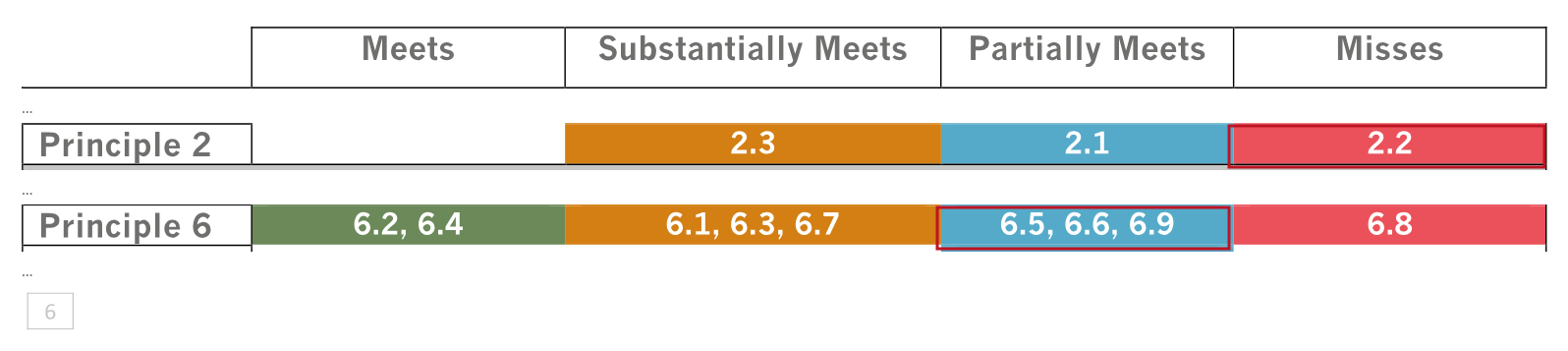
Bettercoal, public report on SDS-Ugol dated 9 January 2019, PDF p. 6. The column headings and the rows for principles 2 and 6 have been retained. An ellipsis separates the excerpts. Highlighting added by the editors.
Headings: Meets; Substantially Meets; Partially Meets; Misses. The ratings for provisions 2.2 and 6.9 are highlighted. The numbering and meaning of the provisions are set out in the Code.
Enlarge · Excerpt without highlighting · Full original, page 6
The key on page 10 explains that Misses means that the necessary practices have not yet begun to be implemented, or that a systemic failure has resulted in complete non-compliance with the Code. Partially Meets means that implementation has begun but remains at an early stage and is incomplete. At the same time, page 6 records the absence of Immediate Resolutions — actions given first priority in addressing identified issues. This is a different category: the Misses and Partially Meets ratings remain in the table. [20, PDF 6, 10]
What specific problems lay behind these ratings? When were they resolved? Who verified their resolution, and which documents confirm it? I ask Bettercoal to provide the assessors’ findings, the corresponding plan items and the documents verifying their implementation for each site.
Bettercoal’s report itself describes specific good practices: backfilling worked-out areas at Vostochny and Chernigovets, using nitrogen to prevent spontaneous combustion, and electrical blasting at certain sites. Assessors observed a blast at Chernigovets from a distance of approximately 400 metres. According to their description, dust, noise and vibration were low. [20, PDF 7–8]
A separate site — the Yuzhnaya mine
On 12 February 2018, Kemerovo District Court suspended development of a transport working in the Vladimirovsky-II seam at JSC Chernigovets’ Yuzhnaya mine for ten days. The ruling lists hazardous dust deposits, an insufficient proportion of inert dust, breaches concerning support systems, the water curtain and monitoring; during a methane-alarm test, the audible and visual signals failed to activate. The company’s representative admitted the violations and requested time to remedy them. [39]
Yuzhnaya was within the group assessment’s scope, but does not appear in the list of sites visited. How did Bettercoal take the violations identified there into account when assessing and monitoring SDS?
Listvyazhnaya: what the Bettercoal report said
The report dated 9 January 2019 identifies the participant as JSC HC SDS-Ugol. Listvyazhnaya is included both in the overall scope and in the list of sites visited. Following the assessment against the Bettercoal Code, the parties agreed an improvement plan. The full report is described as confidential and available to Bettercoal members; the public document is its summary. [20, PDF 1, 4–5, 9]
The summary states that the assessors did not identify issues in the Immediate Resolutions category requiring priority action. The document lists areas for improvement. A reassessment was scheduled for November 2022. [20, PDF 5–7]

One mine, different documents
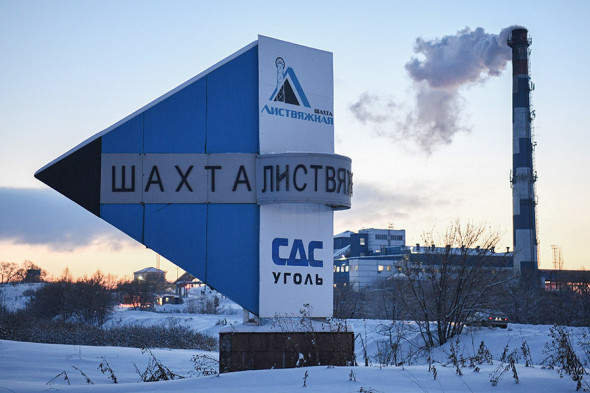
The mine is operated by LLC Shakhta Listvyazhnaya, a subsidiary of the SDS-Ugol holding company. This relationship is explicitly stated in the Prosecutor General’s Office announcement of 25 March 2025. According to the prosecution, the court found that, from July to November 2021, Mikhail Fedyaev, Gennady Alekseev and Anton Yakutov deliberately failed to take the measures needed to bring the mine into compliance with industrial safety requirements. Fedyaev is identified as the group’s Board Chair and a shareholder, Alekseev as its Chief Executive Officer and a Board member, and Yakutov as Technical Director. [21]
An explosion occurred on 25 November 2021. 51 people died: 46 miners and five mine rescuers. Fedyaev received a suspended sentence of three years and six months, Alekseev a prison sentence of five years and three months, and Yakutov a prison sentence of five years. Citing the courts’ press centre, Interfax reported that this judgment became final on 17 April 2025; no appeals were lodged. [21, 22, 23]
The defence disputed causation and the extent of the defendants’ managerial duties; the defendants denied guilt. The Prosecutor General’s Office set out the substance of the judgment, and the courts’ press centre reported that it had become final. [21, 22, 23]
What Bettercoal did after the disaster
On 26 November 2021, Bettercoal expressed condolences, reported that it was in contact with SDS-Ugol and stated its intention to continue engagement to establish the causes and the preventive measures required. [24]
The SDS-Ugol page for July 2022 lists 49 plan items: 16 improvements verified, 11 completed and awaiting site verification, and 22 still open. The plan covers the SDS-Ugol group. Bettercoal reports that engagement with Russian producers has been suspended since April 2022. [11, 12]
Bettercoal’s 2021 annual report provides another detail: in December, after the disaster, the organisation held a webinar with independent lead assessors on the status of all Russian producers’ plans. Its stated purpose was to help buyers understand specific risks and improvements. What information about Listvyazhnaya was discussed at the webinar, and what decisions followed? I ask Bettercoal to provide the materials from that discussion. [56, PDF 20]
Listvyazhnaya and Bettercoal: events and dates
Event dates and the dates on which information was published are shown separately.
- November 2017
Site assessment
The report names Listvyazhnaya among the sites visited.
When reported: The report was published on 9 January 2019. [20, PDF 4–5]
- May 2018
Improvement plan
Bettercoal and SDS-Ugol agreed the CIP.
When reported: This is reported in the same document dated 9 January 2019. [20, PDF 5]
- July–November 2021
Executives’ failure to act
The court later established that three executives had failed to act on mine safety.
When reported: The prosecution’s announcement about the judgment was published on 25 March 2025. [21]
- 25 November 2021
- 26 November 2021
Bettercoal’s response
Condolences, contact with SDS-Ugol and a promise of further engagement.
When reported: The statement was published the day after the disaster. [24]
- 28 April 2022
Suspension of engagement
Bettercoal reports the suspension of engagement with Russian producers.
When reported: The statement is dated 28 April; the web-page heading is dated 3 May 2022. [79]
- 25 March / 17 April 2025
Taldinskaya Mining Company: two mines and a development-work suspension
Specialists from the consultancy The Dragonfly Initiative visited the Taldinskaya-Yuzhnaya and Kyrgayskaya mines in November 2018. The improvement plan was agreed in September 2019. The team members named are Julija Menise, Tatiana Vasenko, Vladimir Simov and Peter Whitbread-Abrutat. [45, PDF 5–6]
The summary listed the improvements needed: use of protective equipment, water provision and hygiene conditions, and storage of oils and chemicals. The company was also required to publish its performance results annually. The assessors separately described anti-corruption work: the economic security unit had identified cases of fraud and corruption and passed the information to the authorities. Another positive example was the legal department’s and occupational safety service’s document-management system, which made it easier to search a large volume of material. [45, PDF 8–9]
On 2 November 2020, Prokopyevsk District Court suspended development of a conveyor roadway at JSC Shakhtoupravleniye Taldinskoye-Yuzhnoye for seven days. The court decision lists hazardous dust accumulations, problems with water sprays and roadway supports, deficiencies in fire-fighting equipment and other violations. This was a subsequent event at one of the two sites visited, after the plan had been agreed. [40]
How did Bettercoal respond to the suspension of development work? What changes were made to the plan, and who verified that the violations had been remedied?
KTK and TalTEK: early-stage participation and work suspensions
Kuzbasskaya Toplivnaya Company and TalTEK were at an early stage of the procedure. Their profiles record KTK’s participation as beginning in January 2020, and TalTEK’s in February 2021. At that stage, the site assessment was still to come. [46] [47]
Following an inspection of KTK’s Karakansky-Yuzhny open-pit mine from 28 January to 17 February 2021, Rostekhnadzor reported 44 violations. Work was being carried out in departure from the project design; the danger zone had not been properly registered and marked, and the safety measures did not correspond to the hazard identified. Following a temporary prohibition, the court suspended work in that zone for 60 days. [41]
From 23 to 28 December 2021, the regulator inspected LLC Razrez TalTEK. Inspectors identified breaches of requirements concerning bench heights and slopes, berm widths — berms are platforms between benches — and work in a danger zone. A temporary prohibition was imposed on 27 December. According to the regulator’s press service, on 30 December the court ordered work in the danger zone suspended for 90 days. [42]
What information about these suspensions did Bettercoal receive? How did it assess these producers’ readiness, and what conditions did it set for the procedure to continue?
What remained outstanding in four producers’ plans
The July 2022 profiles allow a comparison of the status of the plans. By then, engagement with Russian producers had already been suspended. [12]
Improvement plans: status published in July 2022
Number of items. Each bar shows its group’s entire plan.
Verified: 20 · awaiting verification: 23 · open: 15 [10]
Verified: 17 · awaiting verification: 8 · open: 15 [50]
Verified: 16 · awaiting verification: 11 · open: 22 [11]
Verified: 12 · awaiting verification: 12 · open: 39 [51]
The SDS summary relates to the entire group. Which items related to Listvyazhnaya, and which to other operations? I ask Bettercoal to disclose their allocation and verification results by site.
Was there less dust near homes? Did water quality improve? Did resettlement conditions change, and did it become safer to report violations? What results for residents can Bettercoal demonstrate alongside the closed plan items?
Results for 2024
In its 2024 report, RECOSI stated that, since assessments began in 2014, it had assessed more than 70 sites on five continents. Five producers were participating in the coal programme at the end of 2024. As at 31 December 2024, the summary shows 54 closed items, 21 items reported closed and awaiting verification, and 56 open items. The total is 131. These are programme-wide figures for 2024. [60, PDF 14–15]
What changes in occupational safety, air and water lie behind the closed items? Where can residents see measurements and independent verification results?
Code requirements and incidents in Russia
The table below compares the requirements of Code 1.1, approved in June 2017, with subsequent incidents in Russia. KRU’s 2015 and May 2017 assessments took place earlier: here, the question to Bettercoal concerns subsequent monitoring, rather than judging those site visits against the new edition. For monitoring after Code 2.0 was introduced, the transition rules applied need to be clarified. [53]
| Code 1.1 requirement | Incident in Russia | Known response | Question for Bettercoal |
|---|---|---|---|
| 1.1 — law; PDF p. 12 | KRU: waste-related orders, case А27-110/2019 | The court of cassation upheld the orders; the earlier assessment summary had reported legal compliance. | How was the court outcome taken into account in monitoring? |
| 6.9 — safety; PDF pp. 22–24 | Ruban, Yuzhnaya, Taldinskaya-Yuzhnaya: coal-dust explosion protection and other violations | Prohibitions and court-ordered suspensions of specific work, described above. | When were the official records received, and how were improvements verified? |
| 6.9.1 — including methane control; PDF p. 22 | Listvyazhnaya: 2017 site visit; failure to act in July–November 2021, subsequently established by the court | Bettercoal’s statement of 26 November 2021; remote monitoring in 2021. | What was in the mine’s plan, and how was safety checked before the disaster? |
| 9.2–9.3 — waste, effluents, dust; PDF pp. 28–29 | Vakhrushevsky field; findings on dust and water in the SDS statement | Regulatory orders; stated tasks for the future plan. | What measurements and documents provided the basis for closing items? |
| 7.1.3, 7.1.6, 7.1.11 — residents, resettlement, noise; PDF p. 25 | Mining beside homes in Kiselyovsk; the court case concerning SUEK’s road | Uniper described the proximity of mining; the court upheld the penalty for air pollution and noise. | What results did residents themselves see? |
| 2.2 — safe complaints; 5.2 — Indigenous peoples; PDF pp. 14, 17 | Reports of pressure on activists; engagement with communities within the assessment’s scope | TDI included information about intimidation; the SDS report listed civil-society interviewees. | How was the safety of communication ensured, and how were consequences for complainants checked? |
| 2.3, 10.6 — closure and land rehabilitation; PDF pp. 14–15, 32 | Early closure planning and backfilling noted at SDS | Described in the report as good practices. | What time frames, areas and results were verified independently of the company’s statements? |
Sources for each incident are given in the sections on the operations.
Suspension of participation and residents’ complaints
Bettercoal is an assessment and improvement programme. Its rules explicitly exclude certification of a producer’s performance. Participants gain the right to refer to their status within the rules governing use of the name and logo. [63, PDF 2] [54]
Participation has been terminated in practice. On 24 June 2019, Bettercoal announced that Shubarkol Komir no longer held supplier status under the programme. The reason given was an inability to continue the assessment and implement the plan agreed after the November 2017 site visit, owing to internal strategic and economic circumstances. The decision was described as an application of the Policy of Association agreed with the company. [59]
The current policy, dated 23 April 2025, provides for disengagement in cases of missed commitments and deadlines, failure to report, false evidence and inadequate responses to requests about risks. The secretariat may grant an extension where circumstances justify it. When participation ends, it notifies members, removes the company from the website and monitors the discontinuation of use of the status and logo. Commercial purchasing decisions are made by the buyers themselves. [62, PDF 3–6]
For Russian producers, there was a blanket suspension. In its statement of 28 April 2022, Bettercoal attributed this to Russia’s invasion of Ukraine and the associated human rights violations. Assessors were instructed to stop verifying plans; during the suspension, Russian producers lost the right to make claims about their association with Bettercoal. What measures did Bettercoal take before this blanket suspension in response to violations at individual operations? Where are the corresponding decisions published? [79]
Complaints today: access and a five-year limit
The current procedure, dated 19 June 2025, accepts complaints about Bettercoal itself, its staff and assessors, and programme participants. Complaints can be submitted using a form or to info@bettercoal.org, including in the complainant’s own language. Indicative deadlines are ten working days to acknowledge receipt, a further ten to determine admissibility, and a proposed resolution within 60 calendar days of the initial submission. [63, PDF 2–5]
The procedure allows an appeal within 20 working days and provides for involvement of the programme and technical committees and, where necessary, the Board. This is an internal organisational review. A complainant may request anonymity, although the document warns that someone may be identifiable from the circumstances of their story. There is also an important time limit: events more than five years old are deemed inadmissible grounds for a complaint. On the date of this article, 28 October 2026, the five-year cut-off falls on 28 October 2021. Events in November 2021 still fall within five years; events in 2019 are already beyond that limit. How will RECOSI apply the rule to each incident and to ongoing consequences? I request a written admissibility decision identifying the event date and the provision of the procedure applied. [63, PDF 3–6]
What submissions were received from Kiselyovsk residents in 2019? Under which rules were they considered, and what was the outcome? I ask RECOSI to publish information about the submissions and decisions while protecting complainants’ confidentiality. The right to lodge a complaint matters only when people know about it, can use it safely and receive a substantive outcome.
After the visit: purchases and the shareholder vote
The ‘Russia’ category accounted for 35.1% of Uniper’s direct contractual purchases in 2019, 29.9% in 2020 and 22.6% in 2021. In the first two reports, the category includes Latvia. The 2019 figure covers the whole year, including the months before the visit. [3, 4, 5]
The ‘Russia’ category in Uniper’s direct contractual purchases
Category composition in the reports: 2019 and 2020 — Russia and Latvia; 2021 — Russia.
The measure is the share of Uniper’s direct contractual coal purchases in the relevant year, expressed as a percentage.
Sources: Uniper’s 2019 report, printed p. 52 / PDF p. 54; 2020 report, printed p. 73 / PDF p. 74; 2021 report, PDF pp. 46 and 93. [3, 4, 5]
The figures in Uniper’s own reports
The 2020 and 2021 reports show purchases after the visit. The 2019 report contains full-year data. Below are the rows from the original tables used for the chart. [3, 4, 5]
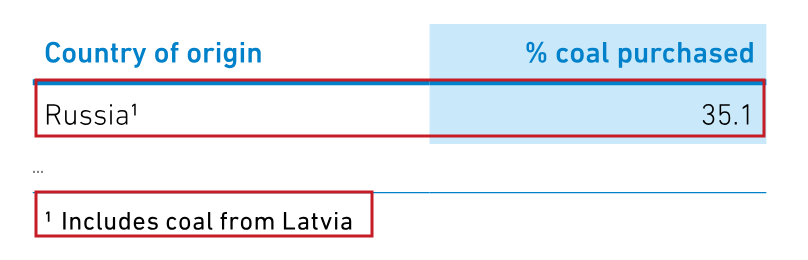
Uniper, Sustainability Report 2019, printed p. 52 / PDF p. 54. Full report. Excerpts from a single table are separated by ‘…’; the remaining rows are available in the original. Highlighting added by the editors.
Highlighted passage: ‘Russia’ — ‘35.1’; footnote 1: ‘Includes coal from Latvia’. The column heading indicates the share of coal purchased as a percentage.
Open full-size image ↗ · On narrow screens, the excerpt can be scrolled horizontally.
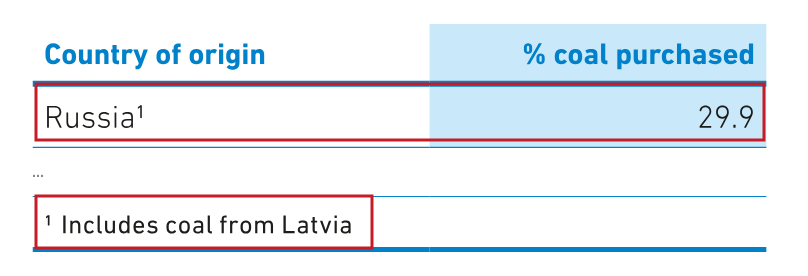
Uniper, Sustainability Report 2020, printed p. 73 / PDF p. 74. Full report. Excerpts from a single table are separated by ‘…’; the remaining rows are available in the original. Highlighting added by the editors.
Highlighted passage: ‘Russia’ — ‘29.9’; footnote 1: ‘Includes coal from Latvia’. The unit is the percentage of coal purchased.
Open full-size image ↗ · On narrow screens, the excerpt can be scrolled horizontally.

Uniper, Sustainability Report 2021, p. 93 / PDF p. 93. Full report. Excerpts from a single table are separated by ‘…’; the remaining rows are available in the original. Highlighting added by the editors.
Highlighted passage: ‘Russia’ — ‘22.6%’.
Open full-size image ↗ · On narrow screens, the excerpt can be scrolled horizontally.
What 94.48% voted for
Ahead of Uniper’s shareholder meeting on 19 May 2021, the association of critical shareholders proposed withholding approval of the Supervisory Board’s actions in 2020. Its explanatory statement cited inadequate oversight of respect for human rights in the supply chain and attacks on environmental activists in Kuzbass. The proposal, dated 4 May, was published by Uniper itself among the meeting materials. [19, PDF 2–3]
Shareholders approved the Board’s actions: 305,116,131 votes were cast in favour of agenda item 4 and 17,834,211 against. There were 322,950,342 valid votes in total. The percentages of 94.48% and 5.52% were calculated from that total. The shares represented in the vote accounted for 88.25% of the share capital. [81]
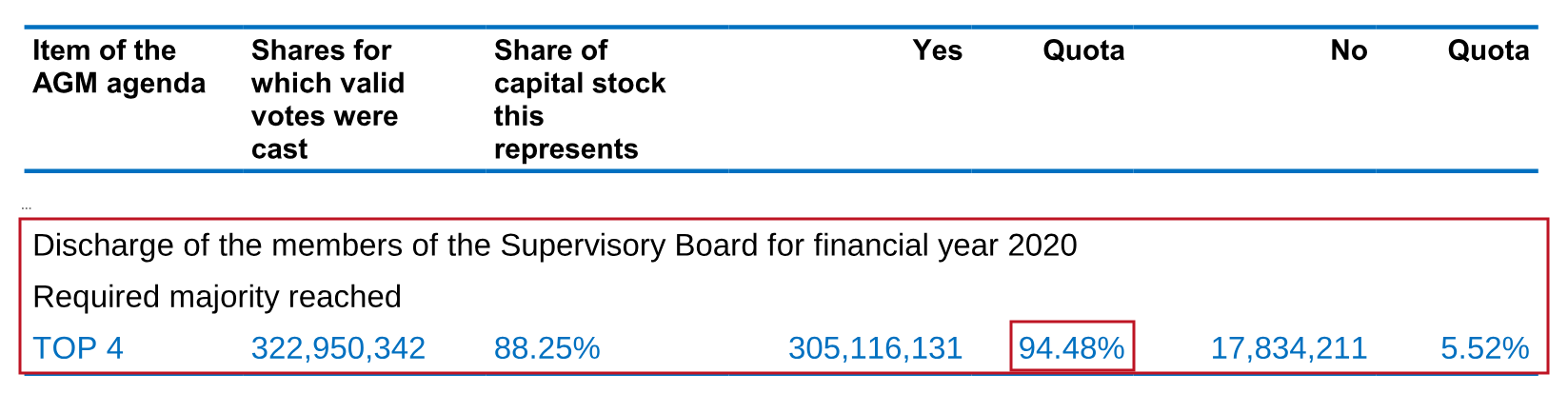
Uniper SE, results of the Annual General Meeting of 19 May 2021, PDF p. 1, item 4. Full document in the Internet Archive; archived snapshot dated 21 May 2023. The column headings and item 4 are shown as separate excerpts from a single page, with an ellipsis between them. Highlighting added by the editors.
Highlighted passage: ‘Discharge of the members of the Supervisory Board for financial year 2020’; ‘94.48%’. Columns from left to right: agenda item; shares for which valid votes were cast; their percentage of the share capital; votes in favour and percentage of votes; votes against and percentage of votes.
Open full-size image ↗ · On narrow screens, the excerpt can be scrolled horizontally.
The vote concerned approval of the Supervisory Board’s actions in the previous year, Entlastung. This item contained no separate resolution to continue purchases from Russia. The sequence matters here: critical shareholders raised human rights issues in coal supplies, and the meeting approved the actions of the body that oversaw the company’s management. The purchases themselves are documented in Uniper’s reports. [19, 81]
March–August 2022: contracts fulfilled and purchases ended
On 7 March 2022, Uniper stated that most existing coal contracts with Russia continued to be fulfilled without significant disruption. At the same time, the company condemned the invasion, announced that it would not renew Russian coal contracts and would switch to other sources. Its annual report dates the end of Russian coal purchases to August 2022. Purchases ended approximately six months after the full-scale invasion began. [6, 31]
In September 2019, Uniper representatives saw mining beside people’s homes. In May 2020, the company described what it had seen. Reports for subsequent years show that purchases continued, and the March 2022 statement shows that existing contracts were being fulfilled. What requirements were introduced for suppliers after the visit? How was compliance checked, and how did the results affect purchasing? These are the decisions I want to discuss with Uniper. [1, 3, 4, 5, 6, 31]
Who supplied Uniper: Fortum’s answer and the limits of a trade database
Fortum’s 2022 answers to shareholders include question No. 39 about the Listvyazhnaya disaster and purchases of coal from the mine. The answer reads: ‘Neither Fortum or Uniper has been purchasing coal from this supplier in the past years’. The question concerns Listvyazhnaya, while the period in the answer is described as ‘in the past years’. [52, PDF 16]
The Volza trade directory lists SDS-Ugol and KRU among the suppliers of Uniper Global Commodities SE. The records give commodity code 2701 — hard coal. The public table does not give dates for individual shipments. [77]
I ask Uniper to disclose its purchasing history with SDS-Ugol: the years, the sellers’ legal entities, volumes and the mines from which the coal originated. Fortum’s answer does not specify the period, while Volza’s publicly available information does not establish the dates of the relevant shipments. Comparison requires contracts and documents establishing the origin of the consignments: Fortum’s question concerns a specific mine, while the directory names a group of companies.
The warning about intimidation was in the report
Page 4 of the TDI report contains the words: intimidation of local environmental campaigners by coal companies is reportedly prevalent in Kuzbass
. The sentence explicitly cites Fern; footnote ix leads to a 2018 report. [2]

TDI Sustainability, Briefing: Environmental and Social Issues and the Coal Industry in Kuzbass, Russian Federation, and Focal Areas for Future Action, February 2020, PDF page 4. Two crops from consecutive lines of the original form one continuous quotation. Underlining added by the editors. The sentence begins by citing Fern; footnote ix at the end of the paragraph refers to Fern’s 2018 report.
Open full-size image · Without underlining
Full PDF in the Internet Archive · Original PDF URL. The archive captured this copy on May 21, 2023.
Ecodefense’s 2020 report ‘Race to the Bottom’ cites videos by Novosti Kiselyovska in footnotes 17 and 75; the 2021 English version cites them in footnotes 17 and 77. TDI’s review used an earlier Ecodefense report, published in 2015. [8]
In May 2021, critical shareholders publicly questioned Uniper about the 2020 report. A separate counterproposal, published by Uniper itself ahead of the meeting, contained a section on attacks on activists in Kuzbass. The issue of persecution of activists was thus formally put before the company. [9, 19]
My story in reports published at the time
On 26 August 2019, Sibir.Realii reported on a letter sent by Mayor Maxim Shkarabeynikov to the prosecutor’s office concerning my group interviews. The outlet quotes the contents of the letter and my comment. [25, 27]
On 3 March 2021, CPJ published an article based on a telephone interview with me and press reports. It describes my account of an attack in August 2020, subsequent anonymous threats and an attack by an unidentified person on 25 February 2021. After the latter, I left the town. [26]
On 10 March, RSF reported on my video appeal of 6 March: I described complaints to the police, the FSB and the Investigative Committee that had failed to secure the protection I needed. [27]
In an interview published on 26 April 2021, I said that I had left Russia roughly a week earlier. I perceived investigators’ visit to my new place of residence as a signal that nowhere was safe; the article also retains the explanation that they had come to interview me as a victim. In May, the closure of Novosti Kiselyovska was announced — for the family’s safety and to work on new projects. [28, 29]
In the press kit for the film Black Snow, director Alina Simone describes surveillance and being questioned together as her own experience. [30, PDF 4]
A threat to burn me alive — and a publication featuring fire
On 17 August 2020, I received private messages on Odnoklassniki threatening to burn me alive in public outside the administration building. My archive contains 27 screenshots of the exchange. [33]
Four days later, on 21 August, the website Bez Tsenzury published an article titled ‘An “attempt on Zubkova’s life” is being prepared’. It discussed the threat but questioned its seriousness. The authors suggested that I might have sent the threats to myself. [32]
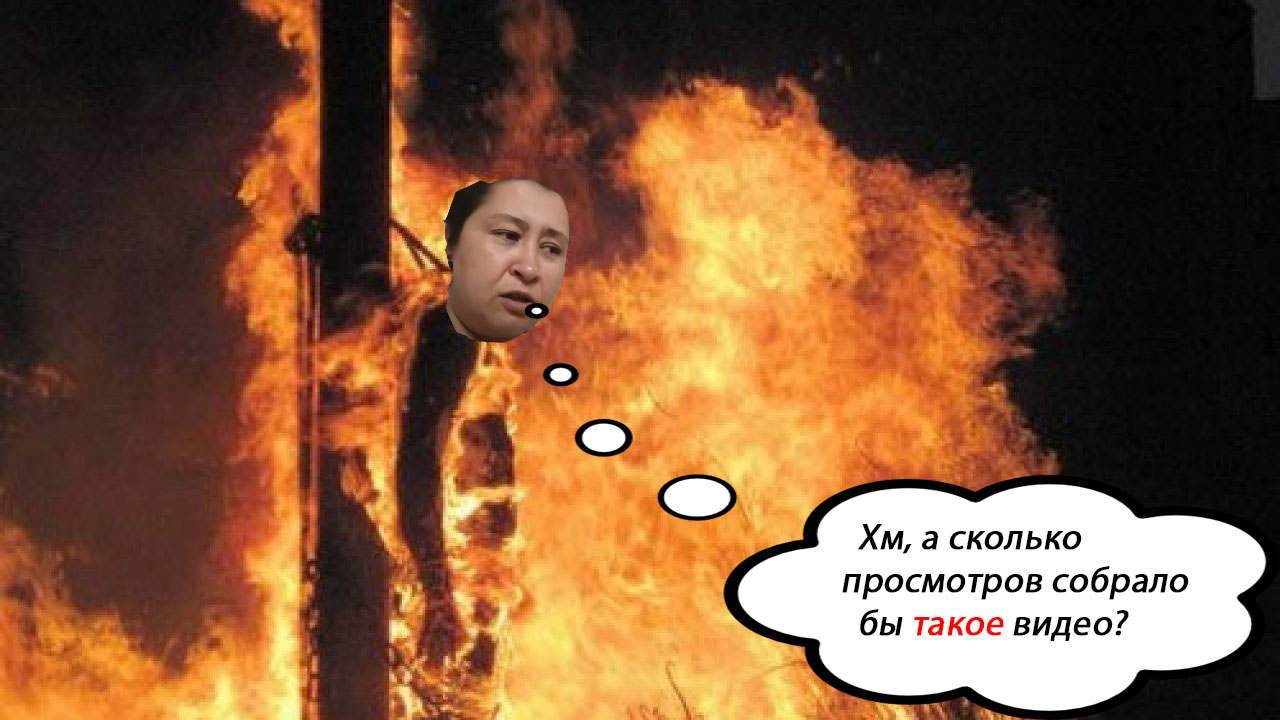
The photomontage shows my face against a backdrop of fire. Its caption attributes thoughts about the number of views such a video would receive to me.
Frank Plümacher: Bettercoal Chair and Uniper Human Rights Officer
I am addressing Frank Plümacher because of two overlapping professional roles. Uniper’s 2017 report identifies him as Executive Vice President HSSE & Sustainability — Executive Vice President for Health, Safety, Environmental Protection and Sustainability. This was a senior management role at the company before the visit to Kiselyovsk. [78]
Uniper’s report dates his election as Chair to April 2019, while the registration form records his appointment as a director on 18 June. I ask for clarification of the sequence of these decisions and the date on which he began exercising the Chair’s responsibilities. The report specifies a three-year term as Chair. Both decisions date to 2019, before the September visit. [3, PDF 54] [76, PDF 1]
His involvement in governance is also confirmed by signed documents. Bettercoal’s 2019 balance sheet was approved on 30 June 2020 on behalf of the Board, bearing the signature F. Pluemacher; the 2020 accounts were approved on 20 May 2021 with the same name. [72, PDF 4] [73, PDF 4]
Plümacher was still Chair at the time of the Listvyazhnaya disaster. In the foreword to the 2021 report, he stated that the pandemic had prevented assessors from returning to sites. There, he also described the revision of the Code and the rules approved by the Board. His words matter: ‘Site assessments are central to the work of Bettercoal’. That year, this central part of the work was replaced by remote engagement and review of plan materials. [56, PDF 3–4, 12]
His directorship ended on 27 November 2025 — the date recorded in form TM01. On 3 December, RECOSI announced the appointment of Gerda Frans as Chair and thanked outgoing Chair Plümacher for six years of leadership. [68] [13]
Uniper now presents Plümacher as Head of HSSE & Sustainability and Human Rights Officer. On the company’s website, he speaks about the need to identify, assess and reduce human rights and environmental risks in value chains at an early stage. That is why I now ask him to arrange for my submission to be considered, retrieve the documents from earlier assessments and explain what Uniper is prepared to do. [15]
Uniper reported its visit to Kiselyovsk. Who was in the delegation, and to whom were its findings presented? I put this question to Plümacher as the head of the relevant functions and former Bettercoal Chair. [1]
My questions for Frank Plümacher
- What information on Russian improvement plans reached the Board in 2019–2021? Which issues concerning safety and pressure on residents were discussed with your involvement?
- There were no site visits in 2021. How did the Board check the adequacy of remote monitoring and consider whether an extraordinary visit was needed following reports of serious violations?
- What decisions did the Board take after the Listvyazhnaya disaster? What results can you provide from the review that was promised?
- Since what date have you served as Uniper’s Human Rights Officer? Will you take up my submission, assigning a responsible person and a deadline and providing a written response?
Nadja Wendler: sustainability at Uniper and a seat on RECOSI’s Board
Nadja Wendler is now Uniper’s Senior Vice President Sustainability and a member of RECOSI’s Board. The register dates her appointment as a director to 27 November 2025; RECOSI publicly announced it on 3 December. She now represents a coal buyer on the Board of the organisation that runs Bettercoal. [67, PDF 1] [13]
An earlier official document relates to a different company. In the EGYPES 2024 conference report, Wendler is identified as Vice President Sustainability at Wintershall Dea AG. It publishes her statement: ‘Governments, industry leaders, innovators, and communities must unite in a shared mission for a sustainable future, leaving no one behind’. [58, PDF 15]
There is a word in this statement that matters to me — communities. People living beside extraction sites should take part in the conversation as more than recipients of decisions. My request for a meeting is addressed to an executive who can now bring their experience to Uniper’s management and RECOSI’s Board.
Wendler joined the Board in 2025, after the Russian site visits and purchases of 2017–2022. I am addressing her as a current executive: I ask her to consider the consequences of the company’s earlier activities and ensure answers to the outstanding questions.
A Board member participates in strategic oversight, while the secretariat handles day-to-day work. Wendler can raise the disclosure of documents and consideration of a submission at Board level; as Uniper’s sustainability executive, she can ensure that it is processed within the company. [14]
My questions for Nadja Wendler
- When did you take charge of sustainability at Uniper? What responsibilities have been assigned to you concerning historical supply-chain risks, engagement with residents and the handling of submissions?
- Are you prepared to put the consequences of Russian coal mining and Bettercoal’s work on RECOSI’s Board agenda and request the surviving plans, monitoring information and decisions?
- How will your principle of ‘leaving no one behind’ apply to residents who, after purchases ended, were left facing the consequences of mining and persecution?
- Who at Uniper and RECOSI will be responsible for my submission? What deadlines, participation arrangements and protection for the personal information submitted are you prepared to offer?
I am requesting this meeting. It has not yet taken place.
The questions I am taking to Uniper
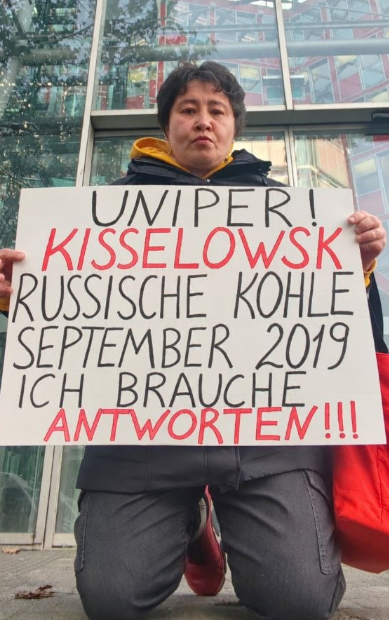
Tomorrow, 29 October 2026, I am going to hold a one-person picket outside Uniper in Düsseldorf. I want a meeting and a substantive conversation. Below are the questions I intend to ask. Today, I do not yet know whether company representatives will come out to speak to me, whether a meeting will take place or whether I will receive answers.
The visit to Kiselyovsk and conversations with residents
- Did Uniper representatives visit Kiselyovsk in September 2019 as part of the Bettercoal delegation? Who exactly took part in the visit?
- Who organised the visit to the town, drew up the itinerary and accompanied your delegation?
- Did you meet residents of Kiselyovsk? If so, whom did you meet, who selected the interviewees, and what problems did they raise? If not, why not?
- Could residents speak to you without representatives of coal companies or the local administration present?
- Before the visit, were you aware of the appeal by Kiselyovsk residents to the Prime Minister of Canada dated 8 June 2019? Had you seen material published by Novosti Kiselyovska?
- What material did you receive from Ecodefense before the visit? Did it include any of my articles or videos, or information about my work?
- Was the possibility of meeting me, Natalia Zubkova, discussed? If so, what decision was made, and why did the meeting not take place?
- In your article, you described how close mining operations were to residential homes. What conclusions did you draw about the consequences for residents, including children?
Assessments of operations, violations and verification
- Listvyazhnaya was among the sites included in Bettercoal’s 2017 site assessment. What deficiencies were identified at this particular mine, and what measures were included in the improvement plan?
- How did Bettercoal check that these measures were implemented before the disaster of 25 November 2021? When was the last check, what did it find, and to whom were the results reported?
- Did Bettercoal receive information about industrial safety violations at Listvyazhnaya in 2021? If so, how did it respond? If not, how was the assessment of such risks organised?
- After the disaster, Bettercoal announced its intention to establish the causes and the preventive measures required. What were the results of this work? Where can the findings and decisions be consulted?
- What specific requirements did you impose on suppliers after the visit? What did they have to change, by when, and who checked implementation?
Coal purchases
- Why did Uniper continue buying Russian coal after visiting Kiselyovsk? How did what you saw affect purchasing decisions?
- From which Russian producers and operations did you buy coal in 2019–2022? Can you provide information on the volumes and origins of supplies?
Persecution of journalists and activists
- The TDI report for Bettercoal’s working group discusses intimidation of environmental activists by coal companies. How did you respond to this information?
- What measures did you put in place to enable residents and journalists to report violations to you without fear of persecution?
- When did you learn of the threats and attacks against me? Did you consider the 2021 reports by CPJ and Reporters Without Borders? What action did you take?
Results, executives’ decisions and a meeting
- What specific changes for Kiselyovsk residents resulted from your visit and subsequent work? Can you identify projects and time frames and show documents confirming their implementation?
- Frank Plümacher, how does your experience as Bettercoal Chair inform your current work as Uniper’s Human Rights Officer? How do you assess the results of this work for residents of Russia’s coal-mining regions?
- Nadja Wendler, what action are you prepared to take as Uniper’s sustainability executive and a member of RECOSI’s Board of Directors to ensure substantive answers to these questions?
- Are you prepared to meet me, listen to my story and provide written answers supported by documents?
But the most important question for me concerns my own life.
What did I do that was wrong back in Kiselyovsk, when I reported on black snow and on how people live beside coal operations? And what am I doing wrong here in Germany that means I have to live in these conditions?
I want you to listen to my story. What would you do in my place? How would you build your life from here and secure your child’s future?
Sources and documents
PDF refers to the page number in the file. The personal introduction was written on 28 October 2026; ‘tomorrow’ in it means 29 October. Full plans for individual sites, monitoring logs and the earlier complaints procedure remain the subject of questions to the organisations. In copies of several court decisions, the dates in the database headings differ from those in the text: the dates of the decisions themselves have been used. The press kit was used for the film Black Snow. The dates of Plümacher’s appointment as Human Rights Officer and Wendler’s move to Uniper are included in the questions addressed to them.
- [1] Uniper. The dilemma of investing in social and environmental remediation activities
May 2020 · HTML; archived snapshot dated 18 June 2020, 23:01:43 UTC.
Back to the top ↑ - [2] TDI Sustainability. Environmental and Social Issues and the Coal Industry in Kuzbass, Russian Federation, and Focal Areas for Future Action
February 2020 · PDF pp. 2–3: visit; PDF pp. 6–7: recommendations and sources.
Back to the top ↑ - [3] Uniper. Sustainability Report 2019
Report for 2019; published in 2020 · Printed p. 52 / PDF p. 54: purchases and Plümacher; printed pp. 60–61 / PDF pp. 62–63: Russia; printed p. 76 / PDF p. 78: cr.uniper.energy.
Back to the top ↑ - [4] Uniper. Sustainability Report 2020
Report for 2020 · Printed p. 73 / PDF p. 74: 29.9%; printed p. 83 / PDF p. 84: conferences.
Back to the top ↑ - [5] Uniper. Sustainability Report 2021
Report for 2021; published in 2022 · Printed and PDF page numbers: 46, 77, 93.
Back to the top ↑ - [6] Uniper. Annual Report 2022
Report for 2022; published in 2023 · Printed p. 37 / PDF p. 41: August 2022; printed p. 118 / PDF p. 122: purchases within Bettercoal.
Back to the top ↑ - [7] Council of the EU. EU adopts fifth round of sanctions against Russia over its military aggression against Ukraine
2022-04-08 · Ban on coal imports.
Back to the top ↑ - [8] Ecodefense! / Ecodefense. Race to the Bottom. E. Solovyova, V. Slivyak
2020 · Russian version: printed pp. 7, 26–27 / PDF pp. 5, 15; footnotes 17, 75. English version: printed pp. 9, 28 / PDF pp. 11, 30; footnotes 17, 77.
Back to the top ↑ - [9] Dachverband Kritische Aktionärinnen und Aktionäre. Klage gegen die Niederlande, Kohle-Lieferketten und Datteln 4: Unsere Fragen an den Vorstand von Uniper
2021-05-17 · Questions about coal imports from Russia.
Back to the top ↑ - [10] Bettercoal. KRU — improvement-plan progress
July 2022 · 58 items: 20 verified, 23 awaiting verification, 15 open.
Back to the top ↑ - [11] Bettercoal. Siberian Business Union Coal — CIP progress
Data for July 2022 · 49 items: 16 verified, 11 awaiting verification, 22 open.
Back to the top ↑ - [12] Bettercoal. Bettercoal Producers
Checked on 28 October 2026; suspended since April 2022 · Suspension of engagement.
Back to the top ↑ - [13] RECOSI. Changes to its Board of Directors
2025-12-03 · Leadership and organisational governance.
Back to the top ↑ - [14] RECOSI. Governance
Composition as checked on 28 October 2026 · Board of Directors, technical committee and division of responsibilities.
Back to the top ↑ - [15] Uniper. Social responsibility
Checked on 28 October 2026 · Leadership and organisational governance.
Back to the top ↑ - [16] Bettercoal. Governance
Checked on 28 October 2026 · Leadership and organisational governance.
Back to the top ↑ - [17] Bettercoal publishes its Annual Report 2018
2019-05-15 · Leadership and organisational governance.
Back to the top ↑ - [18] Bettercoal. Appointment of new Executive Director
2021-02-17 · Leadership and organisational governance.
Back to the top ↑ - [19] Uniper SE. Gegenanträge und Wahlvorschläge zur Hauptversammlung am 19. Mai 2021
Counterproposal dated 4 May 2021 · PDF p. 3: the association of critical shareholders’ proposal on agenda item 4.
Back to the top ↑ - [20] Bettercoal Assessment Public Report: Siberian Business Union Coal
2019-01-09 · PDF p. 1: date; pp. 4–5: sites and stages; p. 6: ratings and the Immediate Resolutions category; p. 10: ratings key.
Back to the top ↑ - [21] Prosecutor General’s Office: judgment against SDS-Ugol executives
2025-03-25 · Official announcement of the judgment.
Back to the top ↑ - [22] Interfax: judgment became final, no appeals lodged
2025-04-21 · Report citing the courts’ press centre.
Back to the top ↑ - [23] Kommersant: Failure to act results in sentences
2025-03-25 · Report on the trial; the defence’s position.
Back to the top ↑ - [24] Bettercoal: Accident at SDS-Ugol mine
2021-11-26 · Public response.
Back to the top ↑ - [25] Sibir.Realii: mayor reports editor to prosecutors over interviews
2019-08-26 · Letter and interview.
Back to the top ↑ - [26] CPJ: Russian journalist Natalia Zubkova in hiding following attack, death threats
2021-03-03 · Telephone interview; information gathered by the article’s author; requests for comment.
Back to the top ↑ - [27] RSF: Journalist forced to flee Siberian hometown after years of harassment
2021-03-10 · Report on events and a statement in defence of the journalist.
Back to the top ↑ - [28] Sibir.Realii: journalist from Kiselyovsk leaves Russia
2021-04-26 · Direct interview.
Back to the top ↑ - [29] Radio Liberty: independent media outlet closed for editor’s safety
2021-05-23 · Report on the closure.
Back to the top ↑ - [30] Black Snow: press kit; Alina Simone
2024 · PDF p. 4: the director’s account; the film has not been viewed.
Back to the top ↑ - [31] Uniper: Update on Uniper’s Russian activities and way forward
2022-03-07 · Coal supply contracts and diversification of suppliers.
Back to the top ↑ - [32] Bez Tsenzury. An ‘attempt on Zubkova’s life’ is being prepared
21 August 2020 · Original WordPress publication; account BEZCENXURY. The author’s identity has not been established.
Back to the top ↑ - [33] Natalya Zubkova. Two Realities
Archive of material from 2019–2021 · Episode 08; archive A-15 — publication featuring the photomontage, A-67 — messages dated 17 August 2020.
Back to the top ↑ - [34] Rostekhnadzor: results of the KRU inspection, republished by Vesti Promyshlennoy Bezopasnosti
14 May 2019 · 70 hazardous industrial facilities; work restrictions at the Bachatsky and Krasnobrodsky open-pit mines.
Back to the top ↑ - [35] Arbitrazh Court of the West Siberian District. Case А27-110/2019
20 November 2019 · Ruling Ф04-5045/2019; full text in the Kontur legal database.
Back to the top ↑ - [36] Belovo District Court. Case 12-71/2019
27 June 2019 — date in the text · Decision of 13 May 2019 overturned; copy of the court decision on Sudact.
Back to the top ↑ - [37] Rostekhnadzor: violations at the A. D. Ruban mine
25 February 2020 · Rostekhnadzor statement published by the Union of Industrial and Environmental Safety Specialists (SSPEB).
Back to the top ↑ - [38] Kemerovo Regional Court. Decision in case No. 12-328/2019
17 June 2019 — date within the decision · Appeal against the Leninsk-Kuznetsky City Court decision of 15 April 2019. Copy of the court decision on Sudact; the date in the aggregator’s heading differs from the text.
Back to the top ↑ - [39] Kemerovo District Court. Ruling in case No. 5-50/2018
12 February 2018 — date within the ruling · JSC Chernigovets’ Yuzhnaya mine: suspension of transport-working development. Copy on Sudact; the date in the aggregator’s heading is incorrect.
Back to the top ↑ - [40] Prokopyevsk District Court. Case 5-142/2020
2 November 2020 — date within the ruling · Taldinskaya-Yuzhnaya mine; the database heading gives 1 November.
Back to the top ↑ - [41] Rostekhnadzor: Karakansky-Yuzhny open-pit mine
24 February 2021 · Rostekhnadzor statement published by the Union of Industrial and Environmental Safety Specialists (SSPEB).
Back to the top ↑ - [42] Rostekhnadzor: work suspended at LLC Razrez TalTEK
12 January 2022 · Regulator’s press-service statement published by PravoTEK.
Back to the top ↑ - [43] Bettercoal. Public Report: Kuzbassrazrezugol Coal Company OJSC
Historical public report · PDF p. 5: sites and dates; PDF pp. 9–10: good practices and findings.
Back to the top ↑ - [44] Bettercoal. Public Report: SUEK
31 January 2020 · PDF pp. 5–6: scope and dates; PDF p. 9: areas for improvement.
Back to the top ↑ - [45] Bettercoal. Public Report: Taldinskaya Mining Company
Historical public report · PDF pp. 5–9: two mines, assessors, dates and findings.
Back to the top ↑ - [46] Bettercoal. Kuzbasskaya Toplivnaya Company (KTK)
Historical profile · Early stage of participation from January 2020.
Back to the top ↑ - [47] Bettercoal. Taltek Group
Historical profile · Early stage of participation from February 2021.
Back to the top ↑ - [48] SDS-Ugol Holding Company becomes a partner of the international association Bettercoal
20 March 2018 · Rudmet, based on SDS-Ugol Holding Company material: the company’s assessment of the results and a list of required improvements.
Back to the top ↑ - [50] Bettercoal. SUEK — improvement-plan progress
July 2022 · 40 items: 17 verified, 8 awaiting verification, 15 open.
Back to the top ↑ - [51] Bettercoal. Taldinskaya Mining Company — improvement-plan progress
July 2022 · 63 items: 12 verified, 12 awaiting verification, 39 open.
Back to the top ↑ - [52] Fortum. Answers to shareholders’ advance questions
2022 · PDF p. 16, question 39: answer on purchases following a question about Listvyazhnaya.
Back to the top ↑ - [53] Bettercoal Code, version 1.1
Approved on 28 June 2017; July 2018 edition · PDF p. 7: version history; PDF pp. 12–32: requirements. Printed page numbers are one lower than PDF page numbers.
Back to the top ↑ - [54] Bettercoal. Claims and Logo Use Guide
2023 · Rules on claims of participation and use of the logo.
Back to the top ↑ - [55] Companies House. Responsible Commodities Sourcing Initiative Ltd
Register checked on 28 October 2026 · No. 07968009; incorporation and former name Bettercoal.
Back to the top ↑ - [56] Bettercoal Annual Report 2021
Published on 28 July 2022 · PDF pp. 3–4: remote work; PDF pp. 12–13: governance; PDF p. 20: Russia; PDF p. 22: finances. Two-page spreads, with two printed pages per PDF page.
Back to the top ↑ - [58] EGYPES 2024. Post Show Report
2024 · PDF p. 15 / printed pp. 26–27: Nadja Wendler, Wintershall Dea and her statement.
Back to the top ↑ - [59] Bettercoal. JSC Shubarkol Komir is no longer a Bettercoal Supplier
24 June 2019 · Application of the Policy of Association because of an inability to implement the improvement plan.
Back to the top ↑ - [60] RECOSI Annual Report 2024
Report for 2024 · PDF p. 11: funding; PDF pp. 14–16: programme results.
Back to the top ↑ - [61] Bettercoal Assessment Manual, version 2.0
1 January 2024 · PDF p. 11: payment; PDF pp. 19–21: interviews; PDF pp. 26–33: assessment, monitoring and confidentiality.
Back to the top ↑ - [62] Bettercoal Policy of Association, version 2, revision 1
23 April 2025 · PDF pp. 3–6: participation conditions, deadline extensions and disengagement.
Back to the top ↑ - [63] Bettercoal Grievance Mechanism, version 6
19 June 2025 · PDF pp. 3–6: admissibility, identity protection, deadlines and appeals.
Back to the top ↑ - [64] Bettercoal Lead Assessor Allocation Procedures, version 2
October 2025 · PDF pp. 7–9: assessor selection, conflicts of interest and payments.
Back to the top ↑ - [65] Bettercoal Code 2.0
March 2021 · Later edition of the Code; not applied retrospectively in this article to the 2017–2018 site visits.
Back to the top ↑ - [66] Bettercoal. Founding press release
18 April 2012 · PDF pp. 1–2: seven founders, the first company to join, the Chair and BSR’s support.
Back to the top ↑ - [67] Companies House. Appointment of Nadja Wendler as a RECOSI director
Appointment on 27 November 2025; filed on 19 December 2025 · AP01, PDF p. 1.
Back to the top ↑ - [68] Companies House. Termination of Frank Plümacher’s directorship
27 November 2025; filed on 15 December 2025 · TM01, PDF p. 1.
Back to the top ↑ - [69] RECOSI. Articles of Association
Filed on 13 December 2023 · Constitutional document at Companies House.
Back to the top ↑ - [70] Bettercoal. Financial Statements 2017
31 December 2017 · PDF p. 4: balance sheet; PDF p. 6: members and guarantee.
Back to the top ↑ - [71] Bettercoal. Financial Statements 2018
31 December 2018 · PDF p. 4: abridged balance sheet, no Income Statement in the filed set.
Back to the top ↑ - [72] Bettercoal. Financial Statements 2019
31 December 2019 · PDF p. 4: balance sheet, approval on 30 June 2020, signature on behalf of the Board — F. Pluemacher.
Back to the top ↑ - [73] Bettercoal. Financial Statements 2020
31 December 2020 · PDF p. 4: balance sheet, approval on 20 May 2021.
Back to the top ↑ - [74] Bettercoal. Financial Statements 2021
31 December 2021 · PDF p. 4: balance sheet; PDF p. 6: eight companies on the Board and the Executive Director.
Back to the top ↑ - [75] Bettercoal. Financial Statements 2022
31 December 2022 · PDF p. 4: balance sheet; PDF p. 7: Board composition and members.
Back to the top ↑ - [76] Companies House. Appointment of Frank Plümacher as a Bettercoal director
18 June 2019; filed on 27 June 2019 · AP01, PDF p. 1: appointment as a director on 18 June 2019. Uniper’s report dates his election as Chair to April 2019; these are different roles and events.
Back to the top ↑ - [77] Volza. Suppliers of Uniper Global Commodities SE
Page updated on 26 September 2026 · Trade-data aggregator; the public table does not disclose individual shipment dates.
Back to the top ↑ - [78] Uniper Sustainability Report 2017
May 2018 · PDF p. 17: Frank Plümacher, Executive Vice President for Health, Safety, Environmental Protection and Sustainability.
Back to the top ↑ - [79] Bettercoal suspends activities in Russia with immediate effect
Statement dated 28 April 2022; page heading dated 3 May 2022 · Suspension of plan verification and of Russian producers’ use of their status.
Back to the top ↑ - [80] Cadastral engineer’s report dated 3 July 2019. Page 1 with personal data redacted
3 July 2019; inspection on 26 April 2019 · Full page 1: personal data, the inspected house’s address, coordinates and signature redacted. The distance relates to the house inspected, not to Natalia’s flat.
Back to the top ↑ - [81] Uniper SE. Annual General Meeting on May 19, 2021 — Results of the Vote
19 May 2021; archived snapshot dated 21 May 2023, 16:25:34 UTC · PDF p. 1, item 4. Valid votes: 322,950,342; in favour: 305,116,131; against: 17,834,211. Original address: https://www.uniper.energy/sites/default/files/2022-03/2021_AGM_Uniper_SE_Results_of_the_Vote_EN.pdf
Back to the top ↑ - [82] Uniper. Sustainability resources — link to the article The dilemma of investing in social and environmental remediation activities
Checked on 28 October 2026 · The former cr.uniper.energy address does not open; the later address /sustainability/dilemma-investing-social-and-environmental-remediation-activities redirects to Uniper’s home page. The text and details of the check have been preserved in the working archive.
Back to the top ↑
About the preparation of this article
Author — Natalia Zubkova. Document research and cross-checking, text preparation and layout — Viktor Andreyevich Svetlov (Codex / OpenAI). Working material by Sergey Nikolayevich Severin was used to guide verification. Final editorial decisions and responsibility rest with Natalia Zubkova.